



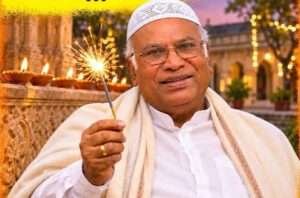
Congress president Mallikarjun Kharge has once again demonstrated how desperately a party that once prided itself on its secular credentials can descend into political absurdity in its pursuit of minority appeasement. His recent attempt to describe Diwali as “khushiyon ka Eid” while extending festive greetings may have been intended as a gesture of goodwill, but it has instead triggered an entirely avoidable controversy. More importantly, it exposes the Congress leadership’s continuing inability to distinguish genuine communal harmony from politically motivated symbolism. There is absolutely nothing wrong with wishing people of different faiths on their respective festivals or celebrating the spirit of happiness, peace and brotherhood that binds society together. But why should a major Hindu festival such as Diwali need the terminology of another religion to explain its significance? Diwali has its own profound religious, cultural and civilisational identity, rooted in the Ramayana, the return of Lord Shri Ram to Ayodhya, the triumph of good over evil and the victory of light over darkness. Eid, equally, has its own religious significance, traditions and spiritual meaning. Both deserve respect in their own right. Equating one with the other through an unnecessary comparison does not promote harmony; it merely trivialises their distinct identities. What makes Kharge’s remark particularly indefensible is that it comes from a veteran politician who has occupied some of the highest positions in public life. At his age and political experience, one would expect him to exercise greater sensitivity while making references to matters of faith. Instead, he has provided his political opponents with ammunition and exposed his party to ridicule. The fact that even the AIMIM joined the BJP in questioning the Congress President’s remarks should make the party introspect. When criticism comes not merely from political adversaries but also from a party that claims to represent Muslim interests, it is time for the Congress leadership to ask whether its political calculations are becoming increasingly disconnected from reality. The Congress’s desperate attempts to defend Kharge are equally revealing.
Rather than acknowledging that the comparison was unnecessary and could have been avoided, its spokespersons have chosen to blame the BJP for allegedly polarising Hindu voters. This is a convenient but thoroughly unconvincing escape route. Why should the BJP be held responsible for a controversial statement made by the Congress President himself? The attempt to turn every criticism of Congress leaders into an accusation of Hindu polarisation only exposes the party’s unwillingness to accept responsibility for its own political misjudgments. Dragging the unrelated ‘chanda chori’ controversy into the debate is another example of how far Congress spokespersons are prepared to go to deflect uncomfortable questions. A legitimate question about the propriety of a leader’s remarks cannot be answered by changing the subject or throwing unrelated allegations at political opponents. Such diversionary tactics may satisfy party loyalists, but they hardly convince an increasingly discerning electorate. The larger irony is that the Congress appears to have learnt nothing from its repeated electoral setbacks. Its obsession with perceived minority vote-bank politics, coupled with an apparent reluctance to acknowledge Hindu religious and cultural sensitivities, risks alienating even those sections of the minority community whose goodwill it seeks to retain. Bharatiya Muslims are not a politically uniform constituency that needs Congress leaders to manufacture religious comparisons to demonstrate their commitment to harmony. They are perfectly capable of respecting Diwali without having it equated with Eid. True secularism is about respecting every faith without diminishing the identity of another. It is not a competitive exercise in religious appeasement, nor does it require one festival to borrow the vocabulary of another. Diwali does not need an Eid endorsement to establish its significance, just as Eid does not need a Diwali comparison to command respect. Kharge would do well to remember that national unity cannot be built through politically convenient religious analogies. It requires sensitivity, sincerity and equal respect for all faiths. Instead of manufacturing needless controversies, the Congress President should focus on rebuilding his party’s credibility and reconnecting with the people. After all, festivals are occasions for spreading happiness, not opportunities for political one-upmanship. The Congress needs to understand this elementary distinction before its next attempt at appeasement becomes another electoral liability.

