



Dharnidhar Bhagvan Temple is a historic Vaishnava temple at Dhima in North Gujarat. Dedicated to Dharnidhar Bhagvan, a form of Lord Vishnu worshipped here with strong Krishna traditions, the temple is an important pilgrimage centre of the region. Dhima is also popularly known as the “Mini Dwarka” of North Gujarat.
The Dharnidhar tradition at Dhima is more than 600 years old. According to the District Census Handbook, the deity was installed at Dhima on Jeth Sud 11, Nirjala Ekadashi, in Vikram Samvat 1477, corresponding to 1421 CE.
The presiding deity is Dharnidhar Bhagvan, a form of Lord Vishnu. The dark-coloured idol is traditionally depicted with a moustache and is popularly known as Moochhala Dharnidhar or Moochhala Shyam. The name Dharnidhar means “the one who supports the earth.”
The temple complex also has shrines dedicated to several other deities. Nearby is the Dhimannag shrine, associated with the ancient Naga tradition of Dhima.
The temple follows the traditional style of a North Indian Hindu temple, with a prominent shikhara over the sanctum and subsidiary structures forming the temple complex. Its principal importance lies in its ancient deity, sacred traditions and continuing pilgrimage rather than elaborate architectural ornamentation.
According to local tradition, the idol of Dharnidhar Bhagvan was brought from the Aravalli region of Rajasthan and installed at Dhima in the 15th century. Government records also preserve the date of installation as 1421 CE, providing an important historical reference for the temple.
Dhima itself has an older sacred tradition. Local belief associates the area with an earlier Varaha temple, while the nearby Dhimannag shrine represents the region’s longstanding Naga worship.
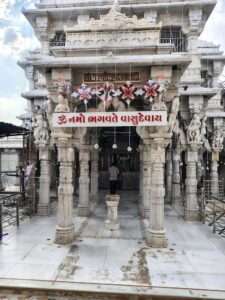
According to the local Sthalapurana, after the destruction of an earlier Varaha temple, the sacred place remained without its principal deity for about 125 years. The people of Dhima continued to worship the empty throne and preserve the sanctity of the place.
A devotee named Ruda Bhagat is said to have received a dream in which Dharnidhar Bhagvan instructed him to search for the deity in the Aravalli hills. Ruda Bhagat and Gadadhar travelled there and, after spending a night in the forest, received another divine instruction. The Lord told Ruda to walk 125 steps east and move a stone slab. Beneath it, they discovered the sacred idol.
The devotees placed the idol on a bullock cart and began their journey towards Dhima. At Shihori, a local ruler stopped them and demanded gold equal to the weight of the idol. Ruda Bhagat prayed to the Lord, who instructed him to place his golden ear ornament, known as a thansio, on the other side of the weighing scale. The tradition says that the scales miraculously balanced, after which the ruler allowed the devotees to continue their journey.
The idol was eventually brought to Dhima and installed on Jeth Sud 11, Nirjala Ekadashi, in Vikram Samvat 1477, or 1421 CE. The installation date is also preserved in government records.
Another local tradition tells of a devotee named Gadadhar who remained deeply devoted to Dharnidhar Bhagvan. When a ruler attempted to take the deity away, Gadadhar is said to have been imprisoned. Dharnidhar Bhagvan then appeared in the ruler’s dream and instructed him to release the devotee.
The sacred landscape of Dhima also includes the Dhimannag or Sheshnag tradition. The serpent deity is regarded as the supporter and protector of the earth, creating an unusual association between the Vaishnava worship of Dharnidhar Bhagvan and the ancient Naga traditions of the region.
