



The latest assessment by the Stockholm International Peace Research Institute (SIPRI) should put to rest a persistent misconception in strategic circles—that Bharat can afford to remain complacent about its nuclear deterrent. The SIPRI Yearbook 2026 estimates that Bharat now possesses around 190 nuclear warheads, overtaking Pakistan’s stockpile of 170. While the numerical gap is modest, the significance lies not in the numbers alone but in the strategic direction New Delhi has chosen.
For years, critics questioned why the Modi government was investing heavily in missile modernization, nuclear-capable submarines, and advanced delivery systems. The answer is becoming increasingly clear. Bharat is not merely preparing for yesterday’s threats; it is building capabilities to deter tomorrow’s challenges.
The reality is that Pakistan has never been the sole factor shaping Bharat’s nuclear doctrine. Islamabad remains a security concern, but it is China that increasingly dominates New Delhi’s long-term strategic calculations. SIPRI estimates China’s nuclear arsenal at around 600 warheads—more than three times India’s stockpile—and Beijing continues to expand its missile forces at a rapid pace.
In such an environment, standing still is not an option.
The most important development is not that Bharat has moved ahead of Pakistan by 20 warheads. It is the transformation of Bharat’s delivery systems. The Agni missile family, particularly the Agni-V, has fundamentally altered the strategic equation in Asia. With an estimated range extending between 5,000 and 8,000 kilometres, the missile can reach virtually every major Chinese city and strategic installation. This capability creates what military planners call a “credible second-strike deterrent”—the ability to inflict unacceptable damage even after absorbing an enemy’s first strike.
Deterrence, after all, is not about fighting a nuclear war. It is about preventing one.
The Modi government’s emphasis on missile modernization, canisterized launch systems, Multiple Independently Targetable Re-entry Vehicle (MIRV) technology under Mission Divyastra, and the strengthening of sea-based deterrence through platforms such as INS Arihant reflects a clear strategic vision. Bharat seeks survivability, flexibility, and credibility in its nuclear posture.
Equally significant is SIPRI’s observation that Bharat has begun moving some warheads into a “mated” state during peacetime, meaning they are attached to delivery systems rather than stored separately. This indicates greater operational readiness and a recognition that modern conflicts may unfold at speeds unimaginable in previous decades.
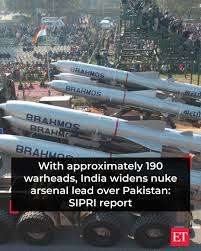
Pakistan, meanwhile, continues to focus on Bharat-centric capabilities. Its Shaheen and Ghauri missile systems, along with the short-range Nasr tactical missile, are designed primarily for regional deterrence. While Pakistan’s longest-range missile can strike targets across Bharat, it lacks the strategic reach that Bharat now possesses.
The contrast is telling. Pakistan’s nuclear programme is largely aimed at deterring Bharat. And, Bharat’s nuclear programme is increasingly structured to deter both Pakistan and China.
This distinction explains why comparisons based solely on warhead numbers are misleading. Strategic capability is determined not merely by how many weapons a country possesses but by how effectively it can deliver them, protect them, and ensure their survivability during a crisis.
Of course, Bharat still trails far behind the world’s major nuclear powers. Russia and the United States possess more than 5,000 warheads each, while China’s arsenal continues to expand. Yet New Delhi does not seek numerical parity with these powers. Such a pursuit would be economically unsustainable and strategically unnecessary.
Bharat’s doctrine has always rested on the principle of credible minimum deterrence. The objective is not to match rivals weapon for weapon but to maintain sufficient capability to make any adversary think twice before contemplating aggression.
That is precisely what the current modernization programme seeks to achieve.
The world is entering an era of heightened geopolitical uncertainty. Border tensions with China, continued instability in Pakistan, and rapidly advancing missile technologies leave little room for strategic complacency. In this environment, strengthening Bharat’s nuclear deterrent is not an act of militarism. It is an act of prudence.
The Modi government’s nuclear modernization push is therefore not about seeking superiority. It is about ensuring that Bharat remains secure, respected, and impossible to coerce. In the unforgiving world of geopolitics, peace is often preserved not by good intentions alone, but by the strength that stands behind them.


Well Shanker this article deserves to be read by the students preparing for competitive exams specially of civil services 👌🏼