



Vaishampayana said, “O King Janamejaya, among all the sacred pilgrim centres, Prabhasa Tirtha shines with exceptional spiritual splendour and sanctity. It was here that Chandra, the Moon-god, was liberated from a grievous affliction after bathing in its holy waters. Listen to the ancient account that made this sacred place immortal.”
Daksha Prajapati had given his twenty-seven daughters in marriage to Chandra, each representing one of the lunar constellations. Though all were equally wedded to him, Chandra was deeply attached to Rohini, whose beauty and grace captivated his heart. His excessive affection for her and neglect of his other wives filled them with sorrow. Unable to bear the injustice, they approached their father and complained of Chandra’s partiality.
Daksha summoned Chandra and counselled him with fatherly affection, urging him to treat all his wives with equal love and respect. But blinded by attachment, Chandra ignored the wise advice and continued to remain devoted only to Rohini. Enraged by this repeated disregard, Daksha pronounced a dreadful curse upon him, condemning him to waste away with a severe disease. Day after day Chandra’s brilliance diminished, his strength faded, and his celestial radiance waned.
The consequences of this curse spread across the universe. Since Chandra was the lord of medicinal herbs, the healing plants began to lose their potency. Human beings suffered without effective remedies, while the fading moonlight disturbed the natural order and brought imbalance to the world.
Alarmed by these developments, the gods assembled to discover the cause of Chandra’s decline. Learning of Daksha’s curse, they approached the Prajapati with humility and pleaded for mercy. Daksha relented but declared that Chandra must honour all his wives equally. He instructed him to bathe at the sacred confluence where the Saraswati meets the ocean at Prabhasa. Yet he also decreed that the curse would not disappear entirely. From that day onward, Chandra would wax in splendour for fifteen days and wane for the next fifteen, preserving the memory of his transgression. Daksha further ordained that on every Amavasya Chandra should purify himself by bathing at Prabhasa and regain his luminous glory. Before departing, he admonished him never to dishonour women or Brahmins. Obeying these sacred instructions, Chandra bathed in the holy waters of Prabhasa and regained his divine brilliance. Thus, Prabhasa became celebrated throughout the three worlds as a supremely sacred Tirtha.
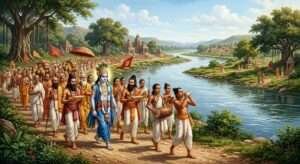
Continuing his pilgrimage, Balarama departed from Prabhasa and reached Chemasodbhedana Tirtha. After taking a holy bath, he spent the night there in worship and devotion. From there he proceeded to the sacred well known as Udapana, where an ancient and remarkable legend was narrated.
Long ago there lived three sage brothers—Ekata, Dvita and Trita. Having officiated at royal sacrifices, they received vast herds of cows as sacrificial gifts from grateful kings. While returning with the cattle, greed overcame Ekata and Dvita. Desiring to possess the entire herd, they conspired against their virtuous brother Trita. At that very moment a fierce wolf appeared on their path. Attempting to escape the beast, Trita accidentally fell into a deep, dry well. Instead of rescuing him, his brothers abandoned him and drove away the cattle.
Though trapped in the waterless well, the noble sage did not lose heart. Filled with unwavering faith, he mentally performed a Soma sacrifice and invoked the gods through the power of his austerities. Pleased with his devotion, the gods appeared and accepted their share of the sacred offerings. By divine grace, the sacred waters of the Saraswati sprang forth within the well, rescuing Trita from certain death.
Delighted by his steadfastness, the gods invited the sage to seek a boon. Trita, thinking not of himself but of future generations, prayed that whoever bathed in that holy Tirtha should obtain the spiritual merit equal to drinking the sacred Soma. Admiring his noble and selfless heart, the gods granted the boon and returned to their celestial abodes. The sanctity of Udapana thus became renowned among all sacred places.
Balarama next journeyed to Vinasana Tirtha, a region celebrated as the delightful abode of celestial dancers whose songs and graceful movements filled the atmosphere with divine joy. Thereafter he reached Gandharva Tirtha, where Visvavasu and many Gandharvas had attained the fruits of their rigorous penance.
From Gandharva Tirtha he proceeded to Garga Srotas, sanctified by the prolonged austerities of the venerable sage Garga. Continuing onward, Balarama worshipped Vasuki, the mighty king of serpents, and then arrived at the sacred forest of Naimisha. There the sages were engaged in a grand sacrifice, and in honour of their holiness the sacred Saraswati herself flowed through that region, making it renowned as a divine seat of righteousness. Filled with reverence, Balarama bathed in its sacred waters before continuing to Sapta Saraswata.
Sapta Saraswata was revered as the hermitage of the illustrious sage Mankana, whose spiritual glory was immeasurable. During the sacrifices of Brahma, the sages of Naimisha, Gaya, Uddalaka, Vasishta’s Saptatantu sacrifice, Garuda’s great Yajna, and many other sacred rites performed at Himavanta, Pushkara and other holy places, the divine Saraswati manifested in seven sacred forms. Known by the names Suprabha, Kanakakshi, Visala, Suratanva, Oghamala, Veni and Vimalodaka, these seven manifestations flowed to the hermitage of the sages, where they were honoured alike by gods and ascetics. Because Saraswati appeared there in seven glorious streams, the region became forever celebrated as Sapta Saraswata.
Vaishampayana concluded by saying that the greatness of Sage Mankana and the sanctity of these sacred Tirthas were beyond measure. Balarama’s pilgrimage through these holy shrines was not merely a physical journey across the land but a spiritual ascent through places hallowed by divine grace, profound penance, sacred sacrifices and timeless legends. Each Tirtha preserved a unique revelation of dharma, making the pilgrimage an eternal source of inspiration for all seekers of righteousness and spiritual wisdom.

