


In today’s world, two communities are disproportionately hated and targeted: Jews globally and Brahmins in Bharat. Both are demographic minorities; Jews form less than 0.2 per cent of the world’s population, while Brahmins constitute roughly 4 to 5 per cent of India’s population. Since the present discussion concerns the question, “Why is there so much hatred towards Brahmins?”, I shall confine myself to that issue and trace the root cause.
The Seed: The British invaders who occupied Bharat in the 18th century CE found that despite 600 years of Muslim rule, much of the country has remained Hindu, unlike Persia, present-day Iran, and several other West and Central Asian countries that completely turned Islamic within a decade of occupation. They identified that Hinduism is strong and thriving because of Brahmins who did not capitulate before the foreign invaders, including Muslims, since the Chanakya era. To the British, they appeared to be pillars of Hindu society, both religiously and in their capacity to resist. For centuries, Brahmins had served as custodians and transmitters of Vedic knowledge, ritual, and scriptures. The British concluded that if they wished to rule Bharat for long, they would have to weaken Hindu society by degrading and isolating the Brahmins from other Hindus. Thus, the seed of ” hatred ” was sown to divide Hindu society. The first Census, conducted in 1871 under Viceroy Lord Mayo, was used to classify and harden social identities. The flexible Varna framework, which had existed in Hindu society for centuries, was recast into a rigid, enumerated caste system. I shall discuss the Varna system later.
Strategy: The Muslim and British invaders understood two enduring truths: i) If the priestly class in any religion collapses the religion will fall, and ii) If top leadership is attacked the nation will fall. Muslim invaders destroyed temples, the visible symbols of Hindu identity and targeted scriptures burning down universities, the spiritual and intellectual centres of learning. They sought conversions on the strength of sword, yet they failed to make Bharat an Islamic country. The British, recognising the limits of coercion, adopted a different strategy. Instead of attacking Hindu society from outside, they sought to divide it from within.
The British understood that religious leadership sustains religious identity. For example, if Muslims were to lose faith in their imams, maulvis, and religious scholars, Islam would be profoundly weakened. Similarly, if Christians came to regard the Pope as irrelevant, Christianity would lose a central pillar of its authority. Even for the non-religious people, religion is an identity and a definition of nationhood. For instance, a more liberal Muslim UAE would lose much of its cultural identity without Islam. In the same way, it is difficult to imagine Bharat without Hinduism. Setting aside debates over political nomenclature, Bharat has been and remains a Hindu Rashtra in its civilisational character.
Methodology: Colonial officials sat down to count and classify nearly 300 million people. But they faced an unexpected problem. The rigid Hindu social hierarchy they had expected did not exist. Census officers recorded their frustration that most of the Indians did not know their caste. So, the officials prompted, interpreted, and standardised their responses. In effect, it was like coaching Indians about their own caste identities that did not exist. So, they built a hierarchy themselves on paper. This paper they made it legal and permanent and left, transforming a flexible social order of our Varna system into rigid, fixed and state-sanctioned caste categories.
Brahmins were placed at the top of this constructed hierarchy and were increasingly portrayed as the principal architects and beneficiaries of caste oppression. Colonial narratives amplified accounts of Brahmin dominance and atrocities against lower castes, often presenting a complex and evolving social order as a single, timeless system of Brahminical tyranny. The result is an inherited paperwork of caste, a social map drawn by the colonial state. The sad part is that the Hindus and non-Hindus alike treat this colonial construction as an ancient, indigenous sin.
Varna system: The foundational verse on the Varna system, spoken by Lord Krishna to Arjuna in the battlefield of Kurukshetra, is given in chapter 4, verse 13 of the Bhagavad Gita: चातुर्वर्ण्यं मया सृष्टं गुणकर्मविभागशः। तस्य कर्तारमपि मां विद्ध्यकर्तारमव्ययम्॥ In English: Chātur-varṇyaṁ mayā sṛṣṭaṁ guṇa-karma-vibhāgaśaḥ; tasya kartāram api māṁ viddhy akartāram avyayam. The verse translates to: “The fourfold order was created by Me according to the division of qualities and actions. Though I am its creator, know Me to be the non-doer and imperishable”.
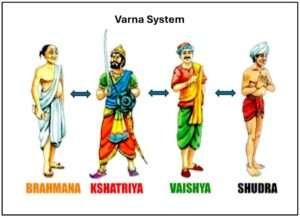
I have highlighted गुणकर्मविभागशः (guṇa-karma-vibhāgaśaḥ) in the verse above as it conveys the essence of Varna system. It means, “according to the qualities and actions” of a person’s nature, abilities, and work, rather than being defined mechanically by birth alone. The fourfold order is further explained in chapter 18, verses 41 to 48: i) Brahmanas – learning, self-discipline, ethical conduct, and spiritual insight, ii) Kshatriyas – protection, governance, courage, and the defence of dharma as warriors, iii) Vaishyas – cultivation, agriculture, trade, business, and iv) Shudras – service, labour and support to society.
While the Bhagavad Gita discusses the concept of Varna, the well-known anatomical metaphor that Brahmana originated from the head, Kshatriya from the arms, Vaishya from the thighs, and Shudra from the feet comes from Purusha Sukta (Hymn to the Cosmic Person) found in Rigveda, Mandala (Book) 10, Sukta (hymn) 90 and Rik (verse) 12, commonly denoted as (10.90.12).
Nowhere in the literature is the hierarchy praised, or the superiority of one varna over another is proclaimed. It recognises that all human actions are imperfect and therefore calls for the performance of one’s duty with detachment, integrity, and dedication, according to one’s qualities. The strength of this vision lies in its interdependent social order, in which a person’s position can change as one’s qualities, abilities, and actions evolve. For example, Valya Koli, a robber, becomes Brahmin Rishi Valmiki by changing his thoughts; King Kaushik, a Kshatriya, undertakes penance and becomes Rishi Vishwamitra; Prince Satyavrat, though a Suryavanshi Kshatriya, was wayward and was kicked out by his father, King Trayaruni, to become a lower Varna chandal.
Inter-Varna marriages were known and accepted. The Brahmin sage Richika married Satyavati, a Kshatriya princess; their grandson, Sage Parashurama, is remembered as a Brahmana with the qualities of a Kshatriya. Such examples challenge the claim that Varna system was a rigid, birth-locked hierarchy. Consider also Rishi Manu, to whom the Manusmriti is attributed. He is routinely demonised by the leftist and Ambedkarites as the architect of Brahmin domination. Yet, Manu was himself a Kshatriya. How, then, did he become the face of Brahminical supremacy?
Parallel social orders: Social orders in the world are a natural progression of human evolution from the caves in Stone Age to settled civilisations. In every society, social order and divisions similar to the Varna system exist. In ancient Chinese civilisation, there were four: i) Scholars and political leaders (shi), ii) Farmers and peasants (nong), iii) Artisans and craftsmen (gong) and iv) Merchants and traders (shang).
Muslims have strong social stratification: i) Ashraf – upper caste higher social and economic status, like Khans, Pathans, Syed and Sheik), ii) Ajlaf – Middle and traditionally working class, like Quereshi, Kasab, Ansari, Mansoori, and iii) Arzal – Dalit and OBC like Bhangi, Dhobi, and others. In addition to this social stratification, there are several religious divisions like Sunnis, Shias and Ahmedias, being the major ones with their different mosques and prayer styles. Christianity is traditionally and taxonomically divided based on historical schisms, authority, and doctrine: i) Catholicism, ii) Eastern Orthodoxy, iii) Oriental Orthodoxy, iv) Protestantism, v) Restorationism, and vi) Church of the East.
Impact on India: After Independence, the Congress’s secular framework carried forward the colonial project of portraying Hinduism as an inherently casteist society, though the word “secular” was introduced through the back door in our constitution during Indira Gandhi Emergency in 1975. This narrow framing overlooked the civilisational ideal expressed in Vasudhaiva Kutumbakam, “the world is one family,” which has long been part of Hindu thought. In the decades that followed, the Congress and its secular allies often used secularism as a political instrument to consolidate their Muslim vote banks while deflecting criticism onto Brahmins and upper-caste Hindus.
The freedom struggle drew participants from every section of Hindu society. Kshatriyas, Vaishyas, Shudras, and Brahmins all contributed, and many made the ultimate sacrifice. Since this article focuses on Brahmins, it is worth recalling the stellar contributions of some of them whose names were underplayed by the leftist historians who were more loyal to their English masters than to Bharat’s history. Thanks to the internet, information is now available at the click of a button. The one-sided narratives of left-oriented writers, often amplified by foreign fellowships and institutional patronage, are increasingly being exposed.
Notable Brahmin freedom fighters who deserve recognition are listed here: i) Nana Phadnavis, ii) Mangal Pandey, iii) Vasudev Balwant Phadke, iv) Lokmanya Tilak, v) Gopal Krishna Gokhale, vi) Veer Savarkar, a daring revolutionary, the longest-imprisoned freedom fighter in Andaman prison, vii) Anant Kanhere, viii) Shivram Rajguru, ix) Wamanrao Joshi, x) Ganesh Savarkar, xi) Ganesh Vaishampayan, xii) Senapati Bapat, xiii) Vasudev Gogate, xiv) Dada Chaudhari, xv) Rani Laxmibai, xvi) Nanasaheb Peshwa, xvii) Chandrashekhar Azad Tiwari, xviii) Subramanyam Bharati, xix) Vanchinathan Iyer, xx) VVS Aiyer, xxi) Chaphekar Brothers, xxii) Virendranath Chatopadhyay, xxiii) Jatindranath Mukherjee Aka Bagah Jatin, xxiv) Bankim Chandra Chattopadhyay. The list is long.
Final Word: I have organised my final thoughts in four categories.
Casteism: A Colonial Wound, Not Hindu Dharma: It is unfortunate that the minds of Hindu society and many non-Hindus have been deeply shaped by the caste system as it was codified and hardened under British rule. Casteism is a social evil imposed upon Hindu society. It is not the essence of Hindu dharma. Yet, the damage caused by more than 150 years of rigid caste classification has become stronger as ever. It must be confronted and ended.
Caste Prejudice: Caste prejudice was never the monopoly of Brahmins alone. Even within communities regarded as upper caste, hierarchy and exclusion were widespread. For example, Kokanastha and Deshastha Brahmins, both considered upper castes, did not always dine together. Upper-caste Maratha Kshatriyas often looked down upon Kunbis and Gomantak Maratha Kshatriyas, even though the latter were also upper castes. The hierarchy extended downward as well. Mahars, considered a lower caste, were treated as untouchable by upper castes; yet many Mahars considered themselves superior to Mangs. Mangs, in turn, regarded themselves as superior to Bhangis, and Bhangis to Dhors. A Bhangi would not eat food served by a Dhor, while Mangs and Mahars would not eat food served by a Bhangi.
Even in religious spaces, exclusion persisted. Mahars, who themselves faced exclusion from upper-caste temples, did not always allow Bhangis and Dhors into temples of Goddess Mariai, also known as Mariamman, their own deity. And yet, Brahmins alone are blamed and targeted for practising untouchability and casteism. Is that not hypocrisy?
Attacking Brahmins to Attack Hinduism: Those who seek to attack Hinduism take an indirect route, they attack Brahmins. Since Brahmins have historically been custodians of Vedic learning, temple traditions, and Hindu intellectual life, hostility towards them becomes a convenient proxy for hostility towards Hinduism itself. What is more painful is that this hatred often receives support from other Hindus who are divided as a society, as well as non-Hindus who watch with glee. That is a matter of shame.
The Larger Danger: Today, Europe is burning and witnessing social and political turmoil due to illegal immigrants from Morocco, Algeria, Tunisia, and other West Asian countries. Bharat has endured similar incidents due to Rohingyas and Bangladeshi illegal immigrants for the last several decades. For Europe, maybe karma is catching up because of their years of exploitation and looting of resources, and atrocities on people in African and Asian countries. Meanwhile, our opposition leaders, led by the Congress scion, left-leaning intellectuals in society, along with a new political breed camouflaged as the “cockroach” movement, are determined to weaken the country by creating disorder, allegedly with the support and funding of foreign forces. Their focus seems to be less on national welfare than on grabbing power by consolidating the 15% minority vote bank, even if it is at the cost of dividing the country. We need to be cautious in reading their design.
To conclude, I would say that it is time to acknowledge the wrongs of the past, correct them where they persist, and refuse to allow colonial-era divisions to define our future. As a liberal country of diverse ethnicities and religions, we must stand united, not as a monolith that erases difference, but as one nation bound by mutual respect. We can do so not by denying injustice, but by rejecting hatred and protecting the dignity, continuity, and pride of our unique Hindu religion and culture. Remember, “When there is no enemy within, the enemies outside cannot hurt you”.


Excellent & Mind Blowing Analyses & It’s Presentation, Great Education to the People who are not aware of the History of the Subject👏🏿👏🏿👏🏿🙏💐🙏
Dr Chadda Saab, excellent analysis, the article brought out many myths, that since childhood we assumed it to be true. Your conclusion has given us a true & principles approach for the Nation & I’m sure if we walk that path, our country will withstand the inimical forced that is trying to divide u. Thank you for your analytical information.
An interesting perspective….. The rigidity seen by people born in around fifties and sixties (a group to which I belong) has reduced substantially if not disappeared altogether, at least in urban and semi urban areas. Rural India needed education which was denied by the rulers and so resulted in perpetuating the rigidity. Once we accept that the rigidity in caste system (and not caste system per se) is the evil, it is much easier to get rid of.
Feeling of Inferiority , incomptenece, intolerence, attitude of inflicting injury with strength were never advocated by Hindu Sanatana Dharma. The basic principle preached by super inyilligent Rishis of Ancient India was Lokaa samastaa sukhino bhavantu. They accepted Pruthik bhava ( Enoromous diversity ) under one and only one Truth that is yekam sath vipraha bahudhavadanti. In modern science it is “”Unified Field Theory “” Unification without hatred and living is what Brahmins always స్పీకర్ and chant. Dr Chaddah garu has very impartially dealt the topic. I thank him 💐💐💐
a Brahmin, I found this article thought-provoking. While history and social realities can be viewed from different perspectives, no community should be judged collectively by stereotypes or hatred. Every society must move towards mutual respect, social harmony, and recognition of both historical achievements and mistakes. Constructive dialogue, not division, is the way forward for Bharat.”
Hindu sanatana Dharma never advocated hatred, intolernce either on humans or other living beings. The Brahmins symbolise the preachings of vaidic universal brotherhood and compassion and also whole hearted acceptance of of unification in diversity. They always chant Lokaa samsta sukhino bhavantu. Enoroumus diversity (pruthik bhava) was recognised with a feelig of unification and was said “” yekam sat vipraha bahudhavadanti :””. The modern intelligence is striving to achieve the concept by formulating “” unified field theorey “”. Very clear analysis by Chaddagaru. This must be known by younger generation
Kudos to the author, for an excellent analysis on Hinduism and our caste system, quoting relevant slokas from Bhagavat Gita in particular. Worth reading to know the history of other faiths. Extremely a difficult task to collate such a detailed report.
https://www.planetayurveda.com/traditional-books/sanatana-hharma-an-elementary-text-book-of-hindu-religion-and-ethics.pdf?srsltid=AYCX9vJA9JE43UOjB1qTJ3rf5ZwrUZ0Fnr1DxyDqiEIsA9xNw8nv8KKy
******
I appreciate Dr. Chadda’s diligence in writing this wonderful essay. HEARTY CONGRATULATIONS TO HIM. IT IS TIME TO WAKE UP FROM FAKE NARRATIVES THAT WE WERE FED SINCE INDEPENDENCE. The above link, a free download, gives a clear picture of the Hindu society.
Even Jews had segregation. The chabad movement is all about that, but they made an attempt in 17th century or there abouts to overcome it by strengthening the basis of wealth. It started in a Russian township called Lubavitch, hence the name chabad lubavitch movement.
Having worked amidst colleagues like Prof Kancha Ilaiah of why I am not a Hindu fame ( there is a why I am not a Christian by Bertrand Russell and Why I am not a Muslim by Ibn Waraq)and Prof Muthaiah of Madiga dandora fame, I felt a great deal was MISSING IN THEIR ARGUMENTS. As a family We do not practice nor believe in caste. My other disadvantage is not knowing sanskrit.
My focus areas are International relations/ Foreign Policy& Strategic Studies.
But last 20 years I had begun unlearning and relearning a great deal.
It is time to call a spade a spade, by overturning fake and agenda driven narratives. LET TRUTH PREVAIL.
History teaches lessons. The purpose of it should not be defeated. Our cultural and Sanatana dharma binds the people and unite the country. Dr Chadda ji highlighted the role of invaders and how they hold political power for hundreds of years in the country. Inspite of those situations, the critical role of Brahmins in protecting it bearing the Love, hate relationship they undergone. A great lesson for the unity of Hindus to protect the culture, Country and then selves with the same forces playing the same tricks again. It is our collective responsibility to stop. it.