



It is sad, but true. Andhra Pradesh, which produced some of the tallest leaders of the freedom struggle and the Congress party, including Pattabhi Sitaramayya, Alluri Sitarama Raju and Tanguturi Prakasam Pantulu, has virtually become a Congress-free political territory. The party that once dominated the political landscape of undivided Andhra Pradesh is today struggling for survival in the residuary state. What makes this political collapse particularly humiliating is that it was largely self-inflicted.
The Congress-led UPA-II government under Dr Manmohan Singh paid an extraordinary political price for its handling of the Telangana statehood demand. Instead of addressing the genuine grievances of the people of Telangana through timely political and administrative reforms, it allowed the agitation to intensify and ultimately chose bifurcation in 2014, apparently calculating that the decision would yield electoral dividends. It badly misread the consequences. Telangana became a reality, but Congress lost its political foothold in Andhra Pradesh almost overnight.
There is nothing inherently wrong with creating smaller states for better administration and balanced development. Bharat’s linguistic reorganisation, beginning with the creation of Andhra State in 1953 and followed by the States Reorganisation Act of 1956, recognised the importance of linguistic identity. The NDA government under Atal Bihari Vajpayee subsequently created Chhattisgarh, Jharkhand and Uttarakhand in 2000 to address administrative and regional aspirations. Telangana’s demand, too, had legitimate historical and developmental foundations. The issue was not whether Telangana deserved statehood, but how Congress handled the process and its consequences.
The Congress leadership failed to appreciate the emotional, economic and political fallout in the residuary Andhra Pradesh. The loss of Hyderabad as the capital and economic hub of the undivided state was a particularly painful issue for people who had invested their resources and aspirations in the city. The promises accompanying bifurcation, including special category status, support for the new capital and assistance for bridging the revenue deficit, further raised expectations. The failure to fulfil these promises became a continuing source of public resentment.
Ironically, Congress had a leader capable of commanding political influence across both regions in Y.S. Rajasekhara Reddy. His popularity was such that the Telangana movement, despite its intensity, could not easily dislodge his political dominance during his lifetime. In the 2004 elections, Congress and the Telangana Rashtra Samithi (TRS) contested in an alliance, and YSR’s leadership helped the Congress consolidate its position in undivided Andhra Pradesh. His untimely death in a helicopter crash in September 2009 left a formidable political vacuum. The party’s inability to manage the emerging crisis, factionalism, and the increasingly aggressive agitation led by K. Chandrashekar Rao only compounded its difficulties.
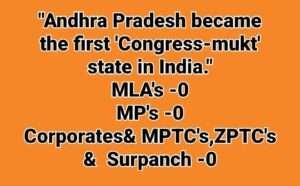
The decision to bifurcate, taken without adequately preparing the ground in the residuary state, proved disastrous. Andhra Pradesh voters delivered their first emphatic rejection of Congress in 2014. The party failed to win a single Assembly seat in the residuary state. Worse, it could not recover in 2019, when its vote share fell to barely 1.2 per cent. Five years later, in 2024, it again failed to win a single Assembly seat, polling only about 1.7 per cent of the votes. These are not the figures of a party merely facing temporary electoral adversity; they reflect a devastating collapse of its organisational strength and political credibility.
However, Congress, despite suffering defeats in the 2014 and 2018 Assembly elections in Telangana, managed a spectacular comeback in 2023 under the leadership of A. Revanth Reddy, who had joined the party in 2017 after leaving the Telugu Desam Party. Revanth’s emergence as a strong state-level leader and his ability to revive the party’s grassroots machinery helped Congress return to power. But such a revival has remained elusive in Andhra Pradesh. Even in the 2024 elections, the party failed to win a single Assembly seat. It has neither produced credible state-level leadership nor rebuilt its grassroots organisation or offered voters a convincing political alternative.
And now comes the bigger question: how long can a national party survive in a state where it has virtually disappeared from the electoral battlefield? Blaming the BJP, TDP, YSRCP or the legacy of bifurcation cannot explain away a decade of organisational neglect and leadership failure.
The Congress may continue to boast of its freedom movement legacy and its illustrious leaders. But history cannot be a substitute for political relevance. Andhra Pradesh has delivered its verdict repeatedly. The grand old party has been reduced from ruling the state to fighting for recognition.
Congress did not simply lose Andhra Pradesh in 2014. It has spent the next decade demonstrating how a national party can squander its legacy, alienate its electorate, and virtually erase itself from the political map of a state it once considered its stronghold.


