


Arulmigu Muthukumaraswamy Temple is located in Parangipettai (historically known as Porto Novo and Muthukrishnapuri) in Cuddalore District, Tamil Nadu. The temple is situated close to the sacred Swetha River (Vellar River) before it merges with the Bay of Bengal. Parangipettai was an important ancient seaport on the Coromandel Coast, and the temple has been a revered place of worship for devotees, traders, and sailors for centuries.
Temple tradition believes this sacred shrine to be around 2,000 years old. Although no inscriptions have been discovered to establish the exact date of its origin or identify its founder, historians consider it an ancient temple that underwent major structural additions during the medieval period. Successive rulers and devotees renovated and expanded the temple while preserving its ancient traditions and religious significance.
The presiding deity is Lord Muthukumaraswamy, a youthful form of Lord Murugan, standing majestically with his divine consorts Valli and Deivanai. The Lord holds the sacred Vel and blesses devotees with courage, wisdom, prosperity and victory over obstacles.
An important feature of this temple is the presence of the ancient shrine of Sri Viswanathar (Lord Shiva) and Goddess Visalakshi within the same complex, indicating that Shiva worship at this sacred place predates the prominence of Murugan. Other shrines include Vinayagar, Bala Subramanyar, Adi Viswanathar, Adi Visalakshi, Dakshinamurthy, Mahalakshmi, Durga, Brahma, Nataraja, Chandikeswarar, Guha Chandikeswarar, Navagrahas and Nagar.
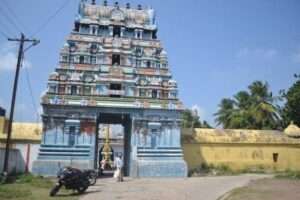
The temple is built in the traditional Dravidian style with an attractive Rajagopuram welcoming devotees into the complex. The sanctum of Lord Muthukumaraswamy is preceded by an Ardha Mandapam and Maha Mandapam supported by beautifully carved stone pillars. Spacious prakarams surround the sanctum and contain several subsidiary shrines arranged according to Agamic tradition.
One of the most remarkable features of the temple is the unique idol of Lord Muthukumaraswamy with six faces, where five faces are visible from the front while the sixth faces the rear, a rare form found in very few Murugan temples. Another rare feature is the image of Lord Brahma seated with folded hands before Murugan, symbolising the episode where Murugan taught Brahma the meaning of the Pranava Mantra. The temple also has two Chandikeswarars, one associated with the Shiva shrine and the other with the Murugan shrine, which is an uncommon feature.
Parangipettai flourished as one of the most important ports of ancient Tamil Nadu and played a significant role in maritime trade with several foreign countries. Over the centuries, the town prospered under various South Indian dynasties and later became known to European traders as Porto Novo.
The temple has remained an important spiritual centre for the people of the region for many generations. Though historical records do not clearly identify its original builder, continuous patronage by rulers and devotees helped preserve the temple and establish it as one of the prominent Murugan temples of the Cuddalore region.
The sacred legend of this temple is associated with Lord Indra, Lord Shiva and the demon Namuchi.
The powerful asura Namuchi had obtained a boon that he could not be killed by any conventional weapon. Protected by this boon, he repeatedly defeated Indra and the Devas, seized the heavenly kingdom and caused great suffering to the celestial worlds.
Unable to defeat the demon, Indra surrendered before Lord Shiva and prayed for his grace. Shiva instructed him to collect foam from the sea while chanting the sacred Panchakshara Mantra, “Om Namah Shivaya.” Since sea foam was neither a weapon nor a living object, it did not violate the conditions of Namuchi’s boon.
By the grace of Lord Shiva, the sea foam became a divine weapon. Indra hurled it at Namuchi, destroying the demon and restoring peace to the celestial worlds.
Filled with gratitude, Indra consecrated a Shiva Linga at this sacred place. The deity came to be worshipped as Indra Lingam and later as Sri Viswanathar with Goddess Visalakshi.
Many centuries later, a shrine dedicated to Lord Muthukumaraswamy was established before the Shiva shrine. As devotion to Murugan steadily increased, he became the principal deity of the temple, while Lord Viswanathar continued to receive daily worship. This is why the temple today is popularly known as the Muthukumaraswamy Temple even though its earliest sacred tradition is connected with Lord Shiva and Lord Indra.
Another unique tradition of the temple is that Lord Muthukumaraswamy is taken in procession not only on the Peacock and Idumban Vahanam but also on Rishabha and Airavata, commemorating Lord Indra’s worship at this sacred place. The sacred Swetha River and the nearby sea are regarded as holy theerthams where ceremonial baths are conducted during important festivals.
Skanda Sashti, Thai Poosam, Vaikasi Visakam, Panguni Uthiram, Karthigai Deepam, Maasi Magam, Maha Shivaratri and the monthly Krittikai are celebrated with great devotion. During Thai Poosam and Maasi Magam, the Lord is taken for the sacred Theerthavari in the Swetha River and the Bay of Bengal, attracting thousands of devotees every year.


