



The Sacred Abode of Lord Murugan and the Divine Wedding of Goddess Deivanai*
Over 1,300 years old, with the present rock-cut temple dating largely to the Pandya period of the 8th century CE. Lord Subramaniya Swamy (Murugan), worshipped along with Goddess Deivanai.
Thiruparankundram is the first among the six sacred abodes of Lord Murugan, collectively known as Arupadai Veedu. It is especially revered as the sacred place where Lord Murugan married Goddess Deivanai following His victory over the demon Surapadman.
The temple stands at the foot of the sacred Thiruparankundram hill, approximately 8 kilometres from Madurai.
Its remarkable architecture combines ancient Pandya rock-cut craftsmanship with later additions by the Nayak rulers.
The sanctum is carved into the natural rock of the hill, while the entrance features an imposing Rajagopuram. Beautifully sculpted pillars, spacious mandapams and intricate stone carvings reflect the artistic excellence of South Indian temple architecture.
An unusual feature of this temple is the presence of several important deities, including Lord Shiva, Lord Vishnu, Lord Vinayaka and Goddess Durga, within the sacred complex.
Thiruparankundram has been a centre of Murugan worship for many centuries. The temple is associated with the early Pandya rulers, who contributed significantly to its rock-cut architecture.
The sacred hill and Lord Murugan’s presence here are celebrated in ancient Tamil devotional literature, including Thirumurugatrupadai, one of the important works of the Sangam literary tradition.
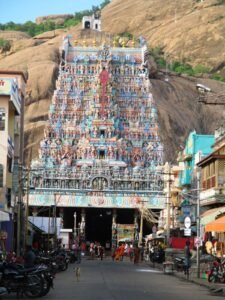
The temple was subsequently expanded and embellished by successive dynasties, particularly the Nayak rulers of Madurai.
According to the sacred traditions of the Skanda Purana, the powerful demon Surapadman and his brothers, Simhamukha and Tarakasura, had become a source of suffering to the Devas. Blessed with extraordinary powers, they challenged the celestial beings and disturbed the peace of the three worlds. Unable to defeat them, Lord Indra and the other Devas approached Lord Shiva, seeking protection.
Lord Shiva’s divine energy manifested as six sparks, which eventually took the form of six children nurtured by the Krittika maidens. Goddess Parvati united the six children into one divine form, Lord Shanmukha, possessing six faces and twelve arms. She bestowed upon Him the sacred Vel, the divine spear, to destroy evil and restore righteousness.
Lord Murugan led the celestial forces against the Asuras. After a fierce battle, He confronted Surapadman at Tiruchendur. When Surapadman transformed himself into a gigantic mango tree, Lord Murugan split it into two with his Vel. The two halves became a peacock and a rooster. In his compassion, Murugan accepted the peacock as his vehicle and the rooster as the emblem on his battle flag.
Following this great victory, Lord Indra wished to express his gratitude to Lord Murugan for restoring peace to the celestial world. He offered the hand of his daughter, Goddess Deivanai, also known as Devasena, in marriage.
The divine wedding was celebrated at the sacred hill of Thiruparankundram. According to tradition, Lord Brahma officiated at the celestial marriage, while Lord Shiva, Goddess Parvati, Lord Vishnu, Goddess Lakshmi and the assembled Devas witnessed the auspicious occasion. The marriage united Lord Murugan, the victorious commander of the celestial army, with Deivanai, the daughter of Indra.
It is believed that Lord Murugan remained at Thiruparankundram with Goddess Deivanai, blessing devotees in his divine wedding form. This sacred association makes Thiruparankundram particularly important for devotees praying for marriage, marital harmony, and family happiness.
Kanda Sashti and Thirukalyanam are among the most important celebrations at Thiruparankundram. The divine wedding festival commemorates the marriage of Lord Murugan and Goddess Deivanai and is celebrated with special rituals, decorations and processions.
Other important festivals include Panguni Uthiram, Vaikasi Visakam, Thaipusam and Karthigai Deepam.
Devotees offer special prayers, abhishekams and archanais to Lord Subramaniya Swamy. Couples and families particularly worship Lord Murugan and Goddess Deivanai seeking blessings for a harmonious married life.


