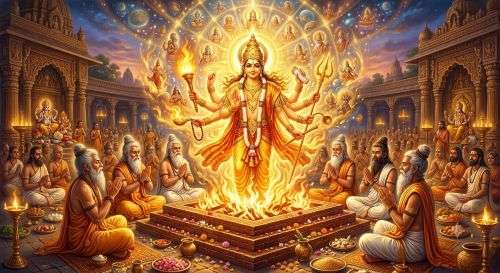

The hymns of the sage Vāmadeva, composed in the majestic Triṣṭubh meter of the Ṛgveda, present Agni not merely as the physical fire kindled upon the sacrificial altar, but as the eternal principle of light, intelligence, transformation, and divine order. Agni is the first recipient of Vedic worship because he stands as the sacred bridge between humanity and the celestial realms. Every offering reaches the gods through him, and every prayer ascends upon his radiant flames. His brilliance is both visible and invisible, illuminating the physical world while awakening the inner consciousness of seekers.
Agni spreads immeasurable masses of light throughout the universe. His movement is compared to that of a vigilant hunter traversing an immense forest, leaving no hidden place unexplored. He is also likened to a mighty king riding upon a royal elephant, accompanied by trusted ministers and surrounded by radiant splendor. His countless rays travel in every direction with remarkable speed, just as an organized army advances with discipline and strength. Wherever darkness, ignorance, or evil attempts to prevail, Agni’s brilliance disperses it completely. His flames become instruments of divine justice, consuming demonic forces that oppose righteousness and disturb the harmony established by Ṛta, the eternal cosmic order.
The Vedic seers perceived Agni’s rays as dynamic streams of energy that travel ceaselessly through all regions of existence. Their swift movement appears almost mysterious, creating effects beyond ordinary perception. Modern minds may recognize in this imagery an intuitive appreciation of radiant energy, heat, light, and the invisible forces that sustain life. The hymns reveal a remarkable scientific temperament by portraying natural phenomena with careful observation while simultaneously unveiling their profound spiritual meaning. Agni’s energy transforms, purifies, nourishes, and protects, reflecting the universal laws that govern both the material and spiritual worlds.
Agni possesses irresistible brilliance that humbles every opposing force. His fiercest rays reduce hostile powers to dust, demonstrating that falsehood cannot withstand the radiance of truth. No enemy can restrain his movement or diminish his strength. During the sacred yajña, however, the same blazing power becomes disciplined through the juhū, the sacrificial ladle that offers clarified butter into the sacred fire. This symbolism teaches that divine energy is never destructive without purpose. Properly directed through sacred knowledge and righteous intention, immense power becomes an instrument of blessing rather than devastation. Sparks of divine illumination spread everywhere, carrying purification to all who approach with sincere devotion.
The prayers repeatedly seek Agni’s protection from dangers arising both near and far. External enemies symbolize hostile forces in the world, while internal enemies represent anger, greed, pride, jealousy, fear, ignorance, and selfishness. The Vedic vision recognizes that the greatest battles are often fought within the human heart. Agni is therefore invoked as the guardian who protects every devotee from visible and invisible dangers alike. Since humanity belongs to Agni through sacred worship, no worldly power, however mighty, can ultimately humiliate those who remain established in truth and righteousness.
The hymns call upon Agni to awaken his blazing flames against the demonic forces that threaten the welfare of the universe. These demons need not always be understood as physical beings alone. They also signify destructive tendencies that obstruct wisdom, compassion, justice, and spiritual growth. Agni’s consuming fire destroys these negative influences one by one, regardless of their apparent strength. His heavenly brilliance shines with increasing intensity, ensuring that divine order always triumphs over disorder. The bow of the hunter who seeks to disturb peaceful life is deprived of its string, signifying the complete removal of the power to inflict harm.
Agni is ever youthful because the divine principle of transformation never grows old. Fire constantly renews itself, consuming one form and giving birth to another. Thus Agni represents eternal freshness, continuous movement, and ceaseless creative activity. Those who worship him with sincerity receive his grace in abundance. As the supreme priest of the yajña, Agni blesses faithful worshippers with auspicious days, lasting prosperity, precious treasures, noble descendants, and homes filled with abundance. His blessings extend beyond material wealth to include wisdom, virtue, courage, and spiritual fulfillment.
Daily prayers, sacred oblations, and the continuous chanting of Vedic hymns delight Agni because they harmonize human life with the rhythm of the cosmos. The generous patron who supports sacred sacrifices becomes a benefactor of society. Such a person develops the virtues of charity, compassion, and responsibility. The hymns pray that these noble patrons enjoy long life extending to a hundred years, experience prosperous days, and become worthy recipients of the immeasurable spiritual merit generated through righteous actions performed for the welfare of all beings.
The worshippers seek Agni’s enlightened intellect, recognizing that true wealth begins with purified understanding. Their hymns are intended not merely to be spoken but to reverberate throughout creation, carrying vibrations of truth and harmony. They pray for flourishing families blessed with children and grandchildren, for excellent horses and magnificent chariots that symbolize strength, progress, and noble accomplishment. Yet all such prosperity is meaningful only when dedicated to divine service and righteous living.
Agni shines unceasingly through both day and night. Every civilization depends upon the principles symbolized by fire for survival, nourishment, protection, and advancement. The Vedic sages recognized this universal dependence and therefore honored Agni as humanity’s constant companion. Even the wealth of former enemies, once transformed through righteousness, becomes dedicated to noble purposes. Generation after generation continues the sacred tradition of serving Agni with gratitude, ensuring that divine wisdom is never extinguished from the earth.
The beautiful horses that draw Agni’s celestial chariot symbolize the swift movement of divine energies throughout the universe. The richly adorned chariot, filled with prosperity and fit for sacrifice, arrives under Agni’s protection. The devoted worshipper who welcomes Agni daily as an honored guest develops a profound spiritual friendship with the divine. This relationship transforms ordinary existence into sacred participation in the eternal order of creation.
Agni is youthful, wise, skillful, and the supreme priest who conducts every sacrifice with perfect knowledge. Through the chanting of sacred hymns, the worshippers establish an enduring relationship with him. The spiritual power generated by sincere praise becomes a force that overcomes the demonic tendencies hidden within human life. The hymns acknowledge their descent through the revered sage Gautama, affirming the uninterrupted transmission of Vedic wisdom across generations. Agni, the destroyer of enemies and knower of all hearts, is requested to understand and graciously accept these ancient prayers.
The omniscient Agni never sleeps. His radiant presence remains constantly awake, witnessing every action and sustaining every aspect of creation. His rays provide comfort, timely assistance, tireless protection, and peaceful guidance. They neither oppress nor injure but preserve life with compassion and justice. Standing firmly at the sacred place of worship, Agni becomes the invisible shield surrounding all sincere seekers, protecting them from both physical harm and spiritual decline.
The compassionate nature of Agni is beautifully illustrated through the remembrance of Dīrghatamas, the son of Mamata, who despite being born blind attained profound spiritual illumination through divine grace. This episode teaches that external limitations cannot prevent the awakening of inner vision. Agni protects, nourishes, and guides every sincere soul with affection. Though hostile forces may attempt to extinguish divine light, their efforts inevitably fail because truth possesses an eternal strength beyond the reach of falsehood.
Agni’s movement is natural, spontaneous, and unstoppable. Those unwilling to follow the path of truth inevitably fall behind, burdened by the shame of ignorance and selfishness. The priests pray that through Agni’s grace they may prosper equally in wisdom and righteous wealth. They seek nourishment for body, mind, and spirit, recognizing that all true sustenance ultimately originates from the divine source represented by the sacred fire.
As the vast embodiment of truth and destroyer of sin, Agni is invoked to remove both nearby and distant obstacles that hinder the performance of sacred duties. Every ritual is prayed to proceed in perfect order, reflecting the harmony of the universe itself. Through resplendent chanting, disciplined worship, and unwavering devotion, the seekers offer themselves entirely to Agni. They ask him to understand their heartfelt hymns, to remove the influence of irreverent and destructive forces, to protect them from blame, conflict, and discord, and to establish them firmly upon the path of righteousness. Thus the hymn concludes by revealing Agni as the eternal flame of divine wisdom, whose radiant presence unites spiritual realization with disciplined observation of nature, harmonizing profound faith with an enduring scientific temperament that continues to inspire humanity across the ages.