


Blessed with divine vision by Sage Vyasa’s grace, Sanjaya continued to narrate the unfolding events of Kurukshetra with unwavering clarity. Yet, even as he revealed the bitter truth, he gently sought to soften the sorrow of the aged monarch Dhritarashtra. His words neither concealed reality nor aggravated despair; instead, they balanced truth with compassion, allowing the grieving king to see destiny’s inevitable workings through the lens of righteousness.
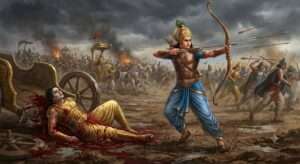
Though Karna’s noble head had fallen upon the blood-soaked earth, severed from his mighty body like a fully blossomed lotus cut from its sacred stem, his lifeless form still radiated an extraordinary brilliance. His broad chest, adorned with countless scars of heroism, glowed with an almost celestial splendour, astonishing warriors who watched from afar. Even in death, Karna seemed untouched by defeat. His fallen frame retained the majestic dignity of a mountain peak kissed by the setting sun, silently proclaiming that true valour survives the destruction of the body.
King Shalya of Madra gazed upon the tragic spectacle with a heart burdened by grief. Karna’s magnificent chariot, now stripped of its royal banner and shattered standard, stood motionless upon the battlefield like a lifeless tree abandoned in a barren wilderness. Recognizing that the day’s fortune had turned irrevocably against the Kauravas, Shalya slowly withdrew the empty chariot, his heart weighed down by disappointment and helplessness.
Arjuna’s relentless assault swept through the Kaurava ranks with terrifying force. His arrows descended like a pride of famished tigers tearing a mighty bull away from its herd. Unable to withstand the irresistible fury of Gandiva, the Kaurava warriors abandoned all order and fled in every direction. Fear overwhelmed discipline, and survival became their only concern. Meanwhile, the Pandava army erupted in jubilant cries of victory. Warriors embraced one another, praising Arjuna’s unwavering resolve and celebrating the fulfilment of a long-awaited vow. Shalya and the surviving Kaurava heroes repeatedly looked back at Arjuna’s fluttering banner bearing Hanuman’s emblem, only to hasten their retreat, stripped alike of pride, honour, and confidence.
The fall of Karna beneath the arrows of Gandiva, the sorrowful withdrawal of Shalya, and the mass flight of the Kaurava host filled Bhima with indescribable joy. He released a thunderous roar that echoed like the united cries of a hundred lions. Its mighty vibration rolled across the heavens, shaking the hearts of friend and foe alike. Sanjaya said, “O Lord of men, Bhima’s triumphant roar infused the Pandava army with renewed courage, steadfast faith, and unconquerable confidence, while it silently drained the strength, boldness, and hope from the hearts of the Kaurava warriors.”
Disturbed in mind, his face pale and his eyes overflowing with tears, Shalya finally approached Duryodhana. Drawing a long sigh, he spoke with solemn gravity. “O King, we have witnessed countless battles fought by mighty monarchs and immortal heroes, yet never have we beheld a duel as fierce and devastating as that between Karna and Arjuna. Even the celestial guardians of the universe must have watched this encounter with astonishment. The intensity of their combat shook the very foundations of creation, as though Nara and Narayana themselves had measured their divine strength against each other. Yet destiny decreed otherwise. It seemed as though even Brahma, the Giver of life, hesitated to prolong the existence of a warrior whose measure of courage had already reached perfection.”
Shalya continued, “Behold the kings who willingly surrendered their lives in the hope that you would one day rule the earth as its sovereign emperor. They now lie motionless amidst slain horses, shattered chariots, broken weapons, and rivers of blood. Their sacrifice deserves remembrance, not endless grief. Those heroes possessed the prowess of Indra, the justice of Yama, the majesty of Varuna, and the wealth of Kubera. Their mighty arms displayed unparalleled strength, yet even such greatness was overcome by the irresistible decree of fate. Therefore, do not lament over what no mortal can alter.”
The battlefield itself had become a fearful monument to human ambition. Broken bows, shattered arrows, torn standards, fallen umbrellas, royal fans, elephant bells, horse ornaments, anklets, bracelets, armlets, necklaces, fragments of glittering crowns, and countless precious ornaments lay scattered across the crimson earth. Every direction revealed the dreadful price of war. The ground that once thundered beneath marching armies had become a vast cemetery where kings and common soldiers rested together without distinction.
At that very moment, Krishna and Arjuna raised their divine conches, Panchajanya and Devadatta. Their sacred resonance rolled across the heavens like the proclamation of cosmic victory. The sound pierced the hearts of the weary Kaurava soldiers, shattering their remaining courage. It seemed as though an unseen army had suddenly descended upon them. Their minds collapsed beneath the divine vibration long before any weapon could strike them.
The scene recalled the ancient victory of Lakshmana over Meghanada. When Lakshmana slew Ravana’s mighty son and released his victorious lion’s roar, the demon armies fled in uncontrollable terror. Likewise, upon hearing the celestial conches of Krishna and Arjuna, the remaining Kaurava warriors abandoned all resistance and scattered in fear. Duryodhana’s face turned pale as humiliation settled upon him like a dark cloud from which there could be no escape.
As the sun gradually descended beyond the western horizon, Shalya gently advised the Kaurava king. “Let the battle cease for this day. Night has claimed the field, and tomorrow’s course may be determined with the coming dawn.” Kripa, Ashwatthama, Kritavarma, Shakuni, Shusharma, and the surviving commanders approached Duryodhana with heavy hearts. Their sighs reflected the crushing realization that the army’s spirit had been broken. The divisions had lost their martial enthusiasm, and under such conditions no commander could restore the shattered ranks before another day of battle.
Respecting Shalya’s counsel, Duryodhana repeatedly cried out Karna’s name in deep anguish. Ordering the exhausted army to rest, he slowly withdrew to his camp, carrying the unbearable burden of defeat upon his shoulders.
Meanwhile, the arrows that Karna had earlier embedded in the bodies of Krishna and Arjuna still shimmered with radiant light. Standing together upon the battlefield, they resembled the Sun and the Moon united at a single place to dispel the deepest darkness from the world. Removing the remaining arrows, Krishna declared that the pursuit of fleeing enemies must end, for righteousness never delights in unnecessary slaughter after the battle has ceased. Thus, he ordered the army to halt all combat.
Having slain Karna, Krishna and Arjuna returned to their camp like Indra and Upendra returning triumphantly to heaven after destroying the mighty demon Bala. The celestial beings showered flowers from the skies, praising the fulfilment of divine justice before returning joyfully to their heavenly abodes.
The victorious Pandavas entered the camp of Dharmaraja Yudhishthira amidst overwhelming rejoicing. The Panchalas, who had long endured sorrow and humiliation, experienced true happiness for the first time in many years. Some bowed respectfully before their king, while others blessed him with heartfelt affection. Joy flowed freely through every conversation.
Arjuna descended from his chariot and humbly bowed at the feet of his elder brother. Bhima, Nakula, and Sahadeva likewise offered their respectful salutations and sought his blessings. Yudhishthira embraced each of them with deep affection, praising every warrior individually for his steadfast devotion and incomparable courage.
Krishna then addressed Dharmaraja with profound seriousness. “O Lord of the Earth, even if the entire universe had united against Karna, overcoming his strength would have been nearly impossible. Yet, consumed by the fire of your righteous indignation and the inevitable decree of destiny, he has fallen. With Karna’s death, the backbone of the Kaurava army has been broken. Let your long-cherished vow now find completion. Cast aside grief and embrace the peace that righteousness has secured.”
Listening with folded hands, Yudhishthira replied, “O Krishna, your grace alone has carried us through every trial. Your very presence is auspicious, and your compassionate glance dispels every misfortune. Since your affection rests upon us, victory could never abandon us. Your kindness has preserved our lives under every hardship. O Lotus-eyed Lord, Protector of all worlds, You always hasten to rescue those who seek refuge in You. To save Your devotees is but the natural expression of Your boundless compassion. Freed from fear and sorrow, I shall finally know peaceful sleep.”
Krishna smiled gently and answered, “O King, your noble words delight the heart. Yet know this truth. I am merely an instrument in the unfolding of divine purpose. Your brothers possess immeasurable strength and extraordinary heroism. Endowed with such virtue, courage, and righteousness, no enemy who stands against you can ultimately prevail.”
After this affectionate exchange, Yudhishthira expressed his desire to witness the battlefield with his own eyes. Receiving Krishna’s approval, he ascended a magnificent chariot drawn by white horses with flowing black tails. Guided by blazing torches and accompanied by relatives and trusted companions, he journeyed across the silent field of war. There he beheld Karna’s severed head, the fallen bodies of his valiant sons, and the countless heroes who had perished. The burden that had oppressed his soul for many years finally dissolved. He felt as though he had crossed the ocean of suffering, regained a lost kingdom, and awakened into a life freed from anxiety.
Sanjaya concluded his narration with profound reflection. “O King Dhritarashtra, the Pandavas have crossed the immeasurable ocean called Karna and reached the secure shore of victory. This great war itself resembles the supreme sacrifice dedicated to Lord Vishnu. Agni, Surya, and Chandra stand as the sacred priests of that cosmic sacrifice. Karna himself became the mighty oblation offered upon the altar of destiny. Thus, while recounting every event with precision, I have sought to reveal not merely the movements of armies, but the subtle workings of righteousness, destiny, sacrifice, and divine will that govern the rise and fall of kings.”

