



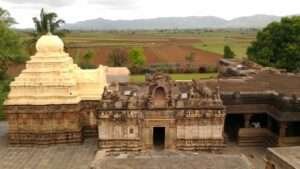
Sri Kalleshvara Temple, situated in the historic village of Bagali near Harapanahalli in Karnataka’s Vijayanagara district, is a magnificent ancient temple dedicated to Lord Shiva. Renowned for its exquisite stone carvings, majestic pillars and remarkable inscriptions, the temple stands as an outstanding example of the architectural and spiritual heritage of Karnataka.
Bagali was once an important centre of Shaiva worship, Vedic learning and religious activities during the Western Chalukya and Hoysala periods.
The temple dates back to approximately the 10th century CE, making it more than 1,000 years old.
An inscription dated 987 CE, belonging to the reign of Western Chalukya ruler Tailapa II, provides evidence of the temple’s antiquity.
The temple witnessed significant development and royal patronage during the Western Chalukya and Hoysala periods. It is presently a protected monument under the Archaeological Survey of India.
The presiding deity is Lord Kalleshvara, a manifestation of Lord Shiva, worshipped in the form of a sacred Shiva Linga.
Ancient inscriptions refer to the deity as Swayambhu Kalideva, meaning the self-manifested Lord Shiva.
The name Kalideva gradually became associated with the present-day name Kalleshvara. The Swayambhu designation reflects the ancient belief in the divine and self-manifested nature of the deity.
The temple is a splendid example of Western Chalukya architecture, displaying remarkable craftsmanship and artistic refinement.
Its magnificent Mahamandapa features beautifully sculpted stone pillars, intricately carved ceilings and ornamental doorways. The sanctum houses the sacred Shiva Linga, while the surrounding structures contain several subsidiary temples.
The sculptures and decorative panels reflect the artistic excellence of the Chalukya craftsmen, with later architectural influences associated with the Hoysala period.
The temple complex is particularly significant for its numerous stone inscriptions, which preserve valuable information about the religious, cultural and social life of ancient Karnataka.
Bagali flourished as an important Agrahara, a settlement associated with Vedic scholars and religious learning, during the Kalyani Chalukya period.
Several inscriptions reveal that the temple received donations from kings, local administrators and devotees for daily worship, religious activities and the maintenance of temple lamps.
An inscription dated 1108 CE refers to the worship of Swayambhu Kalideva, confirming the antiquity of this sacred tradition.
In 1193 CE, Hoysala King Veera Ballala II made an important donation of lands for the service of Lord Swayambhu Kalideva. The inscription records that the donation was made after ceremonially washing the feet of 500 Mahajanas, the learned members of the Bagali community.
These records establish the temple’s importance as a major religious centre for several centuries.
According to the ancient sacred tradition preserved through the inscriptions of Bagali, Lord Shiva has been worshipped here as Swayambhu Kalideva, the self-manifested Lord. The sacred Shiva Linga was revered as a divine presence, and Bagali gradually developed into an important centre of Shaiva devotion and Vedic learning.
One of the most touching accounts of devotion is preserved in an inscription dated 1035 CE. A woman devotee named Siriyave dedicated her house to Lord Kalideva, making arrangements for an annual contribution towards maintaining an Akhand Deepa, an eternal lamp before Lord Shiva. This remarkable offering symbolised her unwavering devotion and the desire that the divine light should continue illuminating the temple.
The sacred importance of Kalleshvara continued through successive generations. In 1193 CE, Hoysala King Veera Ballala II honoured Lord Swayambhu Kalideva through a generous land donation for temple worship and religious services. The involvement of the learned Mahajanas of Bagali demonstrates the deep spiritual significance attached to this ancient Shiva Kshetra.
Maha Shivaratri is an important occasion for worshipping Lord Kalleshvara.
The temple’s Shaiva tradition is also associated with the worship of Lord Shiva through Abhisheka, the offering of Bilva leaves and the lighting of sacred lamps.
The ancient inscriptions particularly highlight the importance of Nitya Pooja and Deepa Seva, reflecting the devotional practices maintained by generations of worshippers.


