Shrikant Rao
When 1,200 new overnight passenger coaches roll out of Chennai’s Integral Coach Factory (ICF) over the coming years, their core stopping, door, and vestibule systems will carry the imprint of an American industrial titan.
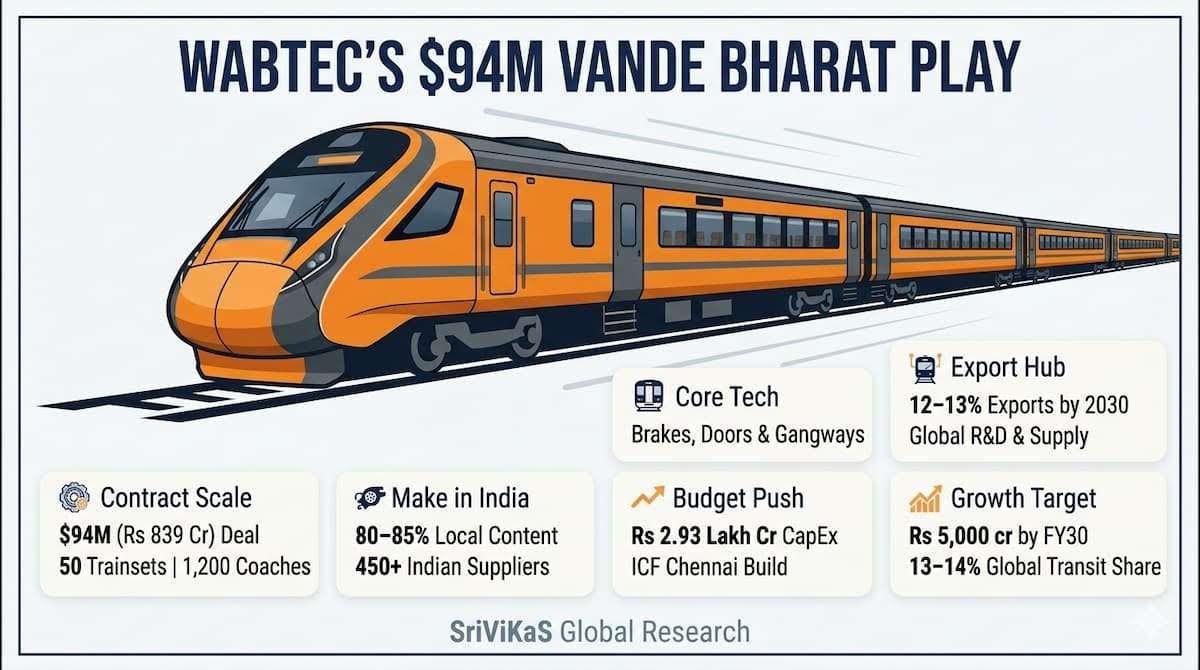
Late last month, Pittsburgh-based rail technology company Wabtec Corporation—headquartered at 30 Isabella Street on Pittsburgh’s North Shore—secured a $94 million (Rs 839 crore) contract from Indian Railways to supply critical onboard subsystems for 50 new Vande Bharat Sleeper trainsets. While public commentary around large railway tenders often frame foreign contracts through the narrow lens of import dependency, an analytical look at the agreement reveals a more nuanced industrial dynamic. Rather than signaling a retreat from domestic self-reliance, the deal demonstrates how Indian Railways is using its procurement scale to extract deep local manufacturing, competitive pricing, and global export commitments from Tier-1 multinational suppliers.
For India’s national transporter, the contract arrives amid an unprecedented capital expansion backed by a record Rs 2.93 lakh crore capital expenditure allocation in Union Budget 2026–27. Following the launch of the first Vande Bharat Sleeper service on the Howrah–Kamakhya (Guwahati) route in January 2026, Indian Railways has moved rapidly to scale its overnight intercity network across high-density trunk routes. Across the broader Vande Bharat ecosystem, ridership reached 3.98 crore passengers in FY25-26, reflecting sustained demand for faster, higher-comfort intercity rail travel. Meeting this demand requires rolling stock that balances rapid acceleration and high-speed stability with overnight passenger comfort, an engineering requirement that places significant demands on braking, access, and coach-connection hardware.
Technical Scope
The agreement covers 1,200 sleeper coaches—configured as 50 trainsets of 24 coaches each—being manufactured by ICF Chennai, with deliveries scheduled over the next two financial years and full program execution extending through March 2029 according to regional media briefings. Unlike conventional locomotive-hauled coaches that rely on standard pneumatic braking and open vestibules, the Vande Bharat Sleeper platform is engineered for semi-high-speed operations, requiring tightly integrated electronic and mechanical subsystems.
Under the October 2026 contract, Wabtec is responsible for delivering three core onboard subsystem packages. The first package provides microprocessor-controlled electro-pneumatic braking systems equipped with wheel-slide protection and anti-drag safety features. By synchronizing braking force across all 24 coaches simultaneously, the system reduces longitudinal jerks during deceleration, directly improving ride quality for sleeping passengers while enhancing stopping performance. The second package comprises automatic door operating systems—including anti-drag mechanisms designed to detect and release flowing garments such as saris or dupattas—improving aerodynamic noise reduction, thermal insulation, and passenger safety. The third package features enclosed, flexible vestibule gangway solutions that connect the 24 coaches into a continuous, climate-controlled environment, allowing safe movement between cars at high speeds.
Beyond hardware delivery, the agreement encompasses end-to-end system integration, static and dynamic testing, commissioning at ICF Chennai, and long-term operational reliability support aligned with Indian Railways’ availability requirements. This order expands Wabtec’s ongoing participation in Indian transit programs, building on earlier contracts to supply over 680 high-reach pantographs—3.6-meter roof-mounted assemblies designed for India’s electrified rail corridors—from its Hosur facility. Across its broader Indian operations, Wabtec has supplied braking systems, doors, and related transit equipment for roughly 3,500 coaches and over 8,000 high-reach pantographs nationwide.
Competitive Dynamics
From a market-structure perspective, the tender process reflects a deliberate evolution in how Indian Railways manages vendor competition. Historically, orders for brakes, doors, and gangways were frequently split across multiple suppliers, including European specialists such as Knorr-Bremse AG and smaller domestic component firms. In this procurement cycle, Indian Railways tendered large volumes across three distinct product packages, and Wabtec secured the primary contract awards across all three categories, capturing a majority share while establishing single-point accountability for subsystem integration.
More importantly, the contract underscores Wabtec’s distinct strategic positioning within India’s passenger railway ecosystem. While global rolling-stock manufacturers such as Siemens Mobility and Alstom compete directly with Wabtec on multi-billion-dollar freight locomotive tenders, Wabtec operates primarily as an agnostic Tier-1 subsystem provider within the passenger coach segment. Whether ICF Chennai, BEML, or a private manufacturing consortium builds the outer passenger coach shells, Wabtec captures component and aftermarket service revenue, remaining shielded from the thinner margins and execution risks of full-trainset assembly.
At the same time, the deal creates substantial switching costs for competitors. Unlike transactional vendors that deliver equipment at the factory gate and exit, Wabtec’s multi-year commissioning and operational reliability obligations embed its engineering teams directly into Indian Railways’ maintenance workflows across 1,200 coaches. Combined with its existing freight footprint—where Wabtec has supplied and services over 600 high-horsepower locomotives nationwide—this aftermarket presence forms a durable competitive advantage.
Localization Footprint
Crucially, the Vande Bharat Sleeper contract does not function as a traditional import arrangement. To qualify for Indian Railways’ stringent local-content mandates, multinational suppliers must maintain substantial domestic value addition. Anticipating this shift, Wabtec has invested roughly Rs 350 crore in expanding its Indian manufacturing and engineering footprint, scaling its direct Indian transit workforce from approximately 600 to nearly 1,500 employees over recent years.
Today, Wabtec’s Indian transit business—operating through Faiveley Transport Rail Technologies India—anchors its production in major hubs including Hosur in Tamil Nadu and Rohtak in Haryana, alongside expanded warehousing and servicing corridors near Anekal and Attibele. Its regional precision engineering base was further strengthened by the integration of Dellner Couplers, adding two facilities in Chennai and rounding out its end-to-end train connection and gangway portfolio. Supported by a localized supply chain of more than 450 domestic vendors, Wabtec estimates that it has achieved 80 percent to 85 percent local content across its Indian transit offerings, allowing it to manufacture internationally benchmarked hardware at competitive Indian cost structures. Still, industry observers note that achieving full indigenization across India’s rail supply chain remains an incremental journey, as specialized electronic sub-assemblies, high-precision brake valves, and semiconductor-grade microprocessors continue to rely on global tier-two networks even as mechanical fabrication and final assembly localize rapidly.
According to Wabtec Transit President Pascal Schweitzer, this domestic scale is transforming India from a local delivery market into a global center of excellence. Backed by steady domestic order visibility and local R&D leadership in Bengaluru and Hosur, Wabtec is increasingly using its Indian engineering centers and factories to develop, test, and supply transit components—including high-reach pantographs, crashworthy couplers, and door systems—to rail operators in Europe and the United States. Company executives project that exports, which currently represent around 5 percent of Wabtec India’s transit revenue, will more than double to 12 percent or 13 percent by 2030.
Financial Outlook
Financially, the transaction reinforces India’s rising strategic weight within Wabtec’s global portfolio. In its third-quarter 2026 financial results, Wabtec reported global sales of $3.12 billion, with its global transit segment growing 11.3 percent year-on-year to $883 million, supported by a total company backlog of $31.44 billion and a 12-month transit backlog of $2.45 billion.
Within that global division, India is one of the fastest-growing engines. According to Wabtec Transit India Managing Director Ajay Mani, the company’s local transit revenue grew from roughly Rs 3,000 crore in 2025 to an expected Rs 3,200 crore in 2026, and is targeted to reach Rs 5,000 crore annually by FY2029-30. Transit equipment accounts for roughly one-third of Wabtec’s overall Indian operations, with the remaining two-thirds driven by freight locomotives and mining equipment. As this expansion unfolds across Vande Bharat, Namo Bharat, and urban metro projects, management projects India’s share of Wabtec’s global transit revenue to climb from nearly 10 percent today to between 13 percent and 14 percent by 2030.
For Indian Railways, the transaction illustrates a pragmatic industrial blueprint. Rather than delaying fleet deployment for years to develop complex, safety-critical braking, coupler, and door subsystems entirely from scratch, New Delhi has retained ownership of trainset architecture and final assembly at ICF Chennai while compelling global technology leaders to localize production, transfer engineering know-how, and compete aggressively on price. As these 50 sleeper trainsets enter overnight service across India’s busiest rail arteries over the coming years, the deal will serve as a key benchmark for whether state-backed procurement scale can permanently anchor global rail engineering on Indian soil.