



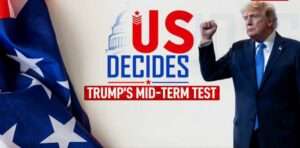
The prospect of US President Donald Trump’s Republican Party losing control of Congress in the ongoing midterm elections is increasingly becoming a serious political possibility. While the outcome remains to be seen, a Democratic takeover of either or both chambers could significantly constrain Trump’s political manoeuvrability. For India, however, the question is not whether Trump suffers a domestic political setback, but whether such a setback translates into consequences for New Delhi’s strategic and economic interests. The answer is nuanced: Bharat may have little to fear immediately, but it cannot afford to be complacent.
A Republican defeat would undoubtedly weaken Trump’s political authority and embolden Democrats to challenge some of his more contentious policies. Yet, it would be premature to assume that a change in congressional arithmetic would automatically reverse the administration’s decisions on tariffs, immigration or foreign policy. The President retains considerable executive authority, including powers over trade measures, immigration enforcement and foreign affairs. Nor can Congress dismantle overnight policies already implemented or agreements already concluded. A divided government could make policymaking more contentious, but it would not necessarily make it more India-friendly.
Trade is perhaps the most immediate area of concern. Trump’s tariff-driven approach has injected considerable uncertainty into global commerce, with Bhartiya exporters in textiles, chemicals and engineering goods particularly vulnerable to sudden policy shifts. A Democratic-controlled Congress could subject aggressive trade measures and bilateral negotiations to greater scrutiny, especially on labour standards, environmental safeguards and digital trade regulations. This could restrain some of Trump’s more arbitrary impulses and offer temporary relief to Bharatiya exporters. Companies such as Bharat Forge and Gokaldas Exports could benefit from improved market sentiment if tariff threats ease. But Bharat should not mistake congressional resistance to Trump for an American embrace of free trade. Protectionism has increasingly acquired bipartisan support in Washington. The flag may change hands, but the instinct to protect American industry is unlikely to disappear.
Immigration presents another sensitive challenge. The H-1B visa programme remains crucial to Indian technology professionals and IT services companies. A Democratic-controlled Congress could intensify scrutiny of high-skilled worker programmes, although immigration policy is shaped by executive action, federal regulations and judicial intervention as much as by legislation. Therefore, a Republican setback would not automatically undo restrictions already imposed by the Trump administration. Bharatiya technology companies must prepare for continuing uncertainty rather than bank on a Democratic rescue.
The bigger reassurance lies in the strategic relationship. Defence cooperation, advanced technology, artificial intelligence, semiconductor development and the TRUST framework have evolved beyond the personal equations between individual leaders. There is substantial bipartisan recognition in Washington that Bharat is an indispensable partner in the Indo-Pacific and an important counterweight to China’s expanding influence. A change in congressional leadership could affect funding priorities, committee oversight and the pace of defence and technology-sharing initiatives. But the strategic foundations of the partnership are unlikely to be shaken by an electoral verdict.
There is, nevertheless, a larger geopolitical variable. A weakened Trump administration could face greater congressional resistance to funding overseas military engagements, including operations in West Asia. Depending on how that translates into American policy, the consequences for regional stability, energy supplies and crude oil prices could be considerable. For an energy-import-dependent India, even a temporary disruption in West Asia can have repercussions on inflation, the rupee, fiscal management and economic growth. Conversely, a more restrained American military posture could reduce regional tensions and offer some relief to global energy markets. Much will depend on developments on the ground rather than the political fortunes of one President.
Ultimately, Bharat’s interests should not be held hostage to the electoral fortunes of either the Republicans or Democrats. New Delhi must engage Washington on the strength of enduring national interests, not partisan loyalties or personal chemistry with its occupant of the White House. Trump may lose Congress, but America will not cease to be a consequential partner. Equally, a Democratic victory will not magically transform Washington into a benign trading partner or an unconditional ally.
India must therefore maintain strategic autonomy, diversify its trade and energy partnerships, and negotiate from a position of economic and geopolitical strength. In international relations, governments change, political equations shift and rhetoric comes and goes. National interests, however, endure. That is the reality New Delhi must keep firmly in view.


