Lakshmanrao Upadhyayula
The revered sage Vāmadeva offers this profound hymn to Lord Agni in the majestic Triṣṭubh Chandas, one of the most celebrated metres of the Ṛgveda. In the Vedic vision, Agni is not merely the physical fire kindled upon the sacrificial altar but the eternal divine presence that unites the earthly realm with the celestial world. He is the sacred messenger who carries the prayers, aspirations, and offerings of humanity to the gods while returning their blessings in the form of wisdom, prosperity, health, and spiritual illumination. Through this hymn, the sage reveals that every sacred fire is a visible manifestation of the Supreme Truth, inspiring humanity to live with purity, discipline, and devotion.
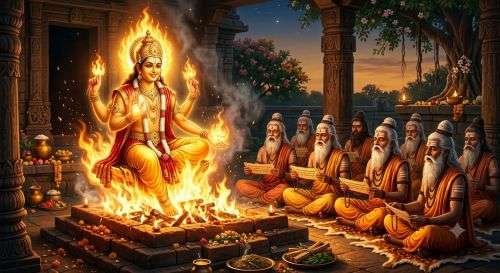
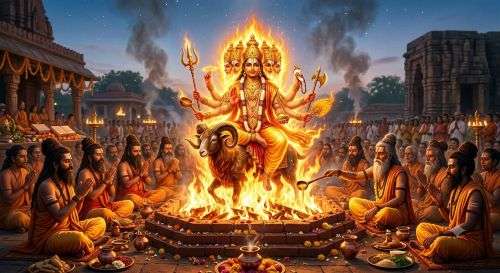
The devoted patron prepares the sacred fire with reverence, using the consecrated wooden ladle to offer clarified butter into the blazing flames. The three daily sacrificial observances at dawn, midday, and dusk symbolize the continuous rhythm of cosmic order and human responsibility. Each offering nourishes Agni, whose radiant flames spread like streams of divine light, dispelling darkness within and without. These sacred rituals are not merely ceremonial acts but profound expressions of harmony between nature, humanity, and the Divine. They awaken noble thoughts, strengthen moral character, and invoke divine protection that keeps hostile forces away from the threshold of prosperity.
The hymn beautifully portrays the collective nature of a Vedic sacrifice. One devotee gathers the sacred fuel, another arranges the holy grass and carefully selects the ritual materials, while another ensures that the sacred fire remains alive throughout the day and night. This division of responsibilities reflects the Vedic understanding that great achievements arise through cooperation, dedication, and selfless service. A household where such sacred discipline flourishes naturally attracts loyal companions, abundant cattle, food, and enduring prosperity. Such a patron becomes strong not merely through material wealth but through righteousness, enabling him to overcome adversaries with ease and earn lasting honour.
Agni is praised as the Lord of immeasurable power, the eternal possessor of nourishment, wealth, vitality, and inexhaustible youthful energy. Though ancient as creation itself, he remains ever young because divine energy never declines. He sustains life through warmth, transforms food into energy, and becomes the invisible force behind growth and renewal. Those who worship him with sincerity receive not only material abundance but also brilliance of intellect, courage in adversity, and a life enriched by noble virtues. His wealth extends beyond possessions to include wisdom, reputation, health, and inner contentment.
With remarkable humility, the sage acknowledges the imperfections inherent in human life. He prays that any sins committed knowingly or unknowingly by those engaged in the sacred service may be completely removed by Agni’s purifying power. The visible and invisible stains of wrongdoing, whether arising through thought, speech, or action, are compared to impurities that can be consumed by the cleansing flames. This prayer reflects the profound Vedic belief that sincere repentance, righteous living, and divine grace together restore moral purity and spiritual balance.
The hymn further recognizes that human beings may have erred not only in relation to fellow beings but also in their duties towards Indra and the other divine powers that govern the universe. The accumulated consequences of such actions should never become obstacles to sacred worship or the pursuit of righteousness. Agni, as the compassionate mediator between humanity and the gods, is invoked to remove these unseen barriers so that every sacrifice may bear its intended fruit. Thus, spiritual progress is presented as a continuous process of self-purification supported by divine compassion.
The sage’s prayer extends beyond his own welfare to embrace future generations. He seeks lasting peace, health, prosperity, and virtuous living for his sons and grandchildren. He prays that they may be protected from the harmful consequences of sin and be blessed with comforts earned through merit rather than mere fortune. Such blessings reflect the Vedic ideal that true inheritance consists not only of wealth but of noble character, wisdom, righteous conduct, and reverence for the Divine. Prosperity is meaningful only when accompanied by ethical living and compassion.
Agni is also remembered as the liberator who released the bound Gaurī cow, an event symbolizing the freeing of light, knowledge, abundance, and divine inspiration from the forces of ignorance. Just as he restored freedom to that sacred being, the devotee implores him to release humanity from the bondage of sin, fear, and spiritual darkness. The symbolism reveals that divine grace liberates both the individual soul and society by removing ignorance and allowing truth to shine unobstructed.
Finally, the sage prays for the blessing of long life under Agni’s compassionate protection. Longevity in the Vedic tradition is valued not merely as the extension of years but as the opportunity to perform righteous deeds, pursue knowledge, serve society, and advance toward spiritual realization. Agni is invoked to strengthen vitality, preserve health, and guide every stage of life with wisdom. The hymn thus emerges as a timeless celebration of purity, cooperation, repentance, prosperity, family welfare, and divine grace.
Viewed through a scientific temperament, the hymn reveals remarkable insights into disciplined living and the observation of natural laws. Fire transforms matter into energy, purifies substances, provides warmth, enables cooking, supports metallurgy, and sustains civilization. The maintenance of a continuously burning sacred fire encouraged careful stewardship of resources, collective responsibility, cleanliness, and regularity in daily life. The three daily rituals established biological and social rhythms that promoted physical health, mental concentration, and communal harmony. The symbolism of Agni also mirrors the inner fire of consciousness, metabolism, and intellectual inquiry, demonstrating that the Vedic seers perceived no contradiction between spiritual wisdom and rational observation. Their vision united the material and the spiritual into a single, harmonious understanding of existence, where every flame became both a scientific reality and a sacred reminder of the eternal light dwelling within all creation.