



The archaeological remains found from Rakhigarhi in Haryana provide an opportunity to understand the status of women in ancient society, cultural traditions, and the development of Indian civilization from a new perspective.
History is not just an account of kings, wars, empires, and political changes. It is also the story of the lives, labors, beliefs, relationships, and cultural contributions of countless men and women who built civilizations. Yet, for a long time, the role of women has been relatively limited in popular history books. They have been presented sometimes as protectors of the family, sometimes as bearers of traditions, and sometimes as silent participants in power struggles, while not enough questions have been raised to understand their true contribution to the formation of society and culture. The archaeological site of Rakhigarhi, located in Hisar district of Haryana, offers an opportunity to reread this incomplete history.
Rakhigarhi is one of the largest known archaeological sites of the Harappan or Indus Valley Civilization. The planned settlement, drainage system, mud and baked brick structures, seals, beads, pottery, artifacts, cemeteries, and human remains discovered here shed light on various aspects of contemporary society. According to the Haryana Archaeological Department, evidence of cultural phases ranging from the Early Harappan to the Advanced Harappan period has been found here. The significance of these discoveries is not limited to understanding ancient town planning or economic life; they also address questions related to women’s social existence, burial rites, jewelry, craft traditions, and cultural identity.
Viewing Rakhigarhi from a woman-centered perspective does not mean declaring that society there was necessarily matriarchal. Its real purpose is to recognize women as independent historical subjects in the study of civilization, and to attempt to understand their lives and contributions through archaeological evidence.
Rakhigarhi: A Civilization’s Memory Preserved in Soil
Rakhigarhi’s identity has steadily expanded with modern archaeological research. Excavations here reveal that the Harappans lived in planned settlements. Residential structures, streets, drainage systems, craft products, and standardized weights and measures point to their technical proficiency and organized social life. Clay toys, beads, seals, metal objects, and various types of jewelry also reveal the artistic tastes and production skills of the time.
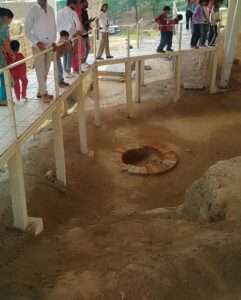
Among these remains, human burials hold special significance because they allow us to question the life and death rituals of those whose individual voices have not survived history. Pottery, jewelry, and other objects found in graves can help us understand the beliefs, social practices, and attitudes toward the dead of contemporary communities. However, it would be inappropriate to conclude the social structure of an entire society based on a single object or burial tradition.
The significance of Rakhigarhi lies in this broad perspective. Each archaeological site here opens the door to new questions rather than providing final answers about the past. These questions, which include topics such as the role of women, division of labor, family structure, craft production, and social status, can help make history more inclusive.
Conch shell bangles and the historical presence of women
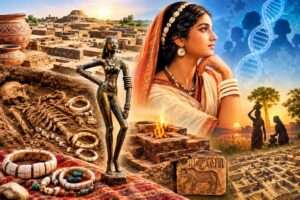
The discovery of shell bangles and other objects along with the human remains of a woman from the Rakhigarhi cemetery is particularly noteworthy. Archaeological accounts mention shell bangles, gold jewelry, and semi-precious stones found with some female skeletons. These discoveries provide important material for studying the use of jewelry and the cultural practices associated with it in contemporary society.
Whether bangles were merely decorative objects or were also associated with marital status, social identity, religious beliefs, or community traditions—this question demands research. Bangles have many cultural meanings in modern Indian society, but those meanings cannot be applied to a society thousands of years old without additional evidence. Similarly, it would not be appropriate to draw direct conclusions about a woman’s social status or rights from the presence of jewelry in a grave.
Yet these remains make one important point clear: ancient women were also part of the material culture of their time, and the objects associated with their lives are now forming the basis for the study of history. Their identities were not limited to those of a king’s wife, a warrior’s mother, or a character in a religious narrative. They were members of communities whose labor, family relationships, and cultural practices shaped civilization.
The aim of a woman-centered interpretation of history is not to interpret archaeological evidence as we see fit, but to seriously raise questions about it. The Rakhigarhi bangles inspire us to consider women’s lives with greater sensitivity and scientific understanding in the interpretation of history.
Women, crafts and cultural life
The arts and crafts traditions of the Harappan civilization reveal its developed cultural consciousness. Bead-making, metalwork, pottery, seal design, and the variety of jewelry reveal the development of a wide range of skills in contemporary society. The extent of women’s participation in these activities, the economic significance of their labor, and whether they were involved in craft production—these are questions that require archaeology, anthropology, and comparative studies to answer.
A historical fact needs to be clarified here. The famous bronze statuette from Mohenjo-daro, commonly known as the “Dancing Girl,” is a celebrated example of the artistic achievements of the Indus Valley Civilization. It would be inaccurate to attribute it to the statuette from Rakhigarhi. Similarly, a female statuette cannot be labeled a dancer, a goddess, or a woman from a specific social class solely on the basis of its appearance. Such interpretations require a comprehensive study of the statue’s composition, archaeological context, and other evidence.
Yet the artistic traditions of the Harappan civilization challenge the notion that studying warfare and political power alone is sufficient to understand ancient societies. Art, craft, aesthetics, objects of daily use, and cultural symbols also shape a civilization’s identity. Studying the potential role of women in these areas can illuminate aspects of history that have received relatively little attention in traditional accounts.
Genetic study of Rakhigarhi and new understanding of India’s past
In 2019, a study published in the prestigious scientific journal Cell brought Rakhigarhi to the center of international scientific discussion. A team of researchers, including Vasant Shinde and his colleagues, attempted to obtain ancient DNA from Harappan human remains. After examining several samples, they succeeded in obtaining genetic information from the remains of a woman. The study found genetic affinities of this woman with populations belonging to ancient Iranian farming communities and with ancestry related to ancient hunter-gatherer communities of South Asia. No genetic component related to steppe pastoralists was detected in her genome.
To understand the significance of this finding, it is necessary to distinguish between scientific evidence and historical interpretation. The study shows that the steppe-related genetic component was not necessarily present in the populations of northwestern South Asia during the Mature Harappan period. This is an important contribution to understanding the genetic structure of ancient populations. However, a genetic study of a single individual cannot draw conclusions about the population of the entire Harappan civilization, its language, religious beliefs, or overall cultural identity.
Similarly, this study does not, in itself, provide conclusive answers to all the historical debates concerning the Aryan invasion or Aryan migration. Genetic research, archaeology, linguistics, and literary sources address different questions. A combined study of all this evidence is essential to understand the process of arrival of various populations, their interactions, and cultural change in the Indian subcontinent.
Therefore, the Rakhigarhi DNA study should be viewed not as a confirmation of any single ideological conclusion but as important scientific evidence for understanding the ancient history of Indian populations. Its real achievement is that it has expanded our knowledge of the ancient human history of South Asia and opened new avenues for future research. (To be continued)


