M Radha Madhavi
या देवी सर्वभूतेषु शक्तिरूपेण संस्थिता। नमस्तस्यै नमस्तस्यै नमस्तस्यै नमो नमः॥
\Yā Devī Sarvabhūteṣu Śaktirūpeṇa Saṃsthitā, Namastasyai Namastasyai Namastasyai Namo Namaḥ.\
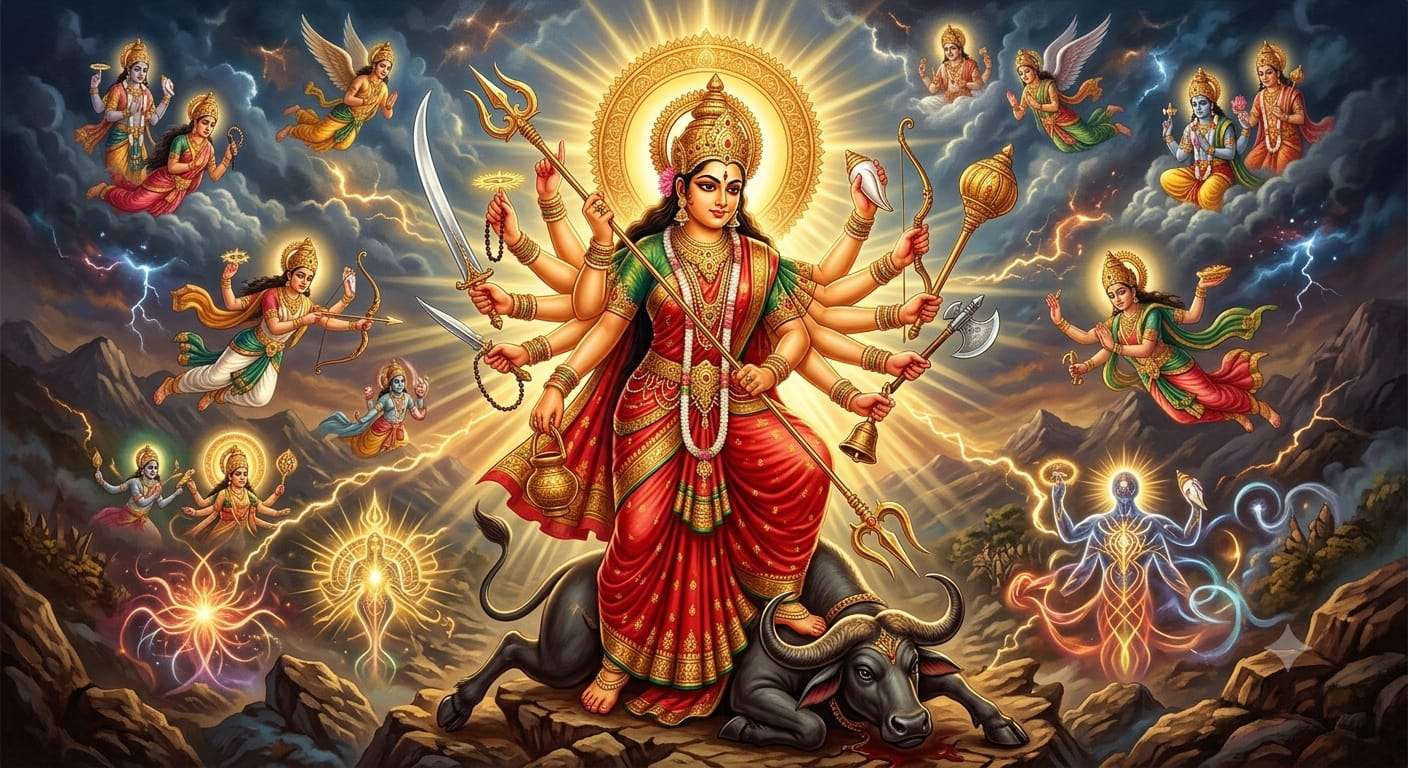
The Divine Mother, who abides in all beings in the form of primordial energy, is worthy of our repeated salutations. This sacred invocation, celebrated in the Devī Māhātmya of the Mārkaṇḍeya Purāṇa, expresses the profound essence of Indian spiritual philosophy: the universe is not merely a physical creation but a living manifestation of divine consciousness, sustained by the immeasurable power of the Supreme Goddess. On the concluding day of the Navarātri celebrations, the worship of Śrī Rājarājeśwarī brings this spiritual understanding to its highest expression, uniting devotion, wisdom, righteous action, family harmony and the ultimate victory of divine order over ignorance and disorder.
This invocation may be understood as a devotional meditation upon the compassionate and protective dimensions of the Divine Feminine, culminating in a prayer to Goddess Durgā to illuminate our intellect and inspire our actions. The familiar Durgā Gāyatrī is commonly recited in the form, “Kātyāyanyai ca vidmahe, Kanyakumāryai ca dhīmahi, tanno Durgiḥ pracodayāt.” Its spiritual purpose is to awaken the devotee to the truth that divine grace is not simply a blessing bestowed from beyond but an inner force that guides human thought, strengthens moral resolve and directs life towards righteousness.
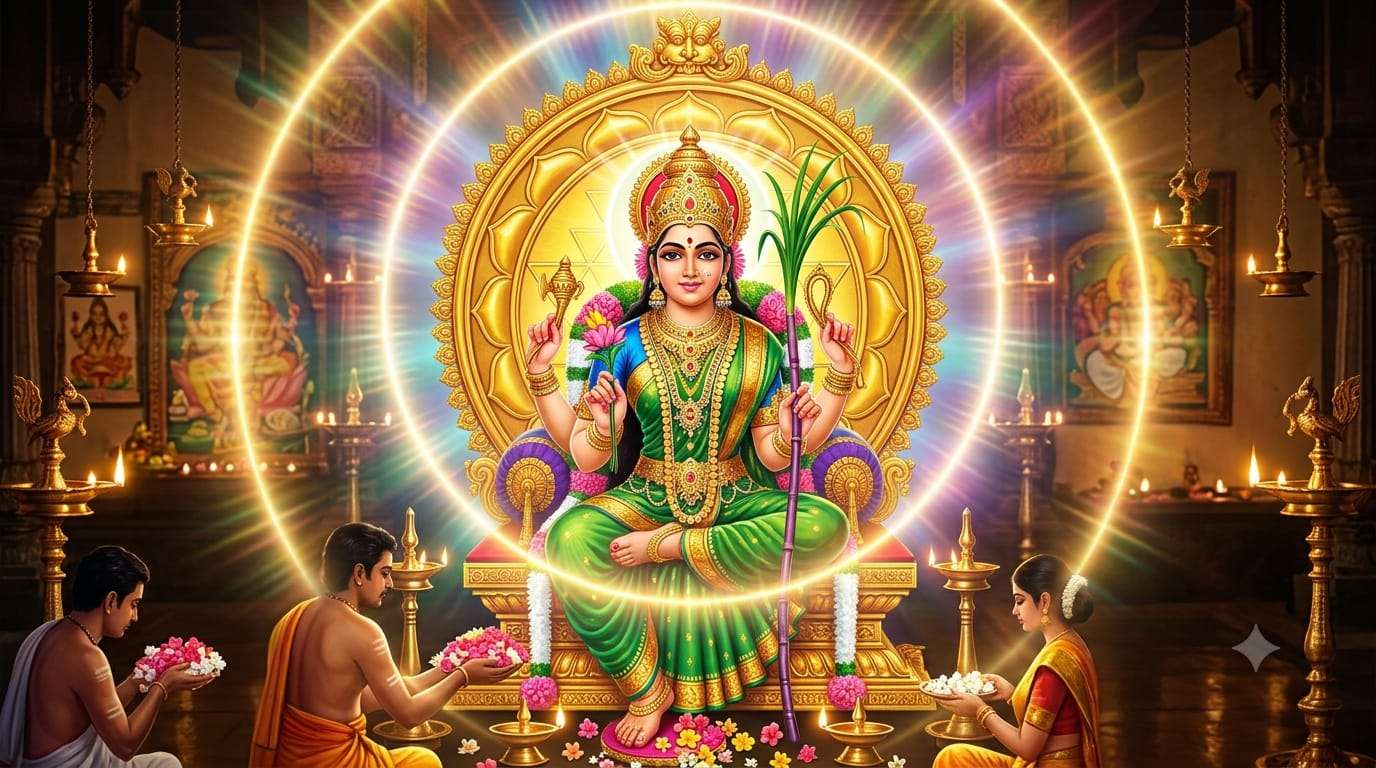
Śrī Rājarājeśwarī, revered as the sovereign Mother of the universe, represents the supreme majesty of Ādi Parāśakti, the primordial consciousness from which creation emerges, through which existence is sustained and into which all manifestations ultimately return. In the Śākta tradition, she is worshipped as Lalitā Tripurasundarī, the beautiful and gracious sovereign who encompasses the totality of existence. Her name signifies the Queen of Kings, yet her sovereignty is not founded upon worldly authority, conquest or material possession. It arises from the eternal principle that consciousness, wisdom, compassion and creative power constitute the deepest foundations of cosmic order. She is the Mother who governs without cruelty, protects without discrimination and transforms without abandoning the essential unity of creation.
The spiritual grandeur of Rājarājeśwarī becomes especially meaningful when understood through the relationship between Śiva and Śakti. Śiva represents pure consciousness, the unchanging witness beyond the movements of existence, while Śakti signifies the dynamic power through which consciousness expresses itself as creation, preservation, transformation and renewal. A celebrated verse of the Saundaryalaharī declares:
शिवः शक्त्या युक्तो यदि भवति शक्तः प्रभवितुं न चेदेवं देवो न खलु कुशलः स्पन्दितुमपि॥
\Śivaḥ śaktyā yukto yadi bhavati śaktaḥ prabhavituṃ, Na cedevaṃ devo na khalu kuśalaḥ spanditum api.\
“When united with Śakti, Śiva becomes capable of creation; otherwise, the Divine is unable even to stir.”
This verse conveys a profound metaphysical insight: existence requires both the principle of consciousness and the power of manifestation. The universe is not sustained by inert existence alone, nor can energy attain its highest purpose without consciousness and direction. Their inseparability becomes the foundation of a philosophy in which spiritual awareness and practical action must complement each other. Rājarājeśwarī embodies this indivisible unity, revealing that true power is not merely the ability to command but the capacity to create, nurture, protect and transform.
The concluding observance of Navarātri, in traditions that dedicate the day to Rājarājeśwarī, also evokes the worship of Aparājitā, the unconquered Goddess whose victory signifies the triumph of dharma over adharma. The name Aparājitā expresses an invincible spiritual principle: truth may be challenged, righteousness may undergo trials, and goodness may appear temporarily weakened, but the enduring force of dharma cannot be permanently extinguished. The Goddess is therefore not merely the destroyer of external enemies. She is the hidden power that enables human beings to conquer their inner adversaries—anger, arrogance, greed, jealousy, fear and ignorance. Such victory is more enduring than military success or political supremacy because it transforms the character of the individual and strengthens the moral foundations of society.
The expression “hidden power of Parameśvara” is particularly significant when interpreted through the philosophical traditions of Śākta worship. Divine power is often hidden not because it is absent but because human perception is limited by the apparent divisions of the world. The seed conceals the tree, the unseen current animates the river, and the invisible laws of nature sustain the visible universe. In a similar manner, Śakti represents the subtle power underlying every movement of life. The Goddess is worshipped as the immeasurable source of this power, and the devotee seeks to recognise its presence within the self, within the family and throughout the universe. This faith does not diminish the mystery of existence; rather, it inspires reverence for the order, interdependence and sacredness of life.
The three fundamental powers associated with the Divine Mother—Icchā Śakti, Kriyā Śakti and Jñāna Śakti—offer an especially illuminating framework for understanding the relationship between spirituality and human development. Icchā Śakti is the power of intention, the capacity to conceive a worthy purpose and aspire towards a higher ideal. Kriyā Śakti is the power of action, through which intention becomes disciplined effort and aspiration acquires practical form. Jñāna Śakti is the power of knowledge and discernment, which enables action to be guided by truth, understanding and wisdom. When these three forces function harmoniously, human potential finds its fullest expression. Knowledge without action remains unfulfilled; action without knowledge can become destructive; and intention without either wisdom or effort remains a mere wish. The worship of Rājarājeśwarī thus becomes a reminder that spiritual advancement requires the integration of thought, purpose and conduct.
This understanding also explains why the Goddess is regarded as the inspirer of intellect and the guardian of the vitality of the mind. In the Indian spiritual imagination, intellect is not merely a tool for acquiring information or securing worldly advantage. Its highest function is viveka—the discrimination between what is enduring and what is transient, what is righteous and what is harmful, and what serves the common good and what merely gratifies personal desire. The mind becomes truly powerful when it is disciplined by wisdom and softened by compassion. Through prayer, meditation, ethical conduct and self-restraint, the devotee seeks to transform mental restlessness into clarity and personal ambition into purposeful endeavour. The blessings of the Divine Mother are therefore understood not only as prosperity or protection but also as the awakening of sound judgement, courage, patience and inner equilibrium.
The association of the concluding day with Suhāsinī Pūjā adds a distinctive cultural and social dimension to this philosophy. In many Śākta traditions, married women are honoured as embodiments of auspiciousness, dignity, continuity and the sustaining force of household life. The term Suhāsinī is associated with the auspicious presence of a married woman, while the worship expresses reverence for the feminine principle that nourishes relationships and preserves the bonds of family and community. Customs differ across regions and lineages, but the underlying spiritual sentiment is one of gratitude towards the women whose affection, labour, wisdom and resilience sustain the domestic world. Properly understood, this observance should not be confined to marital status or outward symbols of auspiciousness. Its deeper ethical meaning lies in respecting women as individuals of inherent dignity, recognising their agency and honouring their indispensable contribution to society.
The family, in the classical Indian understanding, is not simply an arrangement for material survival. It is one of the earliest institutions through which values are transmitted, character is formed, responsibilities are learned and generations remain connected to their cultural inheritance. The household becomes a place of saṃskāra when love is joined with discipline, authority with fairness, tradition with understanding, and prosperity with generosity. Suhāsinī Pūjā symbolically affirms the sanctity of these relationships and the importance of sustaining domestic life without unnecessary conflict or fragmentation. Its blessings may be interpreted as a prayer that family life remain protected from destructive discord and strengthened by mutual respect, patience, fidelity to responsibility and compassionate understanding. Such a family does not merely preserve its own welfare; it becomes a foundation for social harmony and ethical citizenship.
The manifestation of the Goddess through eight celebrated forms further expands the meaning of divine power. In the tradition of the Aṣṭamātṛkās, or Eight Mother Goddesses, the names commonly given are Brāhmī, Māheśvarī, Kaumārī, Vaiṣṇavī, Vārāhī, Indrāṇī, Cāmuṇḍā and Mahālakṣmī. Their precise iconography and associations vary across Purāṇic, Tantric and regional traditions, but together they express the manifold capacities through which the Divine Feminine protects cosmic order. Their worship teaches that the supreme power is one, although its functions appear in many forms. Just as the same light reveals different colours through different conditions, the one divine energy is understood to manifest distinct qualities according to the needs of creation and the demands of dharma.
Brāhmī is associated with Brahmā and evokes the creative intelligence through which order, learning and the possibility of new beginnings emerge. Her symbolic significance lies in the understanding that creation is not mere production but the establishment of meaningful relationships, patterns and purposes. At the level of human life, this creative principle encourages education, thoughtful planning, intellectual discipline and the responsible transmission of knowledge. A society that honours Brāhmī recognises that its future depends not only upon material resources but also upon the cultivation of wisdom and the ability to nurture new generations with sound values.
Māheśvarī, associated with Mahādeva, represents the majestic and transformative dimension of Śakti. Her symbolism evokes spiritual authority, inner strength, detachment and the courage required to confront destructive tendencies. Transformation is essential because no individual or society can remain healthy by clinging indefinitely to every inherited practice, habit or assumption. The wisdom of transformation lies in preserving what is valuable while overcoming what has become harmful. Māheśvarī therefore reminds the devotee that true strength must be accompanied by self-control and that authority acquires legitimacy when it serves righteousness rather than personal vanity.
Kaumārī, associated with Kumāra or Skanda, signifies youthful courage, discipline, readiness and the capacity to defend what is worthy of protection. Her spiritual message is particularly relevant to the formation of character among the young. Courage is not simply the absence of fear; it is the willingness to act responsibly despite uncertainty. Discipline is not merely obedience imposed from outside; it is the cultivation of self-mastery from within. Through Kaumārī, the Goddess is understood to inspire the strength of character needed to protect the vulnerable, uphold justice and face life’s challenges without surrendering to despair or recklessness.
Vaiṣṇavī, associated with Lord Viṣṇu, represents the sustaining and preserving power that maintains harmony within the created world. Preservation, in this sense, is an active responsibility rather than passive resistance to change. Families, institutions and civilisations endure when their foundations are protected, their injustices corrected and their values renewed in response to changing circumstances. Vaiṣṇavī symbolises the balance between continuity and adaptation, teaching that the preservation of dharma requires vigilance, compassion and an unwavering commitment to the welfare of all beings. Her presence reminds humanity that whatever is created must also be nurtured if it is to flourish.
Vārāhī, associated with the boar incarnation of Viṣṇu, evokes the power to recover what has been submerged, restore what has been endangered and re-establish stability when disorder threatens the foundations of life. The symbolism of raising the Earth from the cosmic waters is especially profound: even when hope appears buried beneath confusion or adversity, the possibility of restoration remains. Vārāhī consequently represents practical courage, resilience and the determination to confront difficult realities. Her spiritual lesson is that genuine protection sometimes demands decisive intervention, particularly when the innocent, the vulnerable or the foundations of justice are under threat.
Indrāṇī, also known in many traditions as Aindrī, is associated with Indra and signifies sovereign vitality, alertness, splendour and the capacity to exercise responsibility amid challenge. Her symbolism should not be reduced to domination or the assertion of rank. Rather, it invites reflection upon the ethical obligations accompanying authority. Leadership is worthy of respect when it protects the community, listens to reason, recognises its limitations and remains accountable for its decisions. Indrāṇī thus represents the disciplined use of influence and the understanding that prestige without responsibility is hollow, whereas authority guided by justice becomes a means of collective welfare.
Cāmuṇḍā embodies the fierce and uncompromising power through which destructive forces are confronted and overcome. Her formidable imagery, prominent in Goddess traditions, expresses the refusal to tolerate the unchecked growth of evil, arrogance and delusion. At the inner level, she signifies the difficult but necessary work of confronting the darker tendencies within oneself. Spiritual progress cannot be achieved by pretending that anger, selfishness or cruelty do not exist. It requires honest recognition, disciplined restraint and the courage to transform destructive impulses. Cāmuṇḍā’s fierce aspect therefore complements the Mother’s compassionate aspect: compassion protects life, while righteous firmness prevents that life from being consumed by disorder.
Mahālakṣmī represents auspiciousness, abundance, dignity, beauty and the prosperity that enables life to flourish. Her blessings encompass material well-being, but their highest significance extends beyond the accumulation of wealth. Prosperity becomes truly auspicious when it is accompanied by integrity, generosity, social responsibility and respect for the dignity of others. Wealth without wisdom can nourish arrogance; abundance without compassion can deepen inequality; and success without ethical restraint can undermine the very society that makes prosperity possible. Mahālakṣmī consequently teaches that material well-being and spiritual maturity should reinforce rather than contradict one another.
Taken together, these eight manifestations present a comprehensive vision of life. Creation requires intelligence; transformation requires strength; progress requires courage; continuity requires preservation; restoration requires resilience; leadership requires responsibility; justice requires firmness; and prosperity requires ethical purpose. The eight forms are not merely a catalogue of divine names but a symbolic articulation of the diverse capacities necessary for the maintenance of a balanced world. Their unity expresses an important principle of Indian philosophy: multiplicity need not imply division, and diversity need not destroy harmony. Distinct functions can contribute to one integrated purpose when they are governed by a shared commitment to dharma.
The cultural significance of this worship extends across centuries through temple traditions, household rituals, regional festivals, sacred recitations, music, dance, sculpture and the transmission of stories from one generation to another. The worship of the Goddess assumes different forms in different parts of India. In the eastern regions, Durgā Pūjā gives powerful public expression to the victory of the Divine Mother; in many northern and western communities, Navarātri combines fasting, recitation and communal celebration; in southern traditions, the observance may include Golu or Bommala Koluvu, devotional music, the honouring of women and the worship of Lalitā or other forms of the Goddess. These practices differ in emphasis and ritual detail, yet they share a reverence for the feminine divine as a source of strength, auspiciousness and protection. Their continuity demonstrates how ancient faith remains alive not merely through written texts but through collective memory, artistic expression and everyday acts of devotion.
The endurance of these traditions can also be understood through the relationship between faith and social experience. Civilisations preserve rituals because rituals give visible form to values that might otherwise remain abstract. The lighting of a lamp makes the idea of illumination tangible; the offering of flowers expresses reverence through a physical gesture; the recitation of a sacred verse brings the mind repeatedly back to a moral and spiritual ideal; and the gathering of families and communities reinforces bonds of belonging. Such practices become meaningful when their external forms are accompanied by inward understanding. Ritual without ethical conduct risks becoming mechanical, while ethical ideals without cultural nourishment can lose their connection to communal memory. The living strength of Hindu tradition lies in its capacity to unite symbolic worship with philosophical reflection, personal discipline and social responsibility.
A further dimension of the worship of Rājarājeśwarī is its universal vision. Although the Goddess is approached through the sacred language, iconography and traditions of Hinduism, the qualities she represents—wisdom, courage, compassion, justice, creative energy and the protection of life—speak to concerns shared by humanity. The cosmic Mother is understood as the source of existence, not merely the patroness of one individual or household. This expansive vision encourages the devotee to move beyond narrow self-interest and recognise the interconnectedness of all beings. The blessing of the Goddess, in this sense, is fulfilled when devotion produces greater kindness, when knowledge leads to humility, when strength serves protection rather than oppression, and when prosperity contributes to the welfare of the wider community.
The concluding day of celebration therefore carries a significance that reaches beyond ceremonial completion. It invites the devotee to carry the spirit of Navarātri into the ordinary circumstances of life. The victory of the Goddess must become the victory of clarity over confusion, restraint over impulsiveness, courage over fear, generosity over greed and mutual respect over hostility. The worship of Suhāsinīs must become a sustained commitment to the dignity and well-being of women. The contemplation of the Aṣṭamātṛkās must inspire the balanced cultivation of intelligence, discipline, leadership, resilience and compassion. The recognition of Icchā, Kriyā and Jñāna Śakti must encourage individuals to unite worthy intentions with informed decisions and responsible action. In this way, the sacred festival becomes a continuing process of inner renewal rather than an observance confined to particular days.
The ultimate message of Śrī Rājarājeśwarī is that the universe is sustained by a profound unity whose expressions are innumerable. The Divine Mother is at once gentle and formidable, nurturing and transformative, immanent in the smallest act of care and transcendent in the vastness of cosmic existence. Her victory is not simply the defeat of an adversary; it is the restoration of balance. Her blessing is not merely the fulfilment of a desire; it is the awakening of the wisdom to desire what is worthy. Her sovereignty is not an invitation to domination; it is a reminder that the highest authority is inseparable from responsibility. And her motherhood is not restricted by geography, lineage or worldly distinction; it symbolises the sustaining principle through which life is cherished and existence is made meaningful.
या देवी सर्वभूतेषु मातृरूपेण संस्थिता। नमस्तस्यै नमस्तस्यै नमस्तस्यै नमो नमः॥
\Yā Devī Sarvabhūteṣu Mātṛrūpeṇa Saṃsthitā, Namastasyai Namastasyai Namastasyai Namo Namaḥ.\
Salutations to the Divine Mother who abides in all beings in the form of motherhood. May Śrī Rājarājeśwarī, the eternal embodiment of Ādi Parāśakti, illuminate our intellect, strengthen our righteous intentions, purify our actions and preserve harmony within our families and communities. May the blessings of Aparājitā inspire us to overcome the weaknesses within ourselves; may the wisdom of the eight Mother Goddesses guide humanity towards balanced and responsible living; and may the threefold power of intention, action and knowledge awaken the noblest capacities of the human spirit. May the victory celebrated through Navarātri become a victory of peace over discord, truth over falsehood, compassion over cruelty and dharma over adharma. Above all, may the grace of the Divine Mother sustain the welfare of the universe and remind every generation that the highest expression of faith is a life guided by wisdom, dignity, service and universal goodwill.