



(Continued…) The declassification of the Henderson Brooks Report will provide a balanced perspective of politico-bureaucratic strategic bankruptcy and phenomenal military strategic and tactical bungling at all levels. Neville Maxwell placed the “Henderson Brooks Report” on his website long ago. It provides deep insights into the failures of political and military leadership and helps shape current and future policies and strategies. From the failures of the past, successive Gen-Z generations can learn many critical lessons for posterity.
The Nehru-Menon duo is directly responsible and accountable for the most ignominious “Himalayan Blunder” or “Himalayan Humiliation”. Rahul Ghandy-led I.N.D.I.A. alliance cannot cry “foul” over its declassification!
Real Experiences of the 1962 War
Having served as a company commander in Mechuka with the 2nd Battalion, the Madras Regiment, in the Siang Frontier Division (mentioned in Part I of General Henderson Brooks’s Report), and having survived as the “Rear Guard Commander” tasked with covering the withdrawal of the 2/8 Gorkha Rifles Battalion, I strongly believe that Gen-Z must be told the truth about the developments and events surrounding the humiliating debacle of 1962.
Never in my life can I forget Nehru’s bombastic announcement before departing for Colombo: “Throw the Chinese out!” I heard it on my Japanese transistor radio on October 12, 1962. Throw the Chinese out with what? With vintage November 1895 .303 Lee-Enfield rifles against the Chinese People’s Liberation Army’s shock-wave mass assaults?
I was shocked and surprised by Nehru’s total ignorance of military affairs and his lack of knowledge of how battles are waged at the ground level. It was most quixotic to conduct artillery fire support based on “blank, non-surveyed quarter-inch maps”, a situation that continued until well into the mid-1960s. When I was inducted in July 1961, all I could see was a quarter-inch map with its upper half towards the McMahon Line blank, the line itself marked by a thick line representing almost a mile in space.
Troops were poorly equipped and clothed. They had to carry heavy Wireless Sets 62, powered by 12-volt batteries, with no recharging facilities during withdrawal. They lacked lightweight winter clothing, snow boots, blankets and canvas backpacks. Consequently, troops died while struggling to negotiate snow-covered, high-altitude mountains, including Lieutenant Colonel D. Taylor of the 2/8 Gorkha Rifles, his Adjutant, and others in Mechuka. Those who withstood the rigours suffered from frostbite.
Ill-Conceived Grand Strategy and Higher Direction of War: Henderson Brooks Report
Let me highlight important features of the Henderson Brooks Report. At the political level, it clearly exposes Nehru’s despotic-cum-autocratic leadership style. Nehru’s defence policy after Independence in 1947 was ill-conceived. His stated defence policy was reportedly: “Rubbish, total rubbish. We don’t need a defence plan. Our policy is non-violence. We foresee no military threats. Scrap the Army. The police are good enough to meet our security needs.”
Importantly, Nehru was ignorant of military affairs, lacked depth of military knowledge and experience to wage wars, and had no clue about either the higher direction of war or military strategy and tactics. There was no overall national aim or defined end objective for war. There was no clear-cut political end objective for the border confrontation with China. He never balanced ends and means, and there was no forethought or planning to modernise the armed forces, provide winter clothing, or ensure adequate ammunition and fuel. Consequently, the forces faced a whole host of logistical problems.
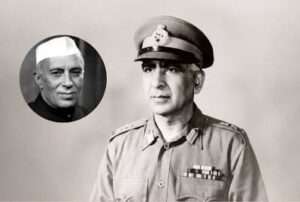
“No loss of an inch of territory” and “Throw the Chinese out” became the higher strategic direction, if not an obsession.
In retrospect, Nehru’s foreign and defence policies reflect rank politico-strategic bankruptcy. How could the Army hierarchy evolve any worthwhile military strategy based on “No loss of an inch of territory”? Political decision-makers need to review the direction of “No loss of an inch of territory” to allow operational flexibility and freedom of action, and specify a clear grand strategy with defined end objectives.
Less publicised is General Thimayya’s resignation in protest to Prime Minister Nehru after Defence Minister Krishna Menon refused to consider his plans for preparing the Army for the forthcoming Sino-Indian conflict of 1962. The full story of this episode is still shrouded in mystery.
By the criterion of seizing opportunities as the hallmark of great statesmanship, Nehru failed dismally. Had Nehru accepted Zhou Enlai’s “quid pro quo” proposal for resolving the border dispute—recognising China’s claims to Aksai Chin in return for recognition of the McMahon Line in 1960—the entire scenario might have been different today. Even the 45 crore “Andh Bhakts” of Nehru, mostly illiterate and blind followers of Nehru, would have accepted it. Such an agreement could possibly have pre-empted the China-Pakistan strategic alliance that exists today.
Intelligence Failure
Next, the Henderson Brooks Report clearly apportions blame for intelligence failure. Until the induction of forces into Ladakh and NEFA in the aftermath of the Longju incident in late 1959, B. N. Mullick, Director of the Intelligence Bureau, was the repository of intelligence for everyone else. Nehru’s view that “China will not be provoked into a showdown” was reinforced by Mullick’s assessment that “China would not militarily respond to the Forward Policy”, which Nehru accepted as gospel truth.
Even the military intelligence assessment during 1959–60 estimated Chinese capability at one regiment or brigade, with some tanks, opposite Ladakh. This was later reassessed as one division or more by October 1960. Similarly, the intelligence assessment in late 1959 estimated one division against Sikkim and three regiments against NEFA. In 1960, this was revised to three divisions, with the bulk deployed against Tawang.
Crisis in Higher Command
Under Nehru’s egocentric political leadership, there was a phenomenal “Crisis in Higher Command”. Nehru held generals in disdain and dismissed outright any intelligence that did not fit his opinion. The Chief of Army Staff (COAS) and the Eastern Army Commander were mere figureheads. Battlefield confusion was real, with orders to withdraw subsequently retracted. Generals in Delhi were commanding platoon-sized posts and issuing orders that countermanded those of intervening headquarters.
The Henderson Brooks Report provides a scathing indictment of General B. M. Kaul, a Nehru crony and an Army Supply Corps officer woefully ill-equipped, both tactically and strategically, to wage war. Kaul first served as Chief of the General Staff at Army Headquarters and later became the ill-fated commander of IV Corps.
General Kaul wanted to prove that he had the mettle to implement the political directive to “throw the Chinese out”. He moved with a skeletal staff and raised the ill-fated Corps Headquarters overnight. Kaul then took a piggyback ride on a Khampa porter to the battle scene at Dhola Pass and fled from the scene, citing sickness, to Delhi, where he conducted the battle from his sickbed. Height of cowardice!
Three-Tiered Military Strategy
The three-tiered military strategy included deployment in isolated, platoon-sized border posts along the watershed; bases in depth forming the second tier; and the defensive line extending through Tawang–Bomdila–Ziro–Daporijo–Along–Roing–Tezu–Lohitpur–Hayuliang.
No troops were available to occupy defensive positions around the bases, and no positions had been prepared along the third-tier defensive line to wage the battle of “defence boxes”, based on the classical style of the Battles of Imphal or Kohima. This represented woeful military operational unpreparedness!
Before the Forward Policy was introduced, 50 Assam Rifles platoons were deployed at 36 outposts to perform a “flag-bearing” role. In June–July 1962, Operation Leghorn was launched, and 42 platoon-sized posts were deployed along the McMahon Line. They were tasked with defending the approaches to the passes “to the last man and the last round”. There was no artillery or air support. Logistical sustenance was a nightmare.
Surely, military strategy must exploit terrain features. Training for high-altitude warfare and logistical support must be maintained at efficient levels. Troops who moved from the plains had no time to acclimatise and were unprepared to fight battles at high altitudes. They were not physically conditioned to sustain marches of 20 miles (32 kilometres) per day for seven consecutive days while remaining totally self-reliant, à la General Wingate’s Chindits of the Burma campaign.
Why were the Indian Air Force and the Indian Navy, including aircraft operating from INS Vikrant, not employed to counter the Chinese offensive, particularly in NEFA? No wonder, military strategy was doomed to disaster from its original conception because of a woeful lack of capability and will.
Need for Declassification of the Henderson Brooks Report
Today, the details of Operation Sindoor are trumpeted, with little public discussion of several key issues and their implications. Why not declassify the Henderson Brooks Report on India’s 1962 war with China so that past shortcomings and fiascos are not repeated today or by future generations, whether at the level of grand strategy and higher political direction or in military strategy, operational art, doctrines and tactical concepts? It should lay out the strategic roadmap ahead for resolving the border dispute with China on a quid pro quo basis.
In the United States, historical records are generally declassified when they reach 25 years of age, unless an agency formally requests an exemption to extend protection to 50 or 75 years. Surely, many important lessons can be drawn from the Henderson Brooks Report to guide political leaders, policymakers and generals in reviewing and determining appropriate policies and strategies.
In sum, Nehru committed Himalayan blunders because of his flawed understanding of the hawkish nature of geopolitics, ill-conceived historical and geographical strategic views and assumptions, lack of strategic foresight and far-sightedness, and total lack of understanding of warfare.
There is no point in Rahul Ghandy and the I.N.D.I.A. alliance indulging in chest-beating over the loss of Aksai Chin and the Shaksgam Valley, which Pakistan ceded to China in 1963. The Shaksgam Valley covers 5,180 sq km. Both territories remain under Chinese control. Recently, Pakistan and China signed an agreement through the Pakistan-China Boundary Joint Commission, which Pakistan described as a “significant milestone” that would deepen cooperation in border management, trade and connectivity.
Undeniably, Modi and the NDA are caught in a politico-diplomatic-military impasse over resolving the border dispute. Zhou Enlai’s “quid pro quo” proposal and Deng Xiaoping’s “Package Proposal”, reportedly advanced to India between 1979 and 1982, offered India its best opportunities for a settlement. However, these opportunities were squandered because of rigid diplomatic postures.
China may still be diplomatically persuaded to reoffer the “Quid Pro Quo/Package Proposal”, providing Modi with another opportunity to exercise his political will. Of course, rival opposition political leaders, supported by partisan media, would spin, stir and spiral the emotions and sentiments of 145 crore people to throw the Modi-led BJP out of power.
Surely, “We, the People” of India will understand the nuances of the border dispute and support Modi’s decision. (Concluded)

