“पश्यैतां पाण्डुपुत्राणामाचार्य महतीं चमूम्।
व्यूढां द्रुपदपुत्रेण तव शिष्येण धीमता॥”
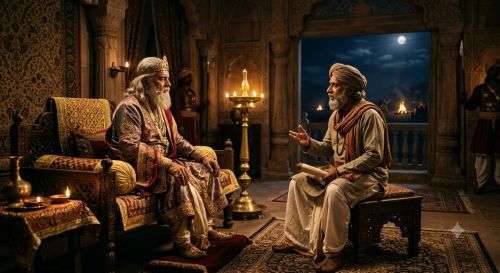
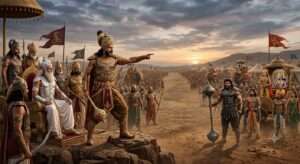
Duryodhana’s words to Dronacharya at the threshold of the great war reveal far more than a simple description of the Pandava army. Standing before the vast battlefield of Kurukshetra, he draws his teacher’s attention to the formidable military formation arranged by the Pandavas. He says, in essence: “O Acharya, behold this mighty army of the sons of Pandu, carefully arrayed before us. It has been strategically organised by your intelligent disciple, the son of Drupada.” The words appear to be merely an observation, yet beneath them lies a complex movement of thought, anxiety and political calculation.
The Pandava army was not merely large in number; its strength lay in its disciplined organisation and the strategic intelligence with which its forces had been deployed. At its head stood Dhrishtadyumna, born to King Drupada with a destiny associated with the destruction of Dronacharya. Yet circumstances had brought this very prince into Drona’s tutelage. Thus, the battlefield presents an extraordinary irony of history: the teacher who had imparted the science of warfare to the son of his own adversary now finds that knowledge being employed against the Kaurava forces under the command of that very disciple.
Duryodhana deliberately reminds Dronacharya of this fact. He does not simply say that Dhrishtadyumna has arranged the army; he calls him tava shishyena—“your disciple.” This expression carries a subtle psychological force. Duryodhana knows the relationship between teacher and disciple, and he also knows the history between Drona and Drupada. By recalling that the Pandava commander is Drona’s own pupil, he attempts to awaken in his teacher a sense of urgency and perhaps even emotional discomfort. The statement therefore becomes more than military commentary; it is a calculated appeal to Drona’s consciousness.
The reference to Dhrishtadyumna’s intelligence is equally significant. Duryodhana recognises that the Pandavas have not entrusted their army to an incapable or accidental commander. Dhrishtadyumna possesses the training, knowledge and authority required to arrange a formidable military formation. His appointment demonstrates that the Pandavas have consciously placed strategic responsibility in the hands of one whom they believe capable of understanding the complexities of war. The arrangement itself therefore becomes a message: the Pandavas have entered the conflict with preparation, discipline and confidence.
From an Ithihasic perspective, this moment is filled with irony. Knowledge is rarely confined to the intentions of the person who imparts it. A teacher gives the science; destiny determines where that science will ultimately be employed. Drona may have trained Dhrishtadyumna in the principles of warfare, but he could not control the circumstances in which those principles would later be used. The Mahabharata repeatedly demonstrates this unsettling truth—that human beings may educate others, build institutions, establish relationships and make choices, only to discover that the consequences of those actions move beyond their original intentions.
Duryodhana’s anxiety is therefore understandable, even though his manner of expressing it reveals his inner agitation. He is standing before an army that includes warriors of extraordinary ability, and he knows that the battle will not be decided merely by numbers. Strategy, discipline, leadership, courage and psychological endurance will determine the course of events. By directing Drona’s attention toward the Pandava formation, Duryodhana is attempting to make his teacher fully conscious of the seriousness of the situation.
There is also a revealing contradiction in Duryodhana’s behaviour. Dronacharya, being one of the greatest masters of military science, does not require instruction from his student in recognising the strengths of an opposing formation. Yet Duryodhana continues to explain what Drona can already see. This suggests that he is no longer speaking merely as a commander reporting facts; he is speaking as a man attempting to manage his own anxiety. His words become a means through which he tries to strengthen the resolve of another because his own mind is unsettled by what he sees.
The deeper lesson is that perception changes under the pressure of fear. A calm mind observes; an anxious mind interprets every circumstance as a warning. Duryodhana sees the Pandava formation, but he also sees the possibility of danger behind it. His description therefore contains both fact and apprehension. The army is indeed formidable, and its commander is indeed Drona’s disciple, but the intensity with which Duryodhana presents these facts reveals the psychological state of the speaker more clearly than the actual condition of the battlefield.
The Gita begins its philosophical journey in this atmosphere of outward preparation and inward disturbance. Before Krishna speaks of the eternal Self, detached action and the nature of Dharma, the narrative first shows human beings overwhelmed by the consequences of their own choices. The battlefield becomes not merely a place where armies confront one another, but a mirror in which the minds of the principal characters are revealed. Duryodhana’s words are among the earliest indications that the greatest conflict of Kurukshetra is not simply between two armies—it is also between clarity and anxiety, duty and attachment, wisdom and the restless calculations of the mind.
Thus, Duryodhana’s address to Dronacharya carries a significance much deeper than its literal meaning. He points toward the Pandava army, but unconsciously exposes his own state of mind. He speaks about Dhrishtadyumna’s strategic ability, yet reveals his concern about the consequences of the knowledge Drona himself imparted. He describes an enemy formation, yet simultaneously reveals the psychological formation within himself. In this way, the Mahabharata transforms a military observation into an enduring study of human nature: when the decisive moment arrives, the external battlefield merely reflects the battle already taking place within the heart.