
Duryodhana’s First Sign of Anxiety
दृष्ट्वा तु पाण्डवानीकं व्यूढं दुर्योधनस्तदा।
आचार्यमुपसंगम्य राजा वचनमब्रवीत्॥
Sanjaya continued his narration to King Dhritarashtra: Having assembled at Kurukshetra, the armies of the Pandavas and the Kauravas stood ready for the great confrontation. Each side had carefully arranged its warriors according to its military strategy. The battlefield had become a vast theatre of human destiny, where not merely two armies, but two opposing visions of duty, justice, power and righteousness were about to confront one another.
At that moment, Duryodhana, the king of the Kauravas, surveyed the carefully organised forces of the Pandavas. What he saw before him was not simply an army; he saw a formidable arrangement of warriors, commanders and allies prepared for battle. Instead of remaining composed in his position as king and commander, he immediately approached his preceptor, Dronacharya, and began speaking to him. This movement itself becomes an important psychological indication in the narrative.
Duryodhana’s approach to Drona is significant when viewed from the larger Ithihasic perspective. Drona was not merely a military teacher; he was the preceptor who had trained both the Kauravas and the Pandavas in the science of warfare. Under ordinary circumstances, a king would summon his teacher or commander to his presence when he wished to discuss military matters. Here, however, Duryodhana himself goes towards Drona after examining the Pandava forces. The movement reveals that the sight before him has disturbed his inner composure.
The opening verse therefore does more than establish the physical arrangement of the armies. It quietly introduces the psychological condition of Duryodhana. His eyes have first encountered the strength and organisation of the opposing army, and his immediate response is to seek the presence of his teacher. The battlefield has not yet witnessed the clash of weapons, but the conflict has already begun within the minds of those who stand upon it.
This is one of the profound features of the Bhagavad Gita. The Itihasa does not begin by describing the destruction caused by weapons. It first reveals the minds of the people who are about to use them. Before an external battle is fought, an internal battle takes place. Confidence, doubt, courage, fear, attachment, and awareness influence human action long before the consequences become visible.
Duryodhana’s conduct can therefore be understood as an illustration of an enduring principle of human psychology: the state of the mind profoundly influences the course of an undertaking. When enthusiasm arises from inner conviction, a person approaches a difficult task with confidence and steadiness. When hesitation enters the mind, even considerable external strength may fail to provide inner security. A person may possess an army, authority, wealth, and resources, yet still experience uncertainty when confronted by a situation that challenges his confidence.
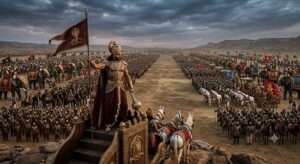
The Pandava army had not yet attacked Duryodhana. Nothing external had occurred to weaken his position. His disturbance arose from what he perceived. This distinction is important. Fear does not always originate from an actual defeat; sometimes it begins with the mind’s interpretation of circumstances. The same situation may inspire courage in one person and apprehension in another. Thus, the Gita’s battlefield is simultaneously a study of human consciousness.
Duryodhana’s approach to Drona also demonstrates another important feature of leadership. A leader’s state of mind can influence everyone around him. Confidence strengthens collective resolve, whereas visible uncertainty can create anxiety among followers. For that reason, mental discipline is as important to leadership as physical resources. The great lesson emerging from the opening of the Gita is that victory or defeat is not determined solely by the number of weapons, warriors or material resources. The quality and steadiness of the mind are equally decisive.
There is also a subtle literary and spiritual observation in the manner in which the verse is presented. In the Bhagavad Gita, whenever a character speaks, the Sanskrit text normally identifies the speaker so that the dialogue remains clear. Yet this particular verse does not explicitly introduce the speaker by name before the words are spoken. The narrative tradition understands the speaker to be Duryodhana from the context: Sanjaya has already described him as the king who saw the Pandava army, approached Drona and began to speak.
Traditional spiritual interpretation sometimes regards this omission as symbolically meaningful. Duryodhana represents the destructive consequences of envy, attachment to power and unrighteousness. In devotional traditions, the sacred Gita is approached with reverence, and the emphasis naturally falls upon the divine teaching that emerges from the battlefield rather than upon glorifying the personality of the antagonist. Such interpretations should be understood as traditional reflections rather than as a grammatical rule governing the Sanskrit text.
The larger Ithihasic lesson is nevertheless unmistakable. The Gita does not portray evil merely as an external force. It shows how destructive tendencies can arise within human beings through attachment, pride, possessiveness and the refusal to recognise righteousness. Duryodhana’s tragedy is therefore deeper than the eventual loss of a kingdom. His inability to restrain destructive impulses places an entire generation of warriors on the path towards catastrophe.
The first movement of the Gita thus begins with a striking contrast. The battlefield is physically prepared, but the decisive conflict has already entered the human mind. Duryodhana sees the Pandava formation and turns towards his teacher; Arjuna, later, will see his own relatives and turn towards Krishna. Both moments arise from what the eyes perceive, but their spiritual consequences are entirely different. One leads towards anxiety and confrontation; the other ultimately opens the way to self-knowledge, duty and liberation.
In this manner, the opening of the Gita establishes a timeless truth: before a human being can overcome an external challenge, the mind must first attain clarity. Courage born of understanding gives strength to action, while action clouded by fear, attachment or confusion can lead even great power towards destruction. The battlefield of Kurukshetra therefore becomes not merely an ancient field of war, but a mirror of the human mind, where every generation can recognise its own struggles between confidence and fear, righteousness and desire, wisdom and delusion.