



There is a point when legitimate concern becomes political habit, and when genuine grievances are repeatedly invoked, they risk becoming little more than a convenient narrative. In Bharat, minorities certainly have the right to complain if they face discrimination. But they also have a corresponding responsibility to acknowledge the enormous political, constitutional and social space they enjoy in the world’s largest democracy.
Tamil Nadu offers an interesting case study.
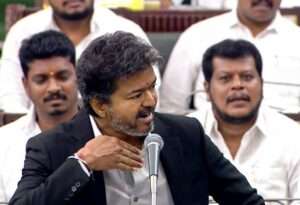
The rise of actor-turned-politician C. Joseph Vijay and the formation of a TVK-led government have once again triggered the familiar debate over representation, minorities and social justice. Yet the facts need to be separated from the noise generated by social-media commentators and self-appointed political experts.
Vijay’s cabinet is not, as some social-media narratives suggest, a government “dominated” by minorities. The officially listed 12-member cabinet is a coalition arrangement, with Vijay retaining several key portfolios and two Congress legislators joining the expanded ministry.
But that itself exposes the larger point.
Why should the representation of minorities in a cabinet automatically be interpreted as evidence of discrimination against the majority? In a democracy, ministers are chosen through electoral politics, political alliances, social equations and the confidence of the elected government. There is nothing inherently sinister about ensuring representation to different sections of society.
The 2011 Census—the latest completed Census religious dataset—puts Tamil Nadu’s Muslim population at around 5.9 per cent and its Christian population at around 6.1 per cent, together accounting for roughly 12 per cent of the State’s population.
A community constituting a significant minority of the population being politically represented is not “appeasement” by definition. Equally, however, minority representation cannot be converted into a perpetual political entitlement or a licence to portray the entire community as permanently persecuted.
That is where the debate in Bharat needs intellectual honesty.
For decades, political parties of different ideological hues have competed for minority votes. In several States, minority communities have emerged as decisive electoral blocs. Political parties have consequently tailored alliances, candidates and policies to accommodate them. That is politics—not proof of an organised conspiracy against the majority.
And if a majority electorate itself votes a particular government into power, it cannot logically blame the government alone for the political consequences of that choice.
The same principle applies to minority voters.
If a government elected through a democratic process provides representation to minorities, minorities cannot simultaneously celebrate that representation as political empowerment and describe the same democratic system as fundamentally hostile to them.
The argument becomes even stronger when one examines the record of the Union government.
The Narendra Modi government has certainly maintained targeted programmes for minority communities. The Ministry of Minority Affairs continues to operate schemes such as PM VIKAS for education, skilling, entrepreneurship and livelihood opportunities, while PM Jan Vikas Karyakram focuses on infrastructure and basic amenities in identified minority-concentration areas. Importantly, the latter’s infrastructure is intended to benefit everyone living in those areas, not merely members of a particular faith.
That is the distinction that is frequently lost in the political shouting match.
The objective should not be to replace minority appeasement with majority appeasement. It should be to replace both with citizen empowerment.
A poor Muslim, a poor Christian, a poor Hindu, a poor Sikh, a poor Buddhist or a poor Jain does not become less deserving of a government benefit because of his or her faith. Nor should poverty become a political commodity that parties distribute selectively to manufacture vote banks.
Bharat’s constitutional promise is not minority privilege or majority privilege. It is equality before the law.
Therefore, the perpetual politics of insecurity needs to end—just as the politics of majoritarian grievance needs to end.
No community should be asked to live permanently as a victim. No community should be permanently treated as a suspect. And no political party should be allowed to convert either sentiment into a vote bank.
The real test is brutally simple: Does the citizen have equal opportunity, equal protection, and equal dignity?
If yes, then Bharat should stop measuring democracy through the number of ministers belonging to one religion or another.
Representation matters. But performance matters more.
The time has come to move from the politics of complaint to the politics of contribution—and from the politics of identity to the politics of citizenship.


