



The Upanishads stand among the most profound explorations of life, consciousness and the ultimate nature of reality in the Vedic tradition. They do not merely prescribe a system of belief; they invite the seeker to inquire, observe, question and ultimately experience. Their central concern is the relationship between the individual self, the universe and the ultimate reality known as Brahman. In this vast philosophical landscape, Adi Shankaracharya brought extraordinary clarity to the vision of Advaita Vedanta. Although the Upanishads do not present Advaita as a neatly formulated philosophical system in the later scholastic sense, Shankaracharya drew upon their profound declarations and revealed their underlying unity with remarkable intellectual precision.
Shankaracharya’s greatness lies not simply in proposing a doctrine, but in transforming difficult metaphysical questions into a disciplined inquiry accessible to the human mind. He entered the immense ocean of the Upanishadic tradition and brought forth what may be compared to precious gems: simple, enduring principles capable of illuminating the deepest uncertainties of human existence. His interpretation of Advaita Vedanta rests upon the recognition that reality, at its ultimate level, is non-dual. The celebrated Upanishadic statement, “Sarvam khalvidam Brahma”—all this indeed is Brahman—expresses the extraordinary breadth of that vision. It does not mean that the empirical world should be denied in a simplistic manner; rather, it asks the seeker to look beyond appearances, distinctions and limited identification and inquire into the underlying unity of existence.
One of the most illuminating dimensions of this philosophy is its attitude towards knowledge. A traditional story associated with Shankaracharya beautifully expresses this principle. During his travels in pursuit of Dharma and teaching, Shankaracharya is said to have stayed in a small village. A villager approached him and asked, “Swami, you are regarded as a universal teacher. How much do you know?” Shankaracharya replied, “I do not know anything.” The villager was immediately struck by remorse and said, “Swami, please excuse me. I have unknowingly committed a mistake.” Shankaracharya asked him to rise and explained, “You have committed no mistake. I spoke the truth.”
The villager, astonished, asked, “If you do not know anything, then what can people like us possibly know?” Shankaracharya’s response captures the essence of intellectual humility: “I know that I do not know; you do not know that you do not know. That is the difference.” Whether understood as a literal historical conversation or as a teaching story preserved to convey a philosophical truth, its significance is profound. True wisdom does not close the doors of inquiry. It keeps them open. The person who recognizes the limits of his knowledge remains capable of learning, whereas the person who assumes that he already knows everything has unknowingly imprisoned his own intellect.
This principle has an interesting correspondence with the scientific temperament. Science progresses not by claiming absolute possession of knowledge, but by recognizing what remains unknown and constructing methods to investigate it. Every discovery opens another question. Every established explanation remains subject to examination when new evidence emerges. In this sense, the Upanishadic spirit of inquiry and the scientific spirit of investigation meet at a fundamental point: both discourage intellectual complacency. Their methods and objectives are not identical, but their respect for questioning, observation, disciplined reasoning and intellectual humility creates an important philosophical parallel.
Advaita Vedanta goes beyond the accumulation of information and beyond ritual action alone. Its fundamental inquiry concerns the nature of the knower himself. If everything ultimately rests in Brahman, how can the apparently separate world of innumerable beings, objects and experiences be understood? Shankaracharya addresses this through the distinction between appearance and ultimate reality, ignorance and knowledge, multiplicity and the underlying unity of existence. The problem is not that human beings perceive differences; distinctions are indispensable for ordinary life. The deeper problem arises when those distinctions are mistaken for the final nature of reality.
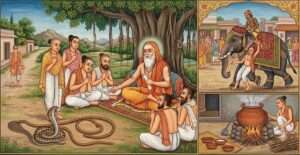
A traditional illustration makes this subtle point accessible. One night, Shankaracharya is said to have awakened a disciple and asked him to accompany him. They walked some distance in darkness when the disciple suddenly cried out, “There is a snake!” Terrified that the snake might attack him, he attempted to flee. Shankaracharya restrained him until another disciple arrived with a lamp. In its light, they discovered that what had appeared to be a snake was actually a rope. The frightened disciple immediately recognized his mistake.
The significance of the story lies not in denying the experience of fear but in examining its cause. In darkness, the mind interpreted an indistinct object according to incomplete information. Illumination revealed the underlying reality. The snake had not been transformed into a rope; the rope had been misunderstood as a snake. In Advaita, this becomes an analogy for ignorance and knowledge. When consciousness is clouded by ignorance, multiplicity and separateness appear to constitute the final reality. When knowledge illuminates perception, the seeker begins to understand the underlying unity. The analogy also has a scientific resonance: an observation made under inadequate conditions can produce an incorrect interpretation, while improved observation can correct the conclusion. The analogy should not be taken to mean that spiritual realization and empirical science are identical; rather, both stories emphasize the importance of examining appearances before accepting them as final truth.
The same philosophical inquiry raises another difficult question. If everything is Brahman, how can there be virtue and wrongdoing, merit and sin, pleasure and suffering? Shankaracharya’s teaching distinguishes between the ultimate level of reality and the empirical level in which human beings act, experience consequences and remain bound by ethical responsibility. A traditional illustration involving fire and water conveys this distinction. When water is poured upon a fire, the flame disappears. When a vessel containing water is placed over a fire, however, the water becomes heated and eventually boils. The fire has not literally become water, nor has the water ceased to be water. The vessel provides the condition through which the heat acts upon the water.
The human body may similarly be understood as the vessel through which actions and their consequences are experienced. As long as embodied existence continues, human beings experience pleasure and pain, virtue and wrongdoing, attraction and aversion, and the consequences of their actions. Advaita does not therefore provide a license to disregard ethical conduct. On the contrary, ethical discipline, self-control and purification of mind are essential preparations for higher knowledge. Liberation, in the classical Advaitic understanding, is not simply the destruction of the physical body; it is freedom from ignorance and from identification with the limited individual self as the ultimate reality.
Another traditional story presents the practical side of non-duality with unusual force. A disciple, deeply absorbed in the idea that everything is Brahman, was walking along a narrow passage when an elephant approached with its mahout. The mahout repeatedly shouted at him to move aside. The disciple, convinced that everything was Brahman, refused to move. The elephant lifted him with its trunk and threw him aside. Injured and bewildered, he returned to his teacher and asked, “If Brahman is one, why did this Brahman discriminate against me?”
The teacher’s answer is memorable: “You heard the mahout, who was also Brahman, telling you to move. Why did you listen only to the elephant and ignore the Brahman speaking through the mahout?” The story reveals an essential distinction. Realizing unity does not mean abandoning practical intelligence. The recognition of non-duality must operate together with discrimination, awareness and appropriate action. In the empirical world, an elephant remains an elephant, a human being remains a human being, and physical laws continue to operate. Wisdom does not require us to deny these distinctions; it requires us to understand their place within a larger vision of reality.
This is where Advaita acquires a remarkable spiritual and rational depth. It is not merely a declaration that everything is one. It is a disciplined pursuit of the question: What is the nature of the “one” behind the many? What is the nature of the consciousness through which the world is experienced? What remains when transient identities, possessions, emotions and concepts are examined and progressively separated from the witnessing awareness? The Upanishads repeatedly direct the seeker inward through inquiry, reflection and realization. Their method is not simply to provide an answer but to transform the person who asks the question.
The famous mahavakyas of the Upanishadic tradition express this realization in concentrated form. “Tat tvam asi” declares, “That thou art.” “Aham Brahmasmi” means, “I am Brahman.” “Prajnanam Brahma” identifies ultimate reality with consciousness, while “Ayam Atma Brahma” declares that this Self is Brahman. These statements are not intended as expressions of individual ego or personal superiority. “Aham Brahmasmi” does not mean that the ordinary personality, with its desires, achievements and limitations, is God in a narcissistic sense. It points instead to the deeper Self beyond the temporary identity constructed by the mind and body.
The scientific temperament can find an intellectually stimulating parallel here, though not an equivalence. Science examines the observable universe through evidence, measurement, experimentation and mathematical reasoning. Vedantic inquiry examines the nature of experience, consciousness and the apparent separation between subject and object through disciplined introspection, reasoning and scriptural reflection. One investigates the external and measurable dimensions of reality; the other asks fundamental questions about consciousness and the nature of the experiencer. The two should neither be artificially merged nor placed in unnecessary opposition. Each belongs to a different mode of inquiry, and the dialogue between them becomes meaningful when their respective methods and limits are clearly understood.
The enduring strength of the Upanishadic vision is therefore its refusal to make ignorance comfortable. It asks the individual to question inherited assumptions, examine appearances, discipline the mind and search for a deeper order beneath the diversity of experience. Shankaracharya’s contribution was to bring these scattered and profound insights into a coherent philosophical framework through Advaita Vedanta. His intellectual achievement was not merely the construction of an abstract theory; it was the demonstration that philosophical reasoning, spiritual discipline and self-knowledge could be brought into a single quest for truth.
The journey from “I do not know” to “I know that I do not know”, from the imagined snake to the recognized rope, from the isolated individual to the recognition of underlying unity, and finally from “Sarvam khalvidam Brahma” to “Aham Brahmasmi,” represents a movement from confusion towards clarity. It is a journey in which knowledge does not inflate the ego but dissolves its unnecessary boundaries. The deeper one enters the inquiry, the less justification there is for arrogance and the greater the responsibility to live with discrimination, compassion and humility.
The Upanishads therefore remain relevant not because they offer easy answers to every modern question, but because they teach the discipline of asking the deepest questions. Their guiding light is inquiry; their instrument is knowledge; their destination is realization. Shankaracharya’s Advaita gives this quest a profound philosophical architecture, while the stories associated with his teaching make its difficult ideas accessible to ordinary human understanding. The ultimate lesson is not merely that everything is one, but that the realization of unity must transform the way one sees, thinks and acts. When knowledge becomes wisdom, wisdom becomes conduct, and conduct becomes a reflection of the unity perceived within existence, the ancient quest of the Upanishads acquires renewed meaning for the modern world.

