


M Radha Madhavi
धर्मक्षेत्रे कुरुक्षेत्रे समवेता युयुत्सवः ।
मामकाः पाण्डवाश्चैव किमकुर्वत सञ्जय ॥
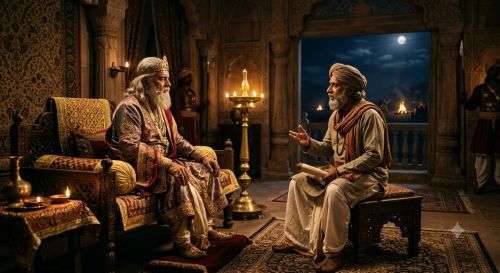
The Bhagavad Gita begins not on the battlefield with a weapon being raised, but with a question. King Dhritarashtra asks Sanjaya what happened when his sons, the Kauravas, and the sons of Pandu, the Pandavas, assembled at Kurukshetra, having come together with the intention of war. The question carries within it the anxiety of a father, the uncertainty of a king and, more profoundly, the inner conflict of a human being who knows that a decisive moment has arrived. “O Sanjaya, what did my sons and the sons of Pandu do after assembling on the sacred field of Kurukshetra?” Thus begins one of the most profound dialogues in the history of human thought.
The word Dharma-kshetra means the field of Dharma, while Kuru-kshetra is the field associated with the Kuru lineage. The field is therefore simultaneously geographical, historical, moral and spiritual. Kurukshetra is a physical place where armies assemble, but in the philosophical vision of the Gita it also becomes the symbolic field of human consciousness. Every human being, at some point, stands upon such a field, confronted by competing duties, desires, attachments, fears and convictions. The battlefield outside becomes a representation of the battlefield within.
Dhritarashtra’s question is particularly significant because he distinguishes between “my sons” and “the sons of Pandu.” The expression reveals attachment even before the great war begins. Though he is the king and therefore expected to look upon the entire kingdom with impartiality, his language exposes the division already present in his mind. The conflict at Kurukshetra did not suddenly arise when the conches were sounded. It had been developing for years through attachment, ambition, injustice, rivalry and the failure to recognise rightful duty.
The Pandavas had repeatedly sought peace, and efforts were made to prevent the destruction that war would inevitably bring. Yet the dispute ultimately moved beyond negotiation and reached Kurukshetra. Dhritarashtra, knowing the destructive consequences of war, could still hope that the sacred character of the place might influence the assembled warriors. His question can therefore be understood at several levels: would they proceed with the intention for which they had gathered, or would the sanctity of the place awaken wisdom and turn them away from destruction?
The answer is revealed through Sanjaya. This itself is one of the remarkable features of the Gita. The sacred teaching is not narrated directly to Dhritarashtra by a priest or a king, but through Sanjaya, the trusted charioteer and counsellor who was entrusted with the extraordinary ability to witness the events taking place at a distance. According to the Mahabharata, Vyasa bestowed upon Sanjaya the divine vision by which he could perceive the events of Kurukshetra and communicate them faithfully to the blind king.
This narrative arrangement has a deeper significance. Sanjaya’s name is traditionally associated with victory and mastery. In the spiritual interpretation, it evokes the person who has gained mastery over himself. The Gita consequently places before us an important principle: spiritual knowledge is not determined by social position, birth or outward status. What matters is the discipline of the seeker, the purity of intention, the capacity for self-restraint and the willingness to understand truth.
The ability to read the Gita, contemplate its meaning and communicate its wisdom is therefore not restricted to any particular social category. The text addresses humanity itself. Its teaching becomes meaningful to the person who approaches it with sincerity, devotion, discrimination and self-discipline. Knowledge may be received through words, but wisdom is realised only when those words are examined within one’s own life.
The word kshetra literally signifies a field or cultivated ground. A field produces according to what is sown and how it is cultivated. This agricultural image becomes an illuminating metaphor for spiritual life. If the right seed is placed in fertile soil and properly nourished, it grows into a healthy plant. Similarly, the human heart is the field in which thoughts, intentions and actions are continuously sown. Anger, greed, hatred and attachment produce one kind of life; compassion, discipline, truthfulness, wisdom and devotion produce another.
Thus Kurukshetra is not merely a battlefield somewhere in the ancient world. It can also be understood as the field of the human heart. Every decision places a seed into that field. Every action strengthens a tendency. Every repeated thought gradually becomes a habit, and habits eventually influence character. The Gita therefore transforms the meaning of the battlefield: the ultimate struggle is not merely between two armies but between opposing tendencies within human consciousness.
The ancient principle, Yato dharmah tato jayah—where Dharma prevails, there is victory—must also be understood carefully. Dharma is not simply victory in a worldly contest, nor does it mean that every person who claims righteousness automatically becomes victorious. Dharma signifies righteous conduct, rightful responsibility and action consistent with truth and moral order. Krishna’s appearance in the epic narrative is connected with the restoration of Dharma, but the restoration of Dharma begins with individuals recognising and performing their rightful duties.
This is why the Gita does not teach escape from responsibility. Krishna does not ask Arjuna to abandon the world because it is difficult. Instead, He leads Arjuna towards clarity regarding action, duty, attachment and the nature of the Self. The central problem is not action itself but action clouded by ignorance, selfish attachment and confusion. When action is performed with understanding, discipline and dedication to Dharma, it becomes a means of inner growth.
The Gita’s message consequently extends beyond the historical circumstances of the Mahabharata. Its characters belong to an ancient epic, but the questions they embody remain universal. What should a person do when duty becomes difficult? How should one act when personal affection conflicts with responsibility? How can action be performed without being imprisoned by its results? What is the nature of the Self? What is the relationship between individual responsibility and universal order? These questions belong not merely to one age but to human existence itself.
The brilliance of the Gita lies in the manner in which an immediate crisis becomes the doorway to eternal knowledge. Arjuna’s confusion is deeply personal, yet Krishna’s response becomes universal. The battlefield becomes a classroom; the warrior becomes a seeker; the charioteer becomes a spiritual teacher; and the conversation between two individuals becomes a dialogue with humanity.
The Gita therefore may be approached not merely as a scripture to be recited, but as a philosophy to be contemplated and a discipline to be lived. Its ultimate concern is the harmonious development of human life—responsibility without bondage, action without selfish attachment, knowledge without arrogance, devotion without narrowness and discipline without rigidity. Its purpose is not to separate spiritual life from ordinary existence but to bring wisdom into the very midst of life.
The opening question of Dhritarashtra thus becomes far more than a request for information about an ancient battle. It opens the door to an examination of human consciousness itself. The real Kurukshetra is wherever duty confronts desire, wherever truth confronts convenience and wherever the individual must choose between the demands of the ego and the call of Dharma.
The eternal relevance of the Gita lies precisely here. Its wisdom is not confined to the battlefield, the palace or the ancient world. It speaks to every person standing upon the field of life, reminding us that the quality of our journey depends upon the seeds we sow in the field of our own heart. When Dharma becomes the foundation of thought and action, life acquires direction, responsibility acquires meaning and spiritual knowledge becomes a living force rather than merely a subject of study.



A very good compilation about the essence of Gita, focussing Kurukshetra.