MS Sparsha
When the world hears the name Mount Everest, it usually remembers Edmund Hillary and Tenzing Norgay, the first confirmed climbers to reach its summit in 1953. Some may also remember Sir George Everest, the British Surveyor General after whom the mountain was eventually named.
But long before human beings stood on its summit, an Indian mathematician had helped establish, through painstaking calculations, that this distant Himalayan giant was the highest known point on Earth.
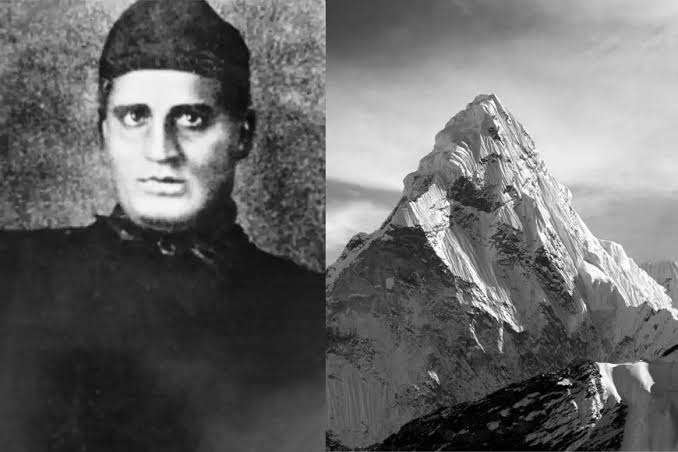
His name was Radhanath Sikdar.
Sikdar was a mathematician, surveyor and geodesist associated with the Great Trigonometrical Survey of India, one of the most ambitious scientific enterprises of the nineteenth century. The Survey sought to measure and map the Indian subcontinent with unprecedented precision. Its work involved enormous chains of triangles, carefully measured baselines, astronomical observations and complex mathematical calculations.
It was within this demanding world of nineteenth-century science that Sikdar made his remarkable contribution.
A Mathematical Prodigy
Born in Bengal in the early nineteenth century, Radhanath Sikdar developed an exceptional aptitude for mathematics. In 1831, he joined the Great Trigonometrical Survey, reportedly at a monthly salary of thirty rupees.
The position he occupied was that of a “Computer”—a term that had nothing to do with machines. In the nineteenth-century Survey, a computer was a highly skilled mathematical specialist responsible for performing and checking complex calculations arising from field observations.
There were no electronic calculators, computers, GPS systems or satellite images. Surveyors and mathematicians worked with instruments, logarithmic tables, astronomical observations and calculations performed by hand.
Sikdar eventually became the Chief Computer of the Survey of India. His responsibilities extended well beyond routine arithmetic. He worked with trigonometry, geodesy, astronomical observations, and the painstaking correction of errors that could affect measurement accuracy.
Senior British officials recognised his mathematical ability. Sir George Everest, who served as Surveyor General of India, reportedly held Sikdar in high regard for his technical competence and understanding of surveying.
The Enigma Called Peak XV
The mountain we now know as Mount Everest was not initially called Everest by the Survey.
It appeared in British survey records as Peak XV.
At the time, Himalayan peaks were being observed from distant locations in the plains and foothills. Determining their elevations was an extraordinarily complicated mathematical exercise.
A surveyor could not simply point an instrument towards a summit and read its height.
The precise locations of observation stations had to be established. Angles to the summit had to be measured from different points. Those observations then had to be combined through mathematical calculations based on trigonometry and geodesy.
And there were numerous sources of possible error.
The curvature of the Earth had to be taken into account. Atmospheric refraction could bend the path of light and alter observed angles. Temperature and air pressure affected observations. Instrumental errors had to be considered. The exact elevations of observation stations had to be established. Even variations associated with gravity and other geodetic factors could influence the final calculation.
This was science conducted under extraordinarily difficult conditions.
Sikdar examined observations of Peak XV obtained from multiple locations and applied the necessary mathematical corrections. Historical accounts commonly refer to observations from six stations, including Jarol, Mirzapur, Janjipati, Ladania, Harpur and Minai.
The calculations indicated something extraordinary: Peak XV was higher than Kangchenjunga, which at that time was widely regarded as the world’s highest mountain.
In 1852, Sikdar is credited with reaching the conclusion that Peak XV was the highest mountain yet measured.
His initial calculation put its elevation at approximately 29,000 feet, or about 8,839 metres.
But the Survey authorities did not rush to announce the finding.
Such a monumental scientific claim required verification.
From Mathematics to History
After further examination of the observations and calculations, the Survey formally announced in 1856 that Peak XV was most probably the highest mountain in the world.
Its official height was given as 29,002 feet, approximately 8,840 metres.
Andrew Scott Waugh, who had succeeded George Everest as Surveyor General, proposed that the mountain be named Mount Everest, in honour of his predecessor.
The naming itself generated debate. George Everest had not personally surveyed Peak XV, and the mountain already possessed names rooted in Himalayan cultures.
In Tibet, the mountain is known as Chomolungma, or Qomolangma, traditionally associated with the meaning “Goddess Mother of the World”. In Nepal, it is called Sagarmatha, generally translated as “goddess of the sky”.
These names are reminders that the mountain was neither nameless nor unknown to the communities living around the Himalayas.
This is why precision matters when describing Sikdar’s achievement.
He did not “discover” Mount Everest in the literal sense. Himalayan communities had known the mountain for centuries. Nor did he climb it.
His achievement was scientific.
He helped establish through mathematical analysis that Peak XV was higher than every other mountain measured at the time.
A Triumph Without a Photograph
Today, determining the height of a mountain may sound relatively straightforward. Satellites, GPS, digital surveying equipment and sophisticated computing systems can perform calculations that would have been unimaginable in Sikdar’s time.
For him, however, every stage involved human observation and painstaking mathematics.
Imagine dealing with thousands of observations and calculations without an electronic calculator, checking figures repeatedly and accounting for the numerous variables that could introduce errors.
Sikdar’s work represented the crucial bridge between field observation and scientific conclusion.
At the same time, it would be unfair to portray the determination of Everest’s height as the work of one individual alone. The Great Trigonometrical Survey was a vast collaborative enterprise involving observers, surveyors, mathematicians and other specialists. Sikdar’s contribution was important within that larger scientific effort, rather than being the sole source of the final result.
That distinction actually makes his achievement more meaningful.
He was one of the highly skilled Indian scientists and mathematical specialists whose work helped sustain one of the world’s great surveying enterprises during the nineteenth century.
Why Sikdar Remained Unseen
There is another dimension to Sikdar’s story.
The mountain ultimately carried the name of a British Surveyor General, while the Indian mathematician whose calculations played a significant role in establishing its extraordinary elevation remained largely unknown to the wider public.
That contrast is striking.
When the world eventually celebrated Everest, attention naturally focused on the dramatic aspects of the mountain—the expeditions, the climbers, the dangers and finally the historic ascent by Hillary and Tenzing.
Sikdar’s contribution was far less dramatic.
There was no summit photograph.
No flag was planted.
No cheering crowd witnessed his achievement.
His battlefield was a calculation room. His weapons were mathematics, observations, logarithmic tables and scientific discipline.
Yet without the painstaking work of surveyors and mathematicians, the world’s understanding of the Himalayan peaks would have been vastly different.
Sikdar continued his association with surveying and was also connected with meteorological work. But his name never achieved the recognition attached to the mountain itself or those who eventually climbed it.
That is precisely why Radhanath Sikdar deserves a place among India’s unsung heroes of science.
The Man Behind the Mountains
The story of Mount Everest is therefore much larger than the story of climbing.
Before Hillary and Tenzing could make history at the summit, scientists had to determine which mountain was the highest. Before that conclusion could be announced, observers had to collect measurements from distant locations. And behind those observations were mathematicians who converted complex data into a scientifically defensible answer.
Radhanath Sikdar was one of those remarkable minds.
His story reminds us that history does not always celebrate the people who make its foundations possible. Some achievements happen in front of cameras; others happen quietly, through calculations that few people ever see.
Mount Everest eventually became the world’s most famous mountain.
But somewhere in the story of that mountain lies the quieter triumph of an Indian mathematician who never climbed it.
Radhanath Sikdar reached the summit of Everest without ever setting foot on its slopes—through the power of mathematics.