The Puranas, when read not merely as repositories of sacred narratives but also as historical traditions preserving dynastic memory, present a remarkable chronological framework extending from the aftermath of the Kurukshetra War to the rise of Mahapadma Nanda. The Matsya, Vayu and Brahmanda Puranas are particularly significant in this context, because the report points to their preservation of the names and regnal periods of successive kings who ruled between the great war and the establishment of Nanda power. The record, as presented in the source, continues through the Nanda, Maurya, Sunga, Kanva and Satavahana dynasties, with the Gupta rulers subsequently mentioned collectively.
This becomes important because the chronological tradition preserved in these texts can be examined alongside the dynastic sequence remembered through the Itihasa tradition. The Mahabharata does not present the Kurukshetra War as an isolated event without consequences; it depicts a profound political reorganisation of the Bharata realm following the destruction of the Kuru and allied warrior houses. The deaths of Bhishma, Drona, Karna, Shalya, Duryodhana and countless other rulers transformed the political landscape. Yudhishthira’s accession therefore represents not simply the conclusion of a family conflict but the beginning of a new dynastic phase whose consequences, according to the Puranic tradition, continued through generations of kings.
The central question raised by the report is whether this remembered succession can be reconciled with the conventional chronology assigned to the Kurukshetra War. It observes that the Puranas preserve a sequence of rulers between the war and Mahapadma Nanda and argues that the cumulative regnal periods become significant when different dates are proposed for the war. According to the source, one chronological reconstruction places the war around 1793 BCE, while another representative reconstruction places it around 3138 BCE, corresponding broadly to the wider 3200–3000 BCE dating proposed by some traditional chronologies.
The significance of the argument lies not in the date of one king alone, but in the cumulative effect of the entire succession. If a chronological system is applied to hundreds of years of successive reigns, even a relatively small initial displacement becomes progressively more difficult to reconcile with independently established historical periods. In that sense, the Puranic king lists invite a methodological question: should the chronology of the Kurukshetra War be tested against the entire succession of rulers that follows it rather than against one isolated synchronism?
The report identifies what it considers a particularly striking difficulty with placing the Kurukshetra War around 3138 BCE. If that date is adopted, the subsequent kings listed by the Puranas would have to be distributed across a period that substantially overlaps the Early, Mature and Late phases of the Sarasvati-Sindhu or Harappan civilisation. The source points out that these rulers are traditionally associated with territories farther east, particularly the regions of the Ganga, Sarayu, Gandaki and Shona in what is now Uttar Pradesh and Bihar.
Here the geographical dimension becomes as important as the chronological one. A civilisation cannot be understood merely through the dates assigned to its archaeological phases; its geographical distribution, settlement density, economic development and interaction with neighbouring regions must also be considered. The report therefore raises the question of whether the political world described by the Puranic dynastic traditions fits naturally into a period when the major archaeological centres of the Sarasvati-Sindhu region were flourishing. It specifically notes that the Puranas do not describe these eastern kings as contemporaries of the great Sarasvati-Sindhu civilisation.
That observation deserves careful analytical treatment. Absence of a reference in an ancient text cannot, by itself, prove that two societies were not contemporaneous. Ancient texts frequently preserve selective memories, and the geographical or cultural interests of a text determine what it records. Nevertheless, when a proposed chronology requires a long succession of eastern kings to coexist with a major civilisation in the northwest, the absence of an explicit synchronism becomes a question worth examining rather than ignoring. The strength of such an argument ultimately depends upon how securely the textual chronology, archaeological chronology and geographical assumptions can be independently established.
The source further contrasts the prosperity of the Sarasvati-Sindhu region during its Early and Mature phases with the archaeological development of the eastern Ganga basin during the same broad period. It argues that assigning the Kurukshetra War to the third millennium BCE would effectively make the later eastern dynasties contemporaries of the flourishing Harappan world, while the archaeological picture presented in the report does not provide comparable evidence for an equally developed eastern political system at that time.
This is where chronology becomes more than a question of counting years. Historical chronology must make sense simultaneously in terms of political succession, material culture, geography and literary memory. A proposed date gains explanatory value when several independent lines of evidence converge upon it. Conversely, if a date creates repeated chronological and geographical tensions, those tensions become legitimate subjects for further investigation. The important point is therefore not to replace one rigid chronology with another, but to ask which reconstruction explains the greatest number of independent observations with the fewest unresolved contradictions.
The report’s alternative framework places the early Kuru generation represented by Shantanu around 1950–1850 BCE and places the Kurukshetra War around 1793 BCE. Within this reconstruction, the succeeding dynasties are said to fall into the Late Harappan period and its subsequent cultural continuity, eventually reaching the period associated with Mahapadma Nanda. The report argues that this produces a continuous chronological alignment without requiring arbitrary additions or subtractions to individual reigns.
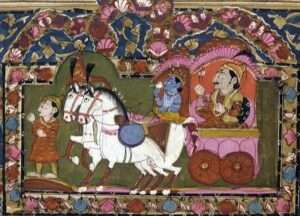
The Itihasa tradition provides a powerful narrative framework for considering this sequence. Shantanu’s dynasty leads through Bhishma, Vichitravirya, Dhritarashtra, and Pandu to the generation of the Pandavas and Kauravas. The Mahabharata then describes the catastrophic war at Kurukshetra, the installation of Yudhishthira, and the gradual transfer of political authority to later generations. The Puranic traditions, in turn, attempt to carry dynastic memory beyond the heroic age into the historical kingdoms of Magadha. Read together, these traditions suggest an ancient Indian conception of history in which mythic memory, dynastic succession and political genealogy were not necessarily separated into the categories that modern historians employ.
The Magadha sequence is particularly important because it provides a potential bridge between the epic age and securely situated historical personalities. The report specifically refers to Jarasandha’s son Sahadeva, who is said in the Mahabharata to have fallen during the Kurukshetra War, and to the later Magadhan succession culminating in Ripunjaya and the subsequent rulers. It then identifies Bimbisara and Ajatashatru as figures who can be situated in relation to the age of the Buddha, followed by Mahanandin and the rise of Mahapadma Nanda in 364 BCE according to the chronology used by the report.
This chain is analytically valuable because it moves from an epic event whose absolute date is disputed toward historical figures whose approximate chronological placement is much more firmly discussed. Bimbisara and Ajatashatru, for example, belong to a period in which Buddhist, Jain and Brahmanical traditions preserve overlapping memories of political and religious developments. The closer one moves toward this historically documented horizon, therefore, the more useful the dynastic succession becomes as a test of earlier chronological assumptions.
The deeper significance of the Puranic material is consequently not that every number in every Purana should automatically be accepted as historically exact. Rather, the existence of a sustained dynastic tradition deserves to be treated as historical evidence in its own right. The report notes that Buddhist and Jain traditions preserve important episodes involving some of these rulers, particularly through their interactions with the Buddha and Mahavira, whereas it credits the Puranas with preserving the broader dynastic chronology extending from the post-Kurukshetra period toward the Nandas, Mauryas, Sungas, Kanvas and Satavahanas.
A rational historical method should therefore neither dismiss the Puranic genealogies merely because they belong to a sacred literary tradition nor accept every chronological claim without examination. The proper approach is comparative: establish the textual sequence, calculate the accumulated regnal periods, compare them with archaeological horizons, identify independent synchronisms, and then determine which chronological reconstruction produces the fewest contradictions. Such a method allows tradition to become evidence without making tradition immune from critical examination.
The report ultimately presents the 1793 BCE reconstruction as one that, in its interpretation, brings the different strands into closer alignment: the later years of the Harappan world, the remembered dynastic succession, the emergence of eastern kingdoms, the Magadhan line, the age of Bimbisara and Ajatashatru, and finally the rise of Mahapadma Nanda. It claims that the sequence reaches the Nanda coronation in 364 BCE without the need to add or subtract individual years from the transmitted regnal framework.
The enduring lesson is that Indian chronology cannot be reconstructed responsibly from a single source or a single archaeological site. The Mahabharata, the Puranas, Buddhist and Jain literature, inscriptions, archaeology, linguistic evidence and regional traditions each preserve different portions of the past. Their value increases when they are placed in dialogue with one another. The real historical question is not whether an ancient tradition should be believed or rejected in advance, but whether its internal sequence and its external synchronisms withstand systematic examination.
Seen in this light, the Puranic king lists become more than a catalogue of forgotten names. They represent a claim about historical continuity: that the political memory of India extended from the age remembered through the Kurukshetra War into the dynasties that can be approached through increasingly independent historical evidence. Whether every proposed date ultimately survives critical scrutiny is a separate question. What cannot easily be dismissed is the methodological challenge presented by the cumulative sequence itself: a chronology should explain the whole chain of history, not merely make one isolated date appear plausible.