



The Makkah Joint Defence Agreement is already facing its first serious credibility test—and Pakistan appears to be quietly backing away from the very commitment it so loudly celebrated.
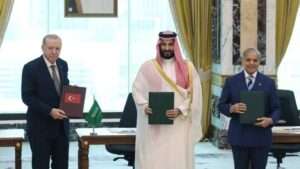
Signed on August 7 by Saudi Arabia, Pakistan and Türkiye in Makkah, the agreement declares that an armed attack against one of the three countries shall be regarded as an attack against all. Pakistan itself described the pact as a mechanism for collective deterrence and defence.
Now comes the test.
Saudi Arabia has intercepted a Houthi drone approaching Makkah, reportedly destroying it south of the holy city before it could breach restricted airspace. Riyadh has called the security of Makkah a red line. The Houthis, however, deny that they targeted the holy city.
What has Pakistan done?
That is precisely where the grand rhetoric of the so-called Makkah pact begins to look embarrassingly hollow. Pakistan has condemned Houthi attacks and its Defence Minister had even suggested that continued attacks could activate the pact. But when the moment came for concrete action, Islamabad subsequently acknowledged that no military response had been discussed under the agreement.
This is the real question: what exactly is the value of a collective-defence pact if the first response to an attack on a signatory is diplomatic language rather than collective action?
Pakistan has perfected the art of making solemn promises to friendly countries when it suits its immediate strategic or financial interests, only to discover later that circumstances require a different interpretation. Saudi Arabia should therefore be asking whether it signed a defence agreement—or merely another carefully worded diplomatic document.
The irony becomes even sharper because reports now say Riyadh has sought Israeli intelligence assistance through US Central Command amid the escalating Houthi threat.
For years, sections of the Islamic world have treated Israel as an adversary beyond the pale. Yet when Saudi Arabia faces a serious security challenge, intelligence from Israel reportedly becomes useful. That is not an indictment of Saudi Arabia; it is a reminder that national security ultimately recognises capability, not slogans.
And where are the much-proclaimed Islamic allies?
This episode should also force Washington and Beijing to examine their own policies towards Pakistan. Why should major powers continue to invest diplomatic, economic or strategic capital in a country whose promises to partners repeatedly raise questions about reliability? China remains deeply engaged with Pakistan through CPEC and its broader strategic partnership, while Pakistan is simultaneously seeking greater financial and strategic engagement with the United States.
The question is not whether Pakistan should be isolated. It is whether its conduct should be judged by the same standards applied to every other country.
Bharat, meanwhile, did not need a grand religious-security pact to respond. New Delhi condemned attacks on Saudi territory, particularly attacks threatening civilians and economic infrastructure, and has consistently advocated regional stability and freedom of navigation.
That is the difference between responsible diplomacy and theatrical posturing.
Bharat has repeatedly demonstrated that humanitarian and diplomatic responsibilities do not begin and end with religion, political alliances or ideological convenience. During crises, its assistance has extended across national and political boundaries.
The Makkah episode therefore deserves to be remembered not merely as another Middle Eastern security incident. It is a credibility test.
Pakistan can continue to issue statements, invoke brotherhood and celebrate strategic partnerships. But alliances are ultimately measured when an ally is actually in danger.
If the Makkah pact cannot produce meaningful collective action when Saudi security is under direct threat, Riyadh has every reason to ask a simple question:
Was the Makkah pact a shield—or merely a slogan?


