
Kathopanishad: Conversation between Lod Yama and Nachiketa
When all the desires dwelling in the heart are destroyed, then the mortal becomes immortal. He attains Brahman even here.
The text continuously reiterates and supports the concept of Jivan Mukhti, which means one can attain liberation even before death, contrary to Videha Mukhti, where one can attain liberation only after death.
Mantra 14 talks of ‘desires dwelling in the heart are destroyed, the mortal becomes immortal’. One has to deal with the onslaught of desires constantly. The moment desires become a source of distraction, it becomes an impediment to one’s goal. The unfulfillment of desires causes frustration and agitation. The desires manifest as emotions and they further unsettle the mind. The more desires one has, the more agitated and restless is his mind. The less the desire, lesser is the restlessness. An individual who has less desires is more peaceful, and more desires is less peaceful.
At the absolute level, these are avidya, ignorance, which manifests in the form of vasanas. At the relative level, the antidote is seeking this knowledge. The wisdom gives the ability not to fall prey to the desires. Slowly and steadily with sadhana, you can uproot the vasanas.
When all the knots of the heart are destroyed here, then the mortal becomes immortal. This much alone is the instruction (of the Upanishads).
Knots of the heart are avidya, that which binds us. The two knots are Kama desire, and Karma desire-prompted action. These two knots bind us, and when they are destroyed, you will attain immortality. It is the instruction of the Vedas, and you must heed to it.
Relatively, we attain immortality when these knots are destroyed and the heart is liberated. You will be free from the pain and agony which arises from desire-ridden actions.
Q: How do you break the bondage of kama and karma?
A: The mind continuously keeps presenting desires. You can exercise your intellect and come out of the onslaught of desire. The intellect has to question every action: ‘Am I obliged to do it? Is it my obligation?’ When you act on the mind, you will end up doing things which you are not obliged to do or avoid things which you are obliged to do. The world sends out umpteen invitations. It could be formal, informal, or temptations. Informal invitations are stimuli that come to you. If you are obliged, you ought to do it, and if you are not, do not fall a prey to emotions or pressure/demand of the world. By relatively acting on the intellect, you will liberate yourself from unnecessary mental agony. With knowledge comes liberation. The shastras state, and this mantra asserts this declaration/instruction of the Upanishads.
In Bhagavad Gita chapter 3, Lord Krishna talks of karma. Karma is divided into:
- Nitya karma (regular duties)
- Naimittika karma (occasional obligatory duties)
- Nishiddha karma (forbidden duties).
You should be able to classify your actions into these three brackets. When you don’t operate on your intellect, you will not know your regular, obligatory and forbidden duties. Then, you will end up doing things which you should not do. The only way to protect yourself is by clearly understanding what your obligatory duties are. It varies to each individual.
Q: What determines obligatory duties?
A: Obligatory is an open and relative term. One could get lost in the so-called obligations of samsara. At every time you are playing a role as a father, spouse, son, brother, son-in-law, grandson, friend, neighbour, etc. and trying to justify your role.
Your primary and foremost obligation, the shastras say, is to realise the Self. In the process of life’s journey, one forgets the primary obligation and keeps fulfilling the subsidiary, secondary obligations that one has picked it up. We feel it is more important than the primary duty of realising the Self. Keep questioning am I obliged to do. The value system and obligations keep changing as you grow spiritually. The ability to pick up a higher obligation than a lower obligation will help you decide the obligatory duties. If it is a compelling duty, you ought to do it. The challenge comes only in naimittika karma, occasional obligatory duties, and not in nitya karma, regular duties.
Hundred and one are the nerves of the heart; of them one emerges from the crown of the head. Going upward through that one attains immortality. The others are led differently.
According to yogic philosophy, there are a hundred and one naadis which are called as chakras. Naadis are subtle energy channels that varies from the heart, which leads you to the crown chakra known as sahasradhara. The root chakra is known as mooladhara. These hundred and one naadis are considered as the conduit for the prana life force in the subtle body. They correspond to their respective nerves and vessels in the physical body. Accordingly to the yogic philosophy the sushushma naadi, which is the central and vital energy, is said to run through the spinal cord, and this connects the mooladhara to sahasradhara. At the time of death, a yogi’s prana is said to pass through this sushushma naadi, and that individual attains immortality. This is applicable to those seekers who pursue apara Brahman.
There is para, which is higher, and apara, which is lower. Apara Brahman are those who pursue the various gods and goddesses. Immortality is not referring to the absolute, but to relative immortality. Those who pursue the gods and goddesses, they attain heavenly abodes of Brahmaloka, Swargaloka, Indraloka, etc. These are the lokas’ paths of return. The spiritually elevated states in apara are temporary experiences. So, those who seek Brahman, which is para, eternal, formless reality, Jivan Mukta, for them there is Kaivalya Mukhti, direct liberation. For them the path is completely different.
The Purusha of the size of a thumb, the inner Self, is ever seated in the heart of living beings. One should draw Him out from one’s own body with steadiness, as one draws pith from a reed. Know Him as pure and immortal, Know Him as pure and immortal.
Purusha is the Atman, all-pervading formless reality. Atman, the inner self, is the size of a thumb and the heart of a living being. Lord gives two indicative definitions of that Atman. Atman is not limited or confined to a thumb. It is giving a pointer to reflect, contemplate and meditate. Seated in the heart means the core of living beings, beyond the Pancha kosha five sheaths.
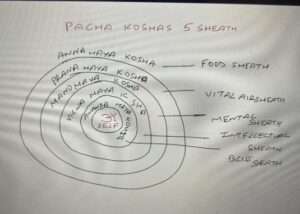
The core of these sheaths is the Self. The sheaths envelop the Atman. The five sheaths are –
Innermost sheath is Bliss sheath Anandamaya kosha
Intellectual sheath Vignanamaya kosha
Mental sheath Manonmaya kosha
Vital air sheath Pranamaya kosha
Food sheath Annamaya kosha
These are sheaths as they cover the Atman. The Atman is not conditioned nor influenced by what it covers it. It is like the sword put into a sheath; the sheath is used to protect the sword. When you put the sword into the sheath, the tip of the sword does not get blunt. It is not touched by the sheath. Similarly, the five sheaths from the vasanas till the gross body do not condition the Atman. The sadhana is to draw the Atman from one’s own body.
The inner sadhana is to draw him out through the process of discriminating Atma and anatma. Through viveka discrimination, you negate and assert. Sadhana is to negate what is not and assert what is to be. You draw the Atman steadily with great consistency and steadfastness like one draws the pith from the reed. The layers that are covering the Atman have to be removed one after the other.
You can conquer the annamaya kosha food sheath by not being a slave to the tongue. When you eat healthy food, your body becomes healthy, junk food creates a junkyard. It is easier to control the grosser than the subtler. It is easier to bring discipline at the food sheath level.
You don’t become sattvic by merely eating sattvic food. It is conducive for your sattvic journey. A sattvic person is not comfortable eating rajasic or tamasic food and will find them revulsive. When the intellect controls the mind, the vital-air and food sheath also gets controlled.
Discrimination of Atma and anatma, negation of anatma and assertion of Atma. When this process is done steadily, one would know him as pure and immortal.
Nachiketa, having been so instructed by Lord Death in this knowledge and in the whole process of Yoga, became free from all impurities and death and attained Brahman; and so too anyone will attain, who knows thus the inner Self.
This wisdom is not exclusive to Nachiketa. It is not a benefit to people of the Vedic period. Anyone of us can be free from all the impurities, control the senses, have the mental discipline, diligently put himself through the instructions given by the Lord of death, and attain Brahman. Nachiketa, having listened to the entire Upanishad, mastered the whole process of yoga and attained the state of realisation. This mantra can be attributed to Shruthi Bhagavati.
This Upanishad is called Katha as it was given by the Rishi Katha. He was the disciple of Rishi Vaishampayan, who was the disciple of Rishi Vyasa. It has the story of Nachiketa and Lord Yama.