Lakshmanrao Upadhyayula
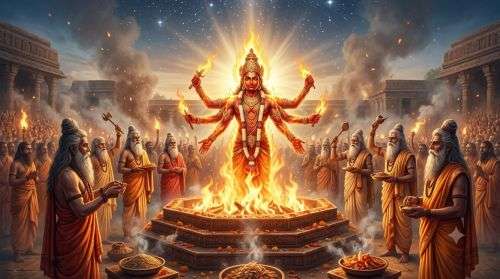
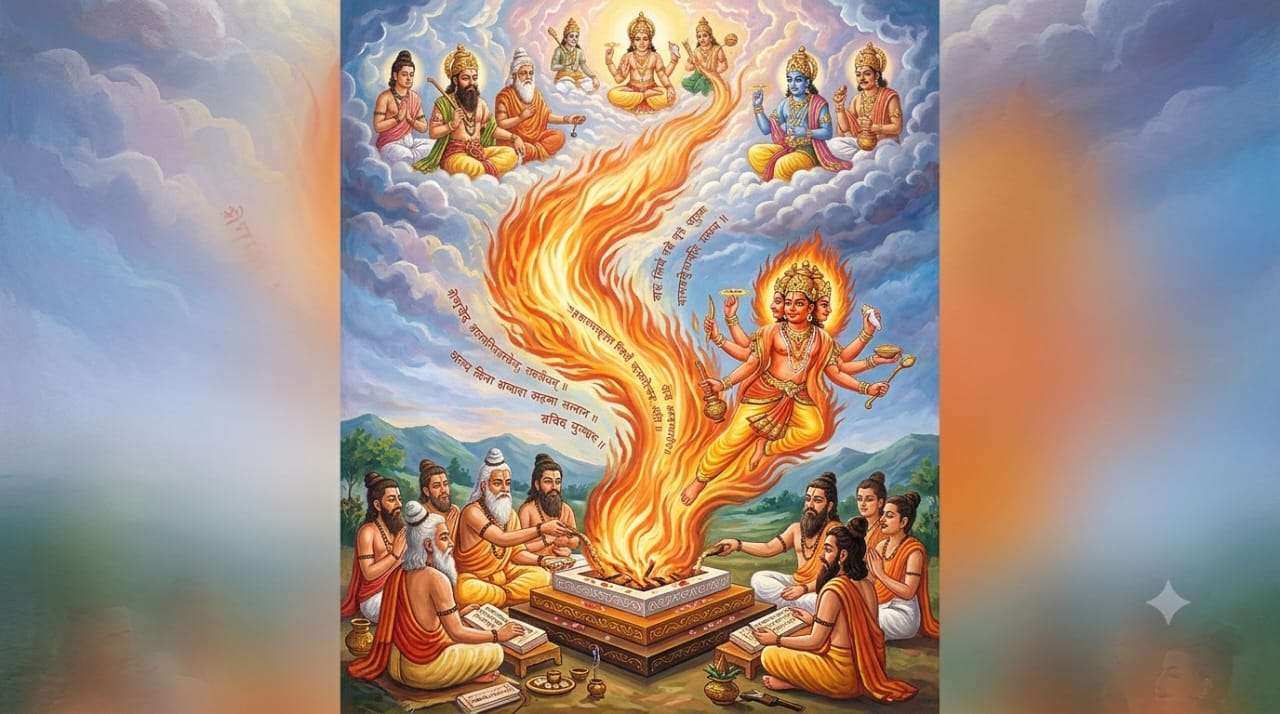
In the sacred hymns of the Rigveda, the venerable sage Vishwamitra invokes Agni, the divine Fire, in the majestic cadence of Triṣṭubh metre. Agni is not merely the visible flame kindled upon the altar; he is the conscious and luminous principle that links humanity with the celestial realms. As the first deity addressed in the Vedas, Agni represents the awakening of intelligence, devotion, and spiritual aspiration. He is the sacred force that rises with the dawn, carrying the prayers of the faithful to the gods and illuminating the path walked by the wise.
Agni is intimately connected with Uṣā, the radiant goddess of dawn, who dispels the darkness of night just as knowledge dispels the ignorance of the mind. When Uṣā spreads her rosy light across the horizon, Agni awakens in the sacrificial hearth and in the hearts of seekers. Rekindled by those who live in faith and reverence, he becomes the most brilliant of powers, transforming offerings into subtle energies and human intentions into divine communion. In this way, Agni symbolizes the ignition of spiritual awareness that accompanies every sincere act of worship.
The hymns, prayers, and sacred utterances of the priests nourish Agni and cause his splendour to increase. The Vedic seers perceived sound as a creative force, and mantra as the vibrational key that awakens divine energies. When invoked through sacred speech, Agni breaks open the gates of ignorance and reveals the inner light concealed within all beings. As the divine messenger, he carries oblations to the gods and returns their blessings in the form of wisdom, strength, prosperity, and peace.
At daybreak, Agni glows with renewed brilliance to receive the offerings of the yajña. He is the beloved friend of patrons and sacrificers, fulfilling righteous desires through the law of sacred reciprocity. Called the “Son of Waters” (Apām Napāt), Agni emerges mysteriously from the latent energies hidden within the cosmic waters, just as fire arises from moisture-bearing clouds and from the subtle energies of nature. This profound imagery reflects the Vedic insight that life and energy are interwoven expressions of one universal reality.
Agni dwells among human beings as a conscious and venerable presence. Seated upon the elevated altar, he becomes the Hotṛ priest who recites the hymns, the Adhvaryu who performs the ritual actions, and the Brahman priest who silently oversees the sacrifice. In his all-encompassing nature, Agni assumes the functions of Mitra, the principle of harmony and friendship; Varuna, the lord of cosmic order; and Vayu, the inspirer and life-breath of the universe. Thus Agni is not one force among many, but the unified intelligence manifesting in diverse forms.
As friend of rivers and mountains, Agni pervades the natural world. He is the heat within the earth, the energy coursing through plants, and the light of the sun traversing the heavens. The Vedic sages intuited that the same principle of energy animates every realm of existence. Modern science echoes this vision by revealing that heat, light, electricity, and biological vitality are transformations of one fundamental energy. Agni therefore stands as both a spiritual symbol and a scientific archetype of universal power.
The hymns praise Agni as the protector of the earth, the atmosphere, and the celestial regions. He safeguards the path of the sun, sustains the Maruts in the mid-space, and preserves the yajña, the sacred process through which cosmic harmony is maintained. As memory among humankind, Agni represents the faculty of retention and understanding. Just as fire transforms matter into energy, memory transforms experience into wisdom. He also releases sweet and life-giving waters, signifying the purification and renewal that follow spiritual illumination.
Even when hidden or apparently dormant, Agni remains tangible and radiant. The Vedic seers observed that fire lies concealed within wood, awaiting release through friction. This insight gave rise to the profound symbolism of the araṇi sticks, whose union produces the sacrificial flame. In the same way, spiritual realization arises when disciplined effort and divine grace interact. The latent light within the human heart becomes manifest through meditation, devotion, and self-knowledge.
Agni is pure, resplendent, and holy. He continually refreshes his parents, Heaven and Earth, sustaining the cosmic order for generation after generation. At his birth, the herbs embrace him, absorbing and transmitting solar energy through their growth. The Vedic poets poetically described what science now explains through photosynthesis: the transformation of sunlight into living substance. Thus the herbs flourish like rivulets of nourishment and yield their fruits for the benefit of all beings.
Nurtured in the lap of Heaven and Earth, Agni is invoked as the guardian of humanity. Through hymns of praise he becomes increasingly luminous, standing at the navel of the earth and illuminating the vastness of space. This “navel” signifies the spiritual centre from which life and consciousness radiate outward. Agni is the universal companion, dwelling in every household, every heart, and every star.
Born from the friction of the araṇi sticks, Agni becomes the divine messenger who invites the gods to the sacrifice. The ancient Bhrigus, symbolized as nurturing cows, discovered and preserved this sacred fire, establishing it in the homes of humanity. Agni, the carrier of oblations, rises with unsurpassed brilliance and upholds the very heavens through the power of sacrifice and truth.
Finally, the sages pray that Agni, the divine provider and lord of action, may bless the earth and all its inhabitants. They seek worthy children, enduring prosperity, and strength for future generations. Yet these blessings are not merely material; they signify the transmission of wisdom, virtue, and spiritual insight through the lineage of humanity. Agni is invoked to grace us with kindness, to nourish our aspirations, and to guide us from darkness to light, from ignorance to knowledge, and from mortality to the realization of the eternal Truth.