



As the final shades of night lingered upon the battlefield, the venerable Dronacharya surged toward the Panchala forces with the irresistible force of a raging tempest. Even before dawn had fully unfolded its light, the war had already reached a dreadful intensity. King Duryodhana advanced boldly against the Pandavas, while the eastern horizon slowly blushed crimson beneath the awakening sun. Observing the movement of the enemy, Sri Krishna spoke to Arjuna, saying that the Kaurava armies were pressing forward from both flanks with great vigor and that their advance must be driven back from the left wing. Guided by the wisdom of the Lord, the divine chariot moved swiftly in the desired direction. Inspired by Krishna’s counsel and the favorable turn of events, Arjuna stood radiant with renewed determination.
At that moment, the four chief pillars of hostility—Duryodhana, Dussasana, Shakuni, and Karna—joined together and confronted Arjuna. They showered him with a relentless storm of arrows, hoping to overwhelm him by their combined might. Yet their appearance only intensified Arjuna’s wrath. His bow moved with astonishing speed, and his movements were so swift that the enemy imagined him to be present in many forms at once. Countless warriors fell beneath his shafts. The thunderous movement of chariots, horses, and elephants raised vast clouds of dust that darkened the battlefield, making the early dawn appear like deep twilight.
The dust grew so dense that friend and foe could scarcely distinguish one another. Chariots crashed together, warriors collided in confusion, and the field became a tumult of uncertainty. Hand-to-hand combat broke out in many places. Men wrestled, grappled, and struggled fiercely. Hair was seized, bodies were locked together, and warriors fought with desperate courage. The ancient code of battle, which forbade a mounted warrior from attacking one deprived of his vehicle, was often forgotten amid the chaos. The battlefield became a terrifying spectacle of unrestrained conflict.
Meanwhile, Dronacharya turned toward the northern sector of the field. As he advanced, the Pandava forces trembled before him like herds of deer at the sight of a tiger. Ordinary soldiers, hearing Drona challenge them to combat, wondered in astonishment why such a mighty master sought battle with men of lesser stature. Some lamented their fate, some forced courage into their hearts and marched forward, while others prepared silently for the ordeal before them.
Soon King Virata, King Drupada, and Drupada’s three grandsons, accompanied by distinguished Pandava warriors, surrounded Drona. The preceptor stood unmoved amid the encircling host. His face was flushed with battle-fury, his eyes reddened and swollen, and his appearance inspired dread. Displaying his terrible prowess, he slew the three grandsons of Drupada and cut down the Kekaya princes with the ease of one plucking lotuses from a tranquil pond. The enemy forces beheld the astonishing strength of his arms and the irresistible power of his bow.
Drona then poured a torrent of sharp arrows upon the Panchala kings. Virata and Drupada, perceiving his extraordinary ferocity, resolved that the moment had come to display their own valor. Filled with righteous anger and martial enthusiasm, they advanced against him and rained arrows upon his position. Yet Drona, consumed by battle-fury, answered with a devastating shower of shafts and slew both Virata and Drupada upon the field.
When Dhrishtadyumna witnessed the fall of King Virata and his own father Drupada at Drona’s hands, grief and wrath blazed within him. Raising his voice so that all could hear, he swore a solemn oath that if he failed to slay Drona, he would be unworthy of his lineage, his duty, and the principles of righteousness. Gathering a mighty fourfold army, he rushed toward the preceptor. Yet Karna and Duryodhana intercepted him, engaging him in fierce combat and hindering his advance.
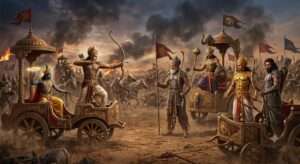
Seeing this, Bhimasena urged Dhrishtadyumna to press onward toward his destined foe. Roaring like a lion, Bhima carved a path through the enemy ranks and moved toward Drona. Dhrishtadyumna joined him, and together they thundered challenges against the great teacher. At Duryodhana’s command, the Kaurava forces surged from every side, and the battle grew even more terrible. Sanjaya narrated that the sun was now rising above the eastern mountains, casting its golden rays upon blooming red lotuses whose beauty shone brilliantly in the morning light.
Before fully engaging in combat, the warriors performed their sacred rites and offered oblations to the Sun God according to ancient custom. Thereafter they returned to battle. As the day advanced toward midday, the heat became oppressive. Exhausted by sleeplessness, hunger, and ceaseless exertion, the warriors sweated profusely. Their limbs drooped with fatigue, and their faces grew pale. Yet their courage remained unbroken, and they continued to fight with unwavering determination.
The clash of weapons, the swift flight of arrows, the rolling of chariot wheels, the trampling of elephants, and the galloping of horses once again raised immense clouds of dust that obscured the sun itself. Many soldiers wondered whether night had returned prematurely. Amid this confusion, Drona and Arjuna preserved the integrity of their respective armies and fought with unmatched zeal. Horses and riders, elephants and warriors, were pierced and cut down by celestial weapons and martial skill. Rivers of blood flowed across the battlefield, dividing into countless streams. The air echoed with cries of battle, groans of agony, triumphant shouts, the blowing of conches, the beating of kettledrums, and the resounding notes of horns and trumpets proclaiming valor and success.
Elsewhere, Duryodhana fought Nakula, Dussasana battled Sahadeva, Karna confronted Bhima, and Drona engaged Arjuna. Their contests were fierce beyond description. The speed of their chariots and the brilliance of their martial skill astonished even the Siddhas and Charanas who watched from the heavens. Nakula and Duryodhana fought with such equal mastery that neither gained an advantage. Their excellence in archery captivated the celestial hosts.
Sahadeva struck down the charioteer of Dussasana. Undeterred, Dussasana seized the reins himself and continued the battle. Sahadeva then pierced the horses of his adversary, causing them to bolt wildly across the field and disappear into the tumult of war. Meanwhile, Bhima and Karna engaged in a fearsome struggle. Their use of mighty weapons filled onlookers with awe. Karna eventually unleashed a deadly shower of arrows and slew Bhima’s horses. Warriors in both camps praised Karna’s valor. Bhima then descended from his disabled chariot and mounted the vehicle of Sahadeva to continue the fight.
The greatest wonder of the day remained the duel between Drona and Arjuna. Arrow met arrow in a dazzling display of skill. Drona’s shafts were severed by Arjuna, while Arjuna’s missiles were shattered by Drona. Their weapons collided and vanished in flashes of light before the eyes of astonished spectators. None could determine who held the advantage. The question of who would ultimately triumph occupied every mind upon the field.
Divine astras were then invoked by both master and disciple. Each celestial weapon released by one was neutralized by the other with equal precision. Their strength, knowledge, and mastery appeared perfectly balanced. Witnessing this extraordinary contest, the Siddhas, Vidyadharas, and Charanas marveled among themselves, declaring that such a duel seemed worthy only of the delight of Lord Shiva. They proclaimed that never before had they witnessed a conflict so sublime and terrible between mortal warriors.
At length, Dronacharya resolved to employ the mighty Brahmastra. With profound concentration and sacred recitation, he invoked the celestial weapon and placed it upon the string of his bow. Instantly the earth and heavens trembled. Mountains shook as though they were dry leaves tossed by a violent wind. Flames seemed to blaze in every direction, and the sky assumed a fearful crimson hue. The gods themselves grew anxious, while soldiers on both sides stood shaken with dread.
Having sanctified the weapon through sacred mantras, Drona released it. Yet Arjuna, possessing equal knowledge and mastery, immediately countered with a corresponding celestial power. The terrible force was checked and restrained. To the astonished spectators, the exchange appeared almost beyond comprehension. The divine missiles met, neutralized one another, and vanished with such swiftness that few could discern what had truly transpired. Thus the supreme mastery of both warriors became evident to all.
Sanjaya concluded his narration to King Dhritarashtra by observing that the struggle between Drona and Arjuna seemed beyond the reach of ordinary victory or defeat. Neither warrior could overcome the other, yet their conflict unleashed devastation upon both armies. Like two blazing suns confronting one another in the heavens, master and disciple stood unmatched, their immortal contest becoming one of the most awe-inspiring spectacles in the history of the great war.

