The Bharatiya Janata Party’s new national team under president Nitin Nabin is more than a routine organisational reshuffle. Read carefully, it is a political statement: the BJP is putting women, experienced political hands and organisationally tested leaders closer to the centre of decision-making as it prepares for the next electoral battles. The most striking feature is the prominence given to women. Seven of the BJP’s 13 national vice-presidents are women, while the new team has 10 women leaders in key positions. This is not token representation confined to a Mahila Morcha or ceremonial responsibilities. Women have been placed in positions that involve political strategy, state-level coordination and organisational decision-making. And then comes Smriti Irani. Her appointment as a national general secretary with charge of Uttar Pradesh is perhaps the most politically consequential of the changes. Uttar Pradesh is not merely another State on the BJP’s electoral map. It is the country’s largest political battleground and the State that can make or break the national narrative. With the 2027 Assembly election approaching, putting Irani in charge signals that the BJP intends to approach Uttar Pradesh with political aggression, organisational discipline and close central supervision. Irani brings an unusual combination to the assignment. She has headed the BJP Mahila Morcha, served as Union Minister for Women and Child Development and acquired a national political profile through some of the most closely watched electoral contests in the country. Her 2019 defeat of Rahul Gandhi in Amethi earned her the enduring “giant killer” tag. Her return to a frontline organisational role therefore carries both political symbolism and practical significance. But the BJP would be fooling itself if it believed that one high-profile appointment can solve Uttar Pradesh’s complicated electoral arithmetic. Irani is not a traditional UP satrap with decades of grassroots caste-network management behind her. The State’s politics remains intensely shaped by Dalit, OBC, upper-caste and minority equations, local leadership, candidate selection and alliance management. The BJP’s 2024 Lok Sabha performance in Uttar Pradesh was a reminder that even a formidable organisation cannot take the State for granted.
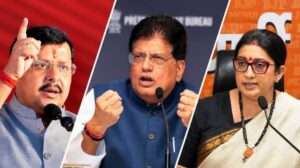
That is precisely why Irani’s appointment matters. She is being brought in not as a substitute for the grassroots organisation but to strengthen and supervise it. Her success will ultimately be measured not by television appearances or high-decibel rallies, but by booth management, candidate selection, coordination with the State leadership and the ability to translate the BJP’s welfare and governance narrative into votes. The larger women’s representation makes the message even clearer. Vasundhara Raje from Rajasthan, D. Purandeshwari from Andhra Pradesh and Bharti Pravin Pawar from Maharashtra are among the women elevated as national vice-presidents. Their presence gives the party regional depth while putting experienced women leaders into the national decision-making structure. This is particularly significant because the Bharatiya woman voter is no longer merely an appendage of the family vote. Women increasingly vote independently, and welfare delivery, household economics, security, dignity and direct benefits have become important electoral considerations. Political parties that understand this shift will have an advantage; those that continue to treat women voters as a captive extension of male preferences will eventually pay a price. The BJP appears to have understood this political transformation. There is another interesting appointment that should not be lost amid the discussion over women: Piyush Goyal has been made national treasurer, not a national secretary. Goyal is simultaneously a senior Union Cabinet minister handling crucial economic and trade responsibilities. But there is little novelty in a prominent minister carrying an important organisational responsibility in the BJP. More importantly, the appointment has an element of institutional continuity: his late father, Ved Prakash Goyal, was BJP national treasurer for more than two decades. Piyush Goyal himself had previously served as the party’s national treasurer. It therefore looks less like an arbitrary additional burden and more like the party placing a trusted financial hand in a sensitive organisational position. The message from Nitin Nabin’s team is consequently broader than “new faces”. It is about women with authority, veterans with experience, regional leaders with political relevance and organisational specialists with defined responsibilities. For the BJP, this is a calculated preparation for the electoral road ahead. For its opponents, dismissing it as another reshuffle would be a serious mistake. The real test, however, begins now. Appointments make headlines; organisations win elections. The BJP has assembled its team. Uttar Pradesh will tell whether its new Nari Shakti can convert representation into organisation, and organisation into victory.