



A stablecoin is a digital token designed to hold a steady value, almost always one US dollar. It works like a digital dollar that can move instantly across borders on a phone, backed by real assets such as cash and short-term US government bonds held by the issuer.
What a stablecoin is and how the peg is maintained
One token is meant to stay close to one dollar at all times.
Issuers keep reserves equal to the tokens in circulation, typically in cash, bank deposits, and very short-term Treasury bills.
When users buy the token, the issuer receives dollars and invests them in those reserves. When users redeem, the issuer sells reserves to pay them back.
This structure is intended to keep the price stable, unlike Bitcoin or other crypto assets that can swing sharply.
In practice, the largest issuers now disclose their reserves through attestations. Tether reports roughly 1.04 times reserves per token, with a large share in Treasuries and repos. Circle’s USDC maintains full one to one backing with high-quality liquid assets.
Why stablecoins are growing so fast in emerging markets
Stablecoins are not just a crypto story. They are a monetary story playing out in everyday wallets.
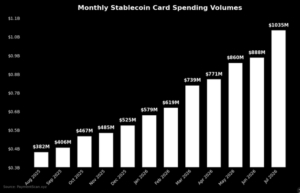
Monthly stablecoin linked card spending rose from about 382 million dollars in August 2025 to roughly 1.04 billion dollars in July 2026, according to Payments can data.
Around nine to ten million purchases occurred in July 2026 alone, with the majority of spend coming from outside the United States.
Dollar pegged tokens make up about 99.5 to 99.8 percent of the roughly 308-to-317-billion-dollar stablecoin market.
Tether states its USD pegged token is used by more than 534 million people, especially in developing economies, for remittances, informal savings, and protection against local currency weakness.
The driver is simple. In countries with high inflation or weak currency management, households want dollar linked purchasing power without needing a US bank account. Stablecoins settle in minutes, work on smartphones people already own, and avoid the three-to-five-day delays of traditional cross-border transfers.
The tension with official de-dollarization efforts
At the sovereign level, many governments, including BRICS members, talk about reducing dollar dependence through local currency trade, gold backed instruments, or basket units.
At the household level, the opposite trend is visible on the ground. People in places like Nigeria, Argentina, Turkey, and parts of South Asia are moving savings into dollar stablecoins because they do not trust their own currency to hold value.
This creates a split reality. Governments push de-dollarization in official channels while citizens quietly dollarize through apps. Once a household gets used to holding and spending in digital dollars, that habit is hard to reverse.
How stablecoin reserves feed demand for US Treasuries
Every stablecoin needs reserves, and US law now requires regulated issuers to back tokens with cash, insured deposits, or very short-term Treasuries.
As of March 31, 2026, Tether reported about 141 billion dollars of direct and indirect exposure to US Treasury bills, making it one of the largest single holders of US government debt globally, ahead of several sovereigns.
The total stablecoin market cap stood at roughly 308 to 317 billion dollars in mid-2026.
If the market grows, issuers collectively become a structural buyer of Treasury bills, channelling demand from crypto wallets in emerging markets rather than from traditional central bank reserve managers.
Forecasts for how large this can get vary:
Standard Chartered projects the stablecoin market could reach about 2 trillion dollars by end 2028, implying roughly 800 billion to 1 trillion dollars of additional Treasury demand from issuers.
Citi’s base case points to around 1.9 trillion dollars by 2030, with a bull case as high as 4 trillion.
JPMorgan has been more conservative, suggesting a more realistic range of 500 to 600 billion dollars by 2028.
Even the conservative case means stablecoin issuers could become a meaningful, persistent source of demand for US government debt.
Why central banks are buying gold at the same time
This is where the story gets subtle. Households in emerging markets are moving into dollar stablecoins because they do not trust local currencies. Central banks in many of the same countries are moving reserves into gold because they do not fully trust that dollar denominated assets cannot be switched off by sanctions or political decisions.
Central banks bought over 1,000 tonnes of gold per year in 2022 to 2024, then 863 tonnes in 2025, still well above the 2010 to 2021 average of about 473 tonnes.
In the first quarter of 2026 alone, official sector purchases reached 244 tonnes, with continued buying into the second quarter.
A World Gold Council survey found 45 percent of central banks plan to add more gold in the next 12 months, and 74 percent expect the dollar’s share of global reserves to fall over the next five years.
BRICS plus nations now hold a significantly larger share of global gold reserves than they did in 2019, reflecting a strategic shift.
So two trades are happening in parallel. Sovereigns are diversifying reserves out of dollar paper into gold to reduce weaponization risk. Households are diversifying savings out of local currency into dollar stablecoins to reduce inflation and devaluation risk. Both are votes of no confidence, but in different currencies and at different levels of the system.
The real question for emerging market central banks
The key issue is not whether stablecoins will matter. The data shows they already do, month after month, as card spending and adoption climb.
The uncomfortable question is how much monetary control central banks are willing to see shift outside their jurisdiction, one wallet and one transaction at a time, before they treat it as a policy emergency.
When a growing share of household savings and transactions moves into dollar stablecoins:
Local interest rate changes have less impact on those balances.
Liquidity management becomes harder when a meaningful slice of money sits outside the domestic banking system.
Currency defines tools work less effectively if people can exit the local currency with a QR code instead of physical cash.
Rebuilding trust in a local currency takes years of credible policy, low inflation, and stable institutions. In many emerging markets, the political runway for that kind of patience is short, while the convenience of stablecoins is immediate.

