



Politics often reveals more through the words chosen in a moment of confrontation than through carefully drafted speeches. When a former Union Home Minister publicly embraces a phrase that the Prime Minister uses to describe an ideological challenge to the State, the remark deserves more than a passing political response. It deserves scrutiny.
That is precisely why P. Chidambaram’s declaration that he is a “proud Dimagi Naxal” cannot simply be brushed aside as another exchange between the ruling party and the Opposition. It may well have been intended as sarcasm or a political counter to Prime Minister Narendra Modi. It does not, by itself, establish that Chidambaram supports Maoist violence or the armed Naxal movement. But coming from a former Home Minister, the choice of those words inevitably invites a larger question: what does he mean by embracing such a politically loaded expression?
A guilty mind can never be at ease. No wonder, P. Chidambaram has responded aggressively. Ipso facto, defensiveness and aggression are common psychological reactions when someone feels exposed or guilty. Guilt makes people do strange things, like trying to fix things that aren’t broken just to feel clean.
No wonder Chidambaram has resorted to shifting blame away from himself by attacking Modi. His outburst is to protect his ego and avoid looking like the “bad guy.” His anger is to intimidate others into dropping the subject. His gaslighting accuses Modi as “crazy,” “paranoid,” or making things up is quite stupid.
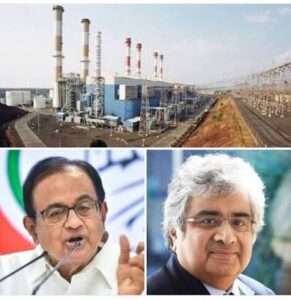
That question becomes even more pertinent when viewed against the broader record of political decisions, ideological positions and controversies involving the Congress and parties that have shared power with it.
The same principle applies to the Dabhol Power Project controversy involving Enron. Under the Vajpayee government, Harish Salve, a distinguished Indian lawyer, was appointed to defend India’s interests in this high-stakes international arbitration. Shockingly, P. Chidambaram, a prominent Congress leader, served as Enron’s legal counsel, advocating against India’s interests.
When the UPA government came to power in 2004, with Chidambaram as Finance Minister, he could no longer directly represent Enron but continued to provide legal advice, reportedly favoring the Company.
In a stunning move, the UPA government removed Harish Salve from the case and appointed Khawar Qureshi, a UK-based lawyer of Pakistani origin, to represent India. The decision to entrust a sensitive case involving billions in taxpayer money to a foreign lawyer with ties to Pakistan raised serious questions about the Congress-led government’s judgment and priorities.
Despite India’s strong position in the arbitration, the appointment of Qureshi led to a predictable outcome: India lost the case. The government was forced to pay substantial settlements of $800 million to Bechtel & General Electric, who had acquired Enron’s stakes after its bankruptcy. Additionally, Qureshi was paid exorbitant legal fees, further burdening Indian taxpayers.
Notably, Khawar Qureshi later represented Pakistan in the Kulbhushan Jadhav case at the International Court of Justice, underscoring the irony of Congress’s choice. And Guess who represented India – Harish Salve, who won the case and stayed the death sentence of Yadav, along with getting him consular access, only for a Fee of Rs 1.
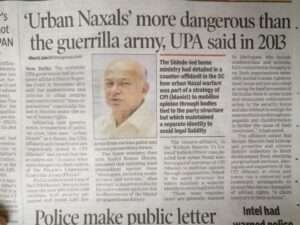
This episode, often downplayed by the media, highlights a disturbing pattern of mismanagement and questionable loyalties under the Congress-led UPA.
The issue is not about branding political opponents as “Dimagi Naxals”. Nor should legitimate dissent or criticism of a government ever be equated with extremism. A democracy must accommodate disagreement. But democracy also demands that public figures be prepared to explain their words and defend their records when those words touch upon matters of national security and ideology.
The Congress and its allies have every right to question the policies of the Narendra Modi government. Equally, the present government and the public have every right to question the record of previous governments. Accountability cannot be a one-way street.
Chidambaram may have intended his “proud Dimagi Naxal” remark to be a clever political repartee. But political repartee becomes something else when it comes from a person who once occupied the country’s most important internal-security portfolio.
So the real issue is not whether Chidambaram is literally a “Dimagi Naxal”. There is no factual or legal basis to make such a claim. The issue is what he intended to convey by proudly embracing the phrase—and whether he is prepared to explain that position to the same citizens whose security he once had the constitutional responsibility to protect.
The facts are available in the public domain. The history is documented. The questions are legitimate.
Connecting the dots is not the same as making accusations. Sometimes, it is simply asking the public to remember.

