



On 24 September 2026, the Securities and Exchange Board of India (SEBI) approved a major overhaul of the portfolio management services (PMS) framework through the new SEBI (Portfolio Managers) Regulations, 2026, which replace the earlier 2020 regulations. One of the most significant innovations under this overhaul is the introduction of the Portfolio Managers Route for Investing in Mutual Fund Units, popularly known as PRIM.
PRIM creates a dedicated, regulated pathway that allows SEBI-registered portfolio managers to construct and manage client portfolios exclusively (or primarily) using direct plans of mutual fund schemes, exchange-traded funds (ETFs), index funds, and Specialised Investment Funds (SIFs) offered by Indian asset management companies (AMCs). This marks a clear departure from traditional PMS, which typically focuses on direct equity stocks, bonds, and other securities.
Background and Rationale
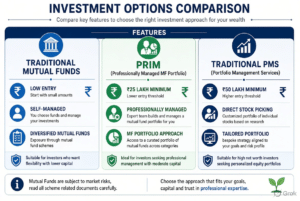
Conventional PMS in India has long required a high minimum investment of Rs 50 lakh, positioning it as a product primarily for ultra-high-net-worth individuals (UHNIs). Mutual funds, by contrast, offer accessibility with much lower entry barriers but leave fund selection, asset allocation, and rebalancing decisions largely to the investor or their adviser. A gap existed for affluent investors seeking professional portfolio construction using the mutual fund ecosystem without the complexity or higher ticket size of traditional stock-picking PMS.
SEBI had proposed a mutual-fund-focused PMS structure earlier (around July 2026). The September 2026 board approval formalised this as PRIM, aiming to widen access to professionally managed portfolios while keeping the activity firmly within a regulated PMS structure. Industry participants, including the Association of Portfolio Managers in India (APMI), have welcomed the move as a step that expands the addressable market for PMS providers and brings more investors into a supervised professional management framework.
Specialised Investment Funds (SIFs), which form part of the eligible investment universe under PRIM, themselves represent a relatively new SEBI category (operational framework effective from April 2025). SIFs sit between traditional mutual funds and PMS: they are pooled vehicles managed by AMCs, allow more flexible strategies (including limited long-short positions via derivatives), and carry a minimum investment of Rs 10 lakh at the PAN level. Including SIFs in PRIM further enhances the strategy toolkit available to portfolio managers.
Key Features and Regulatory Requirements of PRIM
Minimum Investment (Ticket Size): Rs 25 lakh. This is half the Rs 50 lakh threshold applicable to conventional discretionary or non-discretionary PMS, making professional portfolio management accessible to a broader segment of affluent investors.
Net Worth Requirement: Portfolio managers offering only PRIM need a minimum net worth of Rs 2 crore (lower than the requirement for full-fledged traditional PMS entities). Existing registered portfolio managers can offer PRIM as a separate investment approach without needing a fresh full registration. New entities seeking exclusive PRIM registration can apply under the simplified norms.
Eligible Investments: Direct plans of mutual fund schemes (including ETFs and index funds) and SIFs of Indian AMCs. The focus on direct plans eliminates distributor commissions at the scheme level, potentially improving net returns for clients.
Fee Structure: Fixed management fee is capped at a maximum of 1% of the client’s assets under management (AUM). Performance-linked (incentive) fees are also permitted, aligning the manager’s interests with client outcomes. Exit-load provisions have been waived for PRIM.
Prudential Limits and Conflict Management: Investments in schemes of affiliated, group, or associate AMCs are capped at 25% of the portfolio. This limit aims to mitigate concentration risk and potential conflicts of interest. Additionally, portfolio managers who also act as mutual fund distributors must segregate their PRIM activities and clients from their distribution business (with an exception for accredited investors).
Eligibility of Key Personnel: The Principal Officer must hold a graduation degree, CFA, or CA qualification, possess at least two years of securities market experience, and complete a simplified NISM certification. These requirements are lighter than those for traditional PMS principal officers, facilitating entry of suitably qualified professionals.
Independent Fund Managers: The broader 2026 regulations also introduce a framework for Independent Fund Managers who can manage client portfolios in association with a registered portfolio manager, adding further operational flexibility.
Implications for Investors
PRIM occupies a strategic middle ground between do-it-yourself mutual fund investing and full-fledged traditional PMS. Investors gain professional expertise in fund selection, strategic and tactical asset allocation, rebalancing, and ongoing monitoring – decisions that many individual investors find challenging to execute consistently. Because the underlying holdings are mutual fund units and SIFs (held in the client’s name or under the PMS structure as applicable), investors benefit from the transparency, regulatory oversight, and liquidity characteristics associated with these products.
The lower entry barrier of Rs 25 lakh expands the pool of eligible investors beyond the traditional UHNI segment. Fee transparency (1% fixed fee cap plus optional performance fee) and the use of direct plans should result in relatively competitive cost structures compared with conventional PMS. Waiver of exit loads further improves flexibility.
Potential drawbacks include the fact that ultimate stock selection remains with the underlying mutual fund or SIF managers; the PRIM manager’s skill lies in selection and allocation rather than direct security picking. Investors must still perform due diligence on the portfolio manager’s track record, philosophy, and risk management processes. As with any PMS, returns are not guaranteed and depend on market conditions and manager skill.
Implications for the Industry and Market Structure
For existing PMS firms, PRIM offers a natural extension of their product suite and a channel to onboard clients who may later graduate to traditional equity PMS strategies. Newer or specialized players focused purely on fund-of-funds style management can enter with lower capital requirements. Mutual fund AMCs may see increased inflows into their direct plans and SIFs as PRIM managers allocate client capital.
The introduction of PRIM is expected to intensify competition in the wealth management space for affluent clients (roughly the Rs 25 lakh-Rs 1 crore segment). It may also encourage greater professionalisation of mutual fund portfolio construction, moving away from ad-hoc scheme selection towards systematic, rules-based, or research-driven approaches.
Broader reforms approved alongside PRIM further strengthen the PMS ecosystem: permission to invest in IPOs and primary debt issuances, limited exposure (up to 10% of client AUM) to investment-grade unlisted debt (with client consent), greater flexibility in exchange-traded derivatives (up to 1.25 times AUM), and expanded access to overseas securities (subject to FEMA/LRS limits). These changes collectively modernise the PMS industry and align it more closely with evolving investor needs and global practices.
SEBI’s approval of PRIM in September 2026 represents a thoughtful regulatory innovation that bridges the accessibility of mutual funds with the professional management of PMS. By lowering the entry threshold to Rs 25 lakh, permitting investments only in direct mutual fund plans, ETFs, index funds and SIFs, imposing prudent fee and conflict-of-interest safeguards, and simplifying entry requirements for managers, PRIM is well-positioned to democratise access to high-quality, professionally constructed portfolios.
As the detailed regulations are notified and operationalised, market participants will watch closely how portfolio managers design PRIM strategies, how investors respond to the offering, and whether the category successfully channels meaningful capital while upholding investor protection standards. In the evolving Indian wealth management landscape, PRIM is likely to emerge as an important product category for the next generation of affluent investors seeking disciplined, expert-led mutual fund portfolio management.

