

Shekhar Maramraju
In the modern hyper-connected era, internet folklore has an uncanny ability to morph into widely accepted alternative reality. Few subjects demonstrate this phenomenon better than the legend of the TR-3B “Black Manta”—a persistent aerospace rumour and unverified conspiracy theory that completely lacks official military proof, documentation, or physical evidence.
The myth recently saw a viral resurgence across social platforms, making Bharat’s high-profile Major Toor entirely right to step in and dismantle it before speculative fiction gained permanent roots as accepted fact.
Until Major Toor chose to directly address and deconstruct the claims, online forums had gone wild. Enthusiasts and armchair theorists painted a vivid picture of the hypothetical craft: a massive, sharp black triangle featuring distinct illumination at each of its three points.
Proponents went so far as to suggest that the vehicle utilized exotic “anti-gravity” propulsion, supposedly powered by a rapidly spinning, mercury-based plasma ring.
According to internet lore, this technology allowed the aircraft to hover in total silence, disappear from radar displays, and accelerate at physics-defying speeds. Underpinning these sensational claims was a familiar trope: allegations that the U.S. military built the craft by reverse-engineering crashed extraterrestrial spacecraft.
Yet, cold reality tells a very different story. Neither the United States military nor the Department of Defense has ever acknowledged the existence of the TR-3B. To date, there are no official blueprints, verified test datasets, or authentic high-resolution photographs of the vehicle anywhere in the public record.
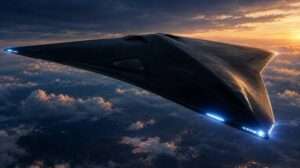
Furthermore, the Pentagon has explicitly stated in public Unidentified Anomalous Phenomena (UAP) reviews that it possesses zero verifiable evidence of reverse-engineered alien technology.
Why do stories like the Black Manta persist so stubbornly? The answer lies at the intersection of legitimate military secrecy and public fascination. Throughout modern history, genuine aerospace breakthroughs—such as the angular, radar-evading F-117 Nighthawk or the stealth B-2 Spirit bomber—looked impossibly alien when first tested in nocturnal skies.
When observers catch fleeting glimpses of actual, classified prototype drones or experimental stealth craft, their minds naturally attempt to fill in the blanks. Conspiracy theories take this valid technological secrecy and inflate it into stories of anti-gravity propulsion and recovered UFOs.
When analysts like Major Toor step forward to debunk these narratives, they perform a necessary reality check for public discourse. Allowing unverified rumors to circulate unchecked degrades scientific literacy and distracts from actual advances in defense aviation. Extraordinary claims demand extraordinary evidence, and a narrative built purely on anonymous forum posts and blurry video clips fails to meet even the most basic standard of proof.
At the end of the day, rumors—no matter how viral, detailed, or widespread—cannot rewrite the laws of physics or fabricate physical reality out of thin air. The TR-3B “Black Manta” remains what it has always been: an intriguing piece of modern digital folklore, but an unproven phantom nonetheless.