



The Supreme Court’s sharp questioning of Rahul Gandhi’s description of Veer Savarkar as a British “servant” exposed a fundamental problem with political narratives built on selective quotations: history cannot be reduced to a convenient sentence, a political slogan or a social-media meme. The Court’s intervention was particularly significant because the argument before it involved the language used in historical letters. Justice Dipankar Datta asked Rahul Gandhi’s counsel, senior advocate Abhishek Manu Singhvi, whether his client was aware that Mahatma Gandhi himself had used the expression “your faithful servant” while writing to the Viceroy. The Court also pointed out that former Prime Minister Indira Gandhi had written appreciatively about Savarkar. That observation should force a larger question: Can the language of a letter, by itself, become sufficient evidence to pronounce a historical figure a collaborator or traitor? Obviously, history demands more than that. Colonial Bharat was governed by a British administrative system. Bharatiyans communicating with British officials necessarily operated within the conventions of that system. Formal expressions in correspondence cannot automatically be converted into political verdicts without examining the circumstances, purpose and substance of the communication. That is precisely why the Supreme Court’s questioning mattered. The Court did not declare Mahatma Gandhi a British agent. Nor did it issue a judicial certificate declaring Savarkar innocent of every historical criticism. What it did was challenge the intellectual shortcut involved in using one expression as a sweeping historical verdict. Justice Datta even warned against making “irresponsible statements” about freedom fighters and reminded the counsel that freedom fighters should not be treated in such a manner. This is where the Congress’s political discourse deserves scrutiny.
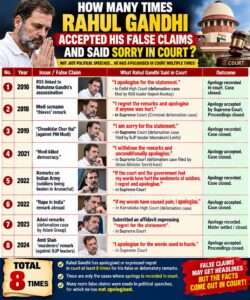
For years, Savarkar has remained a deeply contested historical figure. His petitions seeking release from the Cellular Jail are part of the historical record, and so are his revolutionary activities and his later political positions. Reasonable historians may interpret those episodes differently. But reducing the entire life of a freedom-era figure to the label “Mercy Veer” does not constitute serious historical argument. The same standard must apply to everyone—including Mahatma Gandhi. If a phrase such as “your faithful servant” were sufficient to establish loyalty to British rule, then the same yardstick would have to be applied consistently. History cannot become a courtroom where one side is judged by documents while the other is protected by mythology. There is another lesson here for the Congress leadership. Political parties are perfectly entitled to criticise historical personalities and challenge competing interpretations. But when such criticism enters public discourse, facts cannot be selectively weaponised. A political narrative may generate applause at a rally, but it must withstand scrutiny when placed before institutions that examine evidence and law. The Supreme Court’s remarks therefore offer a useful corrective—not a verdict on history, but a warning against simplistic historical claims. Ironically, the very argument used to diminish one freedom-era personality can boomerang when the same documentary yardstick is applied to another. The answer is not to denigrate Gandhi. It is not to sanctify Savarkar either. The answer is to examine the complete historical record. Bharat deserves that intellectual honesty. The freedom struggle was too vast, too complicated and too consequential to be reduced to partisan slogans. Gandhi, Savarkar, Subhas Chandra Bose, Sardar Patel, Bhagat Singh and countless others belonged to a turbulent period in which strategies, philosophies and methods differed sharply. The Congress, like every other political formation, has every right to defend its historical legacy. But defending a legacy cannot mean demanding that history be read selectively. The Supreme Court’s questioning supplied precisely the dose of perspective that political rhetoric often lacks: a historical label must be supported by history, not merely by repetition. And that is a lesson worth remembering whenever politics attempts to rewrite the past.

