



Bangladesh seems determined to follow Pakistan’s footsteps in displaying hostility towards the very neighbour that stood by it during its darkest hour. Having benefited enormously from Bharat’s friendship, economic assistance, security cooperation and strategic accommodation, Dhaka appears to have mistaken Bharat’s generosity for weakness. Its increasingly confrontational posture, growing proximity to China and Pakistan, and disturbing anti-Bharat rhetoric deserve a firm response from New Delhi. Friendship cannot be a one-way street, nor can Bharat be expected to underwrite the prosperity of a neighbour that increasingly treats it with disdain. December 12, 2026, could mark a defining moment in bilateral relations when the 30-year-old Ganga Water Sharing Treaty, signed in 1996, expires. Bangladesh is understandably seeking a fresh agreement guaranteeing its share of the river waters. But why should Bharat automatically renew an arrangement without reassessing its own requirements? Bihar, West Bengal and other Bharatiya stakeholders have legitimate drinking water, agricultural and industrial requirements that cannot be sacrificed to satisfy Dhaka. The Modi government must ensure that any future arrangement is based on equitable sharing, contemporary hydrological realities and Bharat’s domestic priorities. The Joint Rivers Commission remains the institutional mechanism for negotiations, but an automatic extension on Bangladesh’s preferred terms is certainly not Bharat’s obligation. Trade relations, too, cannot remain insulated from this growing mistrust. Bangladesh first restricted Bharatiya yarn imports through its land ports, ostensibly to protect its domestic textile industry. Bharat responded with reciprocal restrictions, including routing Bangladeshi ready-made garments through designated seaports and restricting several other categories of imports through land customs stations. These were not arbitrary acts of hostility but legitimate trade-policy responses. Why should Bharatiya businesses enjoy fewer opportunities in Bangladesh while Dhaka expects unrestricted access to the Bharatiya market? Reciprocal treatment must become the guiding principle. More disturbing is Bangladesh’s increasingly reckless strategic posturing. Rhetoric about choking Bharat’s strategically vital Siliguri Corridor, popularly known as the Chicken’s Neck, and suggestions of Pakistan’s support in a regional confrontation cannot be dismissed as harmless political theatrics. Any country that entertains such provocations must understand their implications. The corridor is Bharat’s indispensable land connection to its northeastern states. Its security is non-negotiable. Dhaka must also remember that geographical proximity is not a weapon it can brandish against Bharat without consequences.
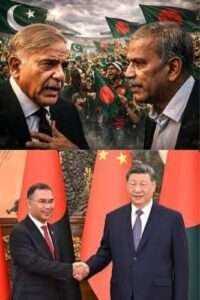
Equally troubling is the treatment of Bangladesh’s Hindu minority. Reports of attacks, intimidation, vandalism and persecution of Hindus have repeatedly raised serious concerns. A government claiming to represent a democratic nation cannot look away when its minorities feel threatened. Bharat has every right to raise these concerns, demand accountability and insist on the protection of Hindu lives, religious institutions and properties. Silence in the face of such intimidation would amount to abandoning a community with deep civilisational and cultural connections to Bharat. What makes Dhaka’s attitude particularly astonishing is its apparent disregard for what Bharat has contributed. Under the Neighbourhood First policy, Bharat extended nearly $7.86 billion in concessional lines of credit to Bangladesh, supporting railway connectivity, power generation, infrastructure and other development projects. The 131-km Bharat-Bangladesh Friendship Pipeline, operationalised in 2023, continues to supply much-needed diesel. Even in March 2026, Bharat supplied a 5,000-tonne diesel consignment through this pipeline. Is this how a neighbour repays sustained cooperation? The contrast with Bangladesh’s growing courtship of Beijing is equally revealing. In October, Dhaka signed a $335-million Chinese loan agreement for the expansion and modernisation of Mongla Port. Its continuing engagement with China over the Teesta River project also has strategic implications for Bharat. Bangladesh is entitled to pursue international partnerships, but it cannot expect New Delhi to ignore the security consequences of Chinese strategic inroads into Bharat’s immediate neighbourhood. The deterioration in relations following Sheikh Hasina’s ouster in August 2024, and the subsequent political realignment, has exposed how fragile the partnership had become. The BNP government under Tarique Rahman must decide whether it wants a constructive relationship with its largest and most consequential neighbour or prefers to play geopolitical games by leaning towards Beijing and Islamabad. Bharat does not seek to dominate Bangladesh, destabilise it or deny its people prosperity. But neither will it tolerate ingratitude, intimidation or strategic mischief indefinitely. Water, trade, energy, transit and development assistance are areas of cooperation, not unconditional entitlements. Modi’s government must put national interest above diplomatic niceties and make reciprocity the cornerstone of engagement. Pakistan learnt, at considerable cost, that Bharat’s restraint should never be mistaken for helplessness. Bangladesh would be foolish to learn the same lesson the hard way. A friendly neighbour deserves friendship; an ungrateful and hostile one must be made to understand that cooperation has consequences when trust is repeatedly abused.

