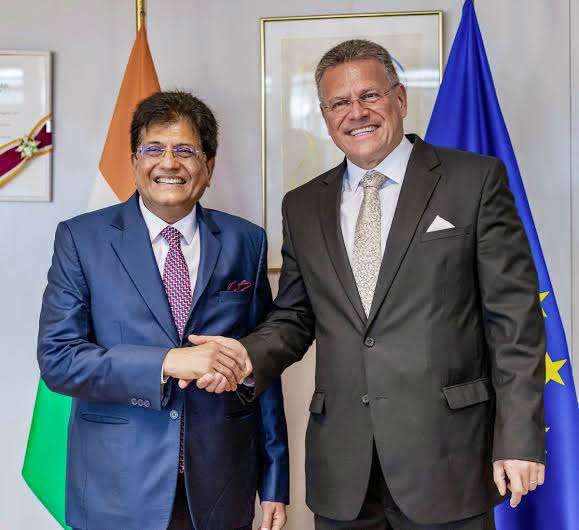
New Delhi: India and the 27-nation European Union have concluded a work programme on FDI screening, with both sides exchanging best practices to further accelerate investment flows, Commerce and Industry Minister Piyush Goyal said on Wednesday.
Addressing the media in Brussels after the third Trade and Technology Council (TTC) meeting, he said the council has helped both sides move from discussions to delivery, according to an official release.
Both the EU and India are committed to de-risking dependencies on certain critical areas, he said.
Following the conclusion of the third India-EU Trade and Technology Council (TTC) Ministerial Meeting in Brussels, Goyal said, “This is a historical year in the ties between the EU and India. We concluded the mother of all trade deals, as Her Excellency Von der Leyen called the EU-India free trade agreement.”
“This free trade agreement is fair, equitable, and balanced, truly a win-win agreement for EU businesses in the EU, India businesses and the people of India,” he said, adding that Prime Minister Narendra Modi had termed it “a partnership for global good.”
Goyal said the discussions in Brussels had reaffirmed the shared direction of the India-EU relationship.
“Today’s discussions reaffirmed our shared vision for an innovation-driven, trusted and future-ready growth partnership. The TTC today has become an important pillar of our engagement,” he said.
Goyal highlighted that the meeting discussed the best practices to implement further to expedite the investment flow on both sides.
“We have concluded a work program on foreign direct investment screening. We have exchanged best practices and will help further speed up the flow of investments on both sides.”
He also flagged global economic instability in the world at the moment, saying, “The multilateral trading system is undergoing great turbulence around the world, and therefore our shared commitment to a rules-based, open, inclusive and non-discriminatory World Trade Organisation will help us steer progress at the WTO in the future.”
He said India and the EU shared a common goal of reducing dependence on single sources for critical areas.
“Both the EU and India are committed to de-risking our dependencies on certain critical areas. We are both committed to building reliable and diversified supply chains. We are committed to ensuring that our work is outcome-oriented, whether it is in market access, whether it is in harmonising standards, working towards operationalising key supply chain imperatives and for greater collaboration in deep tech startups, innovation ecosystem, industrial partnerships, advanced manufacturing, connectivity, particularly with reference to global turbulence in this regard and overall building strong partnerships through our global capability centres,” he said.
He said that through the FTA, they are helping create the framework for greater trade and business. “We look forward to witnessing the signing of the EU-India FTA later this year,” he added.
He also cited PM Modi’s characterisation of India’s economic position, saying, “Prime Minister Modi described India’s growth story. And I quote, along with being a rising power, India is also a reliable power. India is not only fast-growing, but also a credible economy.”
Along with Piyush Goyal, Union Minister of State for Commerce and Industry, Jitin Prasad highlighted that the collaboration between the two nations is moving toward an action plan for “tangible” benefits for the people. He said that both nations have established a clear path for the near future.
“Our cooperation has increasingly moved towards an action-oriented and outcome-driven partnership, bringing together governments, industry, research institutions and innovation ecosystems from India and the European Union. Today, both sides have agreed on a forward-looking action plan for the year 2026-27, which will guide our cooperation across strategic and emerging technologies. This reflects our shared commitment to deepen collaboration in research and innovation, strengthen trusted and resilient technology value chains, promote greater engagement between our industries, and develop digital solutions that deliver tangible benefits to our citizens and businesses,” he said.
The Minister pointed to several cutting-edge sectors where the partnership has already begun to yield results. He noted that the progress achieved in areas such as semiconductor cooperation, Artificial Intelligence (AI), High-Performance Computing (HPC), and Digital Public Infrastructure (DPI) demonstrates the immense potential of the alliance.
He also emphasised that the impact of technological cooperation on the workforce and the general public will remain significant going forward.
“The progress achieved in areas such as semiconductor cooperation, artificial intelligence, and high-performance computing and digital public infrastructure demonstrates the potential of our partnership… At the same time, we recognise that technology cooperation must ultimately benefit our people, delivering digital skills, connecting our talent and innovation ecosystems, and facilitating greater mobility of skilled professionals will remain important elements of our partnership,” he said.
Prasad framed the India-EU alliance as a standard-setter for the international community. He suggested that the two entities are uniquely positioned to advocate for a technology partnership that is both sustainable and inclusive.
He said, “India and the European Union can make an important contribution towards building the global technology frameworks and standards that are open, trusted, interoperable, and responsive to the needs of our societies. The India-EU Technology partnership is entering an important new phase. Our focus going forward will be on implementation and measurable outcomes… India remains committed to working closely with the European Union to build a trusted, ambitious and future-oriented technology partnership that contributes to innovation, economic growth and an inclusive, sustainable digital future.”