



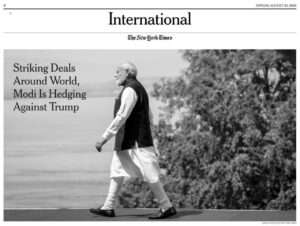
There are moments when recognition from abroad carries a message that domestic political sparring cannot easily drown out. The New York Times, hardly a newspaper that can be dismissed as a Bhartiya government mouthpiece, has drawn attention to Prime Minister Narendra Modi’s energetic diplomatic outreach and Bharat’s efforts to secure concrete gains in an increasingly turbulent world. That, in itself, deserves attention. In its analysis of August 29, 2026, the newspaper noted that Modi had visited at least 20 countries over the preceding year, with many engagements resembling focused, closed-door business negotiations. More importantly, the leaders of more than a dozen countries had also visited Bharat. This is not merely a story about a Prime Minister’s frequent-flyer record. It is about Bharat’s growing relevance in a world desperately searching for dependable partners. Germany’s submarine technology cooperation, improved student mobility prospects with France and reduced duties on Scotch whisky under the Bharat-UK trade agreement illustrate how diplomacy can translate into sector-specific outcomes. Bharat and France are deepening cooperation in artificial intelligence; South Korea is offering shipbuilding assistance; Norway has reiterated its commitment to employment creation in Bharat under the European Free Trade Association framework; and New Zealand is expanding engagement on maritime security. The Bharat-European Union trade agreement represents another potentially transformative opening. These are not identical achievements, nor should every announcement be mistaken for a completed transaction. Agreements must be implemented, investments must materialise and promised jobs must reach Indian workers. But the direction is unmistakable: Bharat’s international engagement is increasingly being assessed through identifiable economic, technological and strategic objectives. Those who reflexively ask why Modi travels abroad should answer a more pertinent question: what outcomes are being pursued, and how are they being measured? Certainly, previous Prime Ministers travelled overseas and built important relationships. Bharat’s diplomacy did not begin in 2014, and no honest assessment should pretend otherwise. The distinction being highlighted is the emphasis on targeted negotiations, defined deliverables and partnerships aligned with Bharat’s changing economic and security priorities. Continuity in foreign policy is no contradiction of progress in its execution.
The political significance is equally important. For decades, Bharat was often discussed as a promising market, a developing economy or a strategic counterweight. Today, countries increasingly see its vast consumer base, technological capabilities, skilled workforce and geopolitical position as assets they cannot afford to overlook. That shift reflects Bharat’s long-term strengths as well as the diplomatic effort to convert them into opportunities. The turbulence unleashed by American tariff policies, the uncertainties surrounding global trade and the Iran war underline why excessive dependence on any single partner is dangerous. Bharat must protect its interests by broadening its options. Stronger ties with Japan and Australia, deeper European engagement and cooperation across Asia are not acts of hostility towards Washington. They are sensible exercises in strategic autonomy. The much-publicised Melody toffees presented to Italian Prime Minister Giorgia Meloni may have generated social-media amusement, but diplomatic relationships cannot be measured in viral moments. Their worth lies in trust, negotiations and results. Nor should Bharat confuse international attention with unconditional admiration. Every partnership involves competing interests, and every agreement demands scrutiny. The real test is whether these engagements create jobs, strengthen defence capabilities, expand markets and improve the lives of ordinary Bharatiyas. Nevertheless, a country facing external economic pressure while widening its diplomatic options deserves credit for refusing to be boxed into a corner. Modi’s diplomacy is not infallible, but neither can it be reduced to a tally of boarding passes and ceremonial photographs. The message is clear: Bharat must engage the world without surrendering its strategic independence. If diplomacy can turn global uncertainty into opportunities for Indian industry, technology and employment, then the Prime Minister’s journeys have a purpose beyond the journey itself. That is the measure that matters. Not how often India travels, but how much India gains.

