



There is a fundamental difference between the right to dissent and the licence to manufacture disorder. Democracy guarantees the former; it does not give anyone a free pass for the latter. The Delhi High Court’s decision to reject, at this stage, AISA president Neha Bora’s challenge to a police notice seeking a peace bond must be viewed in this context. Nobody is above the law—not student leaders, self-styled revolutionaries or political activists who mistake confrontation for courage.
The message must be loud and unmistakable: Bharat is not Bangladesh, Sri Lanka or Nepal, and any attempt to manufacture a similar atmosphere of street-driven instability to overthrow an elected government will be met with the full force of the law. No anarchist experiment, however fashionable its slogans or radical its ideological packaging, can be allowed to hold the nation hostage.
Bora’s reported invocation of Bangladesh-style street protests and her alleged admiration for Sharjeel Imam, who has faced serious criminal allegations, raise questions that cannot be dismissed merely by wrapping them in the national flag. The right to seek regime change through democratic means is unquestionable. The right to incite unlawful disorder, if established, is not. These are two entirely different propositions, and deliberately confusing them is an insult to democracy.
The Delhi High Court, presided over by Justice Subramonium Prasad, declined to entertain Bora’s writ petition at this stage. The court, however, directed that safeguards be observed in the proceedings before the Special Executive Magistrate (SEM), including the furnishing of relevant material to her. It also directed the magistrate to consider whether the bond must be furnished at the outset or during the inquiry.
That distinction matters. The court has not pronounced Bora guilty of any offence, nor has it endorsed every allegation made by the police. But neither has it granted her the relief she sought. The legal process must be allowed to take its course without political theatrics being mistaken for a defence.
The police notice, issued on October 17 under Section 126 of the Bharatiya Nagarik Suraksha Sanhita (BNSS), sought a personal bond of ₹10,000 with one surety to maintain peace during the inquiry. The proceedings reportedly concern alleged sloganeering at Mandi House, protests around Jantar Mantar despite prohibitory orders, and alleged efforts to mobilise people for an October 16 demonstration.
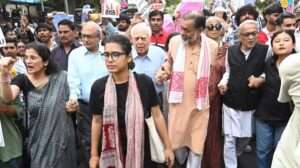
Bora’s counsel argued that the notice lacked independent application of mind and that citizens did not require permission to hoist the national flag or demand a change of government. The arguments deserve examination under the law. But nobody can use the national flag as a shield against scrutiny, just as the police cannot use preventive provisions as a substitute for evidence.
The constitutional position is clear: peaceful protest and criticism of an elected government are legitimate democratic rights. Preventive action, too, must satisfy the law, follow due process and withstand judicial scrutiny. A peace bond is not a declaration of guilt, and refusal to sign one cannot, by itself, establish criminal culpability.
Yet there is an equally important principle that Bharat’s self-appointed revolutionaries must understand. Governments are changed through elections, constitutional processes and the people’s mandate—not through intimidation, manufactured chaos or attempts to replicate upheavals in neighbouring countries. Bangladesh’s recent turmoil and the political upheavals witnessed in Sri Lanka and Nepal should serve as warnings about the consequences of instability, not as blueprints for political adventurism.
Bharat is a constitutional democracy, not a laboratory for importing street revolutions. Its institutions must be firm without becoming arbitrary, and its citizens must be free without being permitted to destroy the freedom and security of others.
The iron hand must fall on proven lawlessness, not legitimate dissent. If anyone attempts to turn Bharat’s streets into instruments for coercive regime change, the response must be swift, lawful and decisive. No political affiliation, ideological slogan or student-union designation can confer immunity.
The Republic will tolerate dissent. It must protect peaceful protest. But it cannot surrender to anarchy. That is the line every activist, political leader and public institution must respect.


The whole opposition is desperate to come back to power in one form or the other, especially in an undemocratic way. It clearly shows that they want to bring a civil war in the country. They lost all the opportunities to come to power in a democratic way. It is shameful for all those senior leaders to tag to CJP and Neha Bora,as parasites , which shows that they fell to the lowest level to gain power in whatever way possible. Shame on the opposition. I request the patriots and Indians to kick this people out of the political system.