
Rajarao Pochiraju
2026 may well go down as a landmark year in Bharat’s technology journey—not merely because of another breakthrough in space, digital technology or artificial intelligence, but because a young Indian private company has ventured into one of the most difficult frontiers of modern science: nuclear fusion.
Bengaluru-based Pranos Fusion’s PRAGYA, described as India’s first privately developed compact, low-aspect-ratio tokamak, marks an important moment in the country’s emergence as a serious private player in fusion technology. More importantly, it demonstrates something bigger: Indian private enterprise is increasingly willing to move from consuming technology to building the machines that create it.
That distinction matters.
Fusion is often described as the ultimate clean-energy dream—the process that powers the Sun, potentially capable of producing enormous quantities of low-carbon electricity. But reaching commercially viable fusion is not simply a question of producing plasma. It requires mastery of extraordinarily complex technologies involving magnets, materials, vacuum systems, plasma physics, control software, diagnostics and advanced engineering.
PRAGYA is therefore not a commercial fusion power plant, nor does its arrival mean that Bharat has “cracked” fusion. It is a testbed designed to study and control plasma and validate technologies needed for more ambitious machines. Yet that is precisely what makes it important.
The journey of a thousand miles, after all, begins with a single step.
Bharat is certainly not a newcomer to fusion. For decades, institutions such as the Institute for Plasma Research (IPR) have worked on magnetic-confinement fusion, operating tokamaks such as ADITYA-U and SST-1. India is also a key participant in the international ITER project, contributing critical components, systems, engineering expertise and a skilled workforce.
What has been relatively less visible is the emergence of a private fusion ecosystem capable of taking this scientific knowledge into the realm of entrepreneurial engineering.
That is where Pranos Fusion becomes interesting.
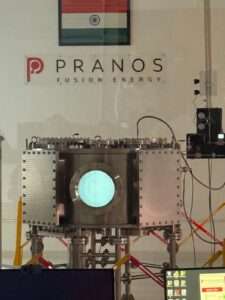
Its approach is not confined to one machine. The company is developing an integrated technology stack involving JENGA, its machine-design and plasma-control software platform; MAGGA, its high-temperature superconducting magnet technology; and PRAGYA, the experimental tokamak itself.
This is perhaps the most significant aspect of the story.
The global fusion race will not ultimately be won merely by the country that first demonstrates fusion electricity. It will also be shaped by who develops the intellectual property, supply chains, specialised manufacturing capabilities, magnets, materials, software and engineering talent required to build fusion machines at scale.
And Bharat has now entered that race with private capital and private risk-taking.
Pranos Fusion has reportedly raised $6.8 million to accelerate its fusion programme—an indication that investors are beginning to recognise fusion not merely as a distant scientific dream but as a potentially transformative deep-tech opportunity.
The larger ambition is even more challenging: developing a future fusion reactor capable of moving beyond experimentation towards energy production.
That will take years of painstaking engineering, repeated experimentation and, inevitably, failures along the way. Fusion is among the hardest technological problems humanity has attempted to solve.
But technological revolutions rarely arrive fully formed.
They begin with laboratories, prototypes, entrepreneurs willing to take risks and engineers determined to turn equations into hardware.
PRAGYA is one such beginning.
For Bharat, the real achievement is therefore not simply that a private tokamak now stands in a Bengaluru laboratory. It is that an Indian startup has chosen to enter a field once dominated almost entirely by governments and large international scientific collaborations.
From building components for global fusion projects to building its own fusion machines, the direction of travel is unmistakable.
The Sun may still be millions of kilometres away.
But with PRAGYA, Bharat’s private sector has taken a small—and potentially historic—step towards bringing the science that powers the Sun a little closer to home.