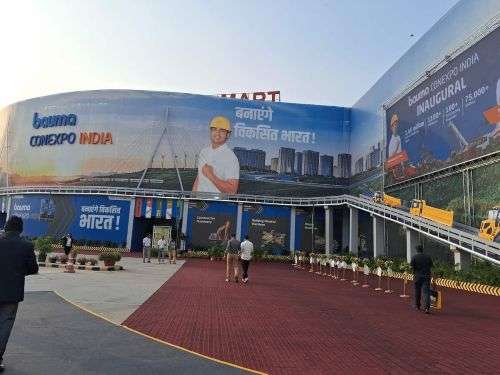
There is a larger story behind Volvo Construction Equipment India’s presence at bauma CONEXPO INDIA 2026. The machines on display will naturally attract attention, but the more significant development is the way India is becoming increasingly connected to Volvo’s wider technology, engineering and industrial network.
From the locally developed EC215 to the L120 Electric and the new Bangalore Technology Centre, the Indian operation is now contributing to a broader technology conversation within the Group.
It is easy to see that the theme, “AAJ BANAYEIN KAL”, fits that direction neatly. India is building roads, cities, industrial facilities, mines and other infrastructure at a considerable pace, while construction equipment itself is going through a period of technological change. Volvo CE is bringing together conventional machines, electric equipment, digital services and applications for construction and mining, while its Indian engineering capabilities are becoming more closely connected with global responsibilities.
That makes Greater Noida an interesting place to look at the Volvo CE story. The exhibition is not simply about what machines are being shown to Indian customers. It also provides a window into how Volvo is developing products and capabilities for a market that is becoming increasingly important within the Group’s global network.
Leadership Direction
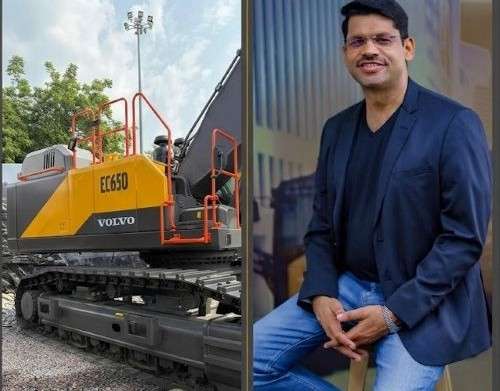
Under Dimitrov Krishnan, Managing Director, Volvo CE India, the Indian operation is increasingly moving beyond the conventional role of a local sales and manufacturing organisation. The direction is visible in the development of India-specific products, the expansion of engineering capability, the push into electric equipment and the strengthening of digital and service offerings. Krishnan’s role is therefore relevant to understanding the larger Volvo CE India story: the company is building a stronger local base while becoming more closely connected with Volvo’s global technology and product-development network.
The EC215 provides one clear example of that direction. Speaking at EXCON 2025, Krishnan described the machine as being built around insights gathered from customers operating across India, with a focus on productivity and fuel efficiency. The emphasis is significant because it places local customer requirements at the centre of product development rather than treating localisation simply as a manufacturing exercise.
Broad Offer
The Volvo CE display covers a wide range of applications. On the mining side are the EC480 and EC650 excavators, and the L150 wheel loader. The construction and infrastructure portfolio includes the EC210, EC220, EC215, L120 Electric, EC300, DD90 and SD110. Together, the machines present a portfolio extending from excavation and loading to road construction, compaction and electric equipment.
There is a useful logic to that mix. India’s construction and infrastructure market is not one single market, and neither are its equipment requirements. A large mining operation, a highway project, an urban infrastructure site and a controlled industrial application can have very different operating conditions. A broad portfolio allows Volvo CE to address those differences while maintaining a common technology and service philosophy.
The emphasis on productivity, efficiency, uptime and value is therefore as important as the machines themselves. For equipment customers, technology ultimately becomes meaningful through operating hours, fuel or energy consumption, maintenance requirements, production output and the ability to keep a project moving.
Local Shift
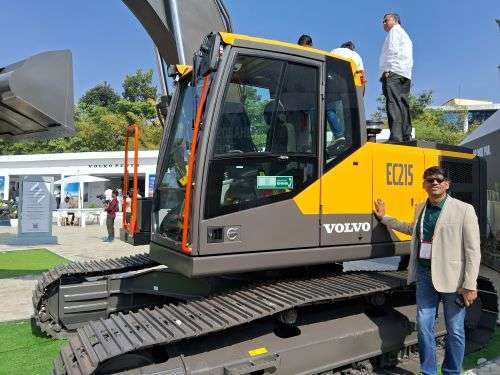
The EC215 is particularly significant in this context. Volvo CE introduced it at EXCON 2025 as a Made-in-Bharat machine for the 20–22-tonne class, following the EC210 introduced the previous year. The company positioned the excavator around productivity, fuel efficiency, value and uptime under its “Zyada Ka Vaada” proposition.
The importance of the machine goes beyond another addition to the excavator range. The 20–22-tonne segment is central to a large part of Indian construction activity, covering applications ranging from earthmoving and infrastructure to quarrying and other general-purpose work. Developing and manufacturing products around those requirements gives Volvo CE an opportunity to bring its global engineering approach closer to Indian operating conditions.
The EC210 had already established this direction. Introduced as a “Built for Bharat” excavator, it incorporated features including positive-control hydraulics, electronic engine management and multiple working modes, with an emphasis on productivity, fuel efficiency and maintenance. The EC215 builds further on the localisation approach.
The significance of localisation becomes even clearer when viewed alongside Volvo CE’s growing engineering presence in Bengaluru. The company has announced progress on its Technology Centre in Bengaluru, with a focus on R&D, localisation and product development for both India and global markets. This makes India part of the development process rather than simply the destination for finished products.

Global Bengaluru
Bengaluru has become an important part of Volvo Group’s technology footprint. The Group describes India as home to its largest R&D and IT hub outside Sweden, with more than 1,600 engineers working across areas including electromobility, automation and connectivity. Volvo Group India also has around 4,500 employees and three manufacturing plants in the country.
The wider Bengaluru ecosystem includes Volvo Group’s IT Competence Center, which works on global product development and digital transformation, as well as CampX, the Group’s innovation platform connecting startups and Volvo product and business teams. Its work spans electromobility, automation, connectivity, IoT, data science, analytics, artificial intelligence and other emerging technologies.
For construction equipment, this technology environment is becoming increasingly relevant. Modern machines combine mechanical systems with electronics, software, connectivity, sensors and increasingly sophisticated control systems. The ability to draw on engineering and digital expertise from the same ecosystem can support product development as well as the evolution of services around the machine.
The Bangalore Technology Centre adds another layer to that development. Volvo CE has specifically identified both local and global responsibilities for the centre, while its wider India strategy points to a growing role for India-centric construction equipment products and services.
Swedish Link
Volvo Construction Equipment is headquartered in Eskilstuna, Sweden, while the Volvo Group is headquartered in Gothenburg. For Volvo CE, Eskilstuna remains an important centre for the company’s global operations, technology and product development. India now sits within that wider network with manufacturing, engineering, digital capabilities, sourcing and service operations.
That creates an interesting connection between Eskilstuna and Bengaluru. One represents Volvo CE’s Swedish headquarters and long engineering heritage; the other brings a large technology talent pool and proximity to one of the world’s fastest-growing major construction and infrastructure markets. The relationship is becoming increasingly two-way.
Volvo Group India’s stated ambition to develop GTO Bangalore as its fourth Industrial Hub reinforces that direction. The company has identified greater regional and global sourcing, an expanded industrial footprint and closer collaboration across technology, purchasing, manufacturing and sales as part of this wider development.
Electric Question
The L120 Electric brings another important dimension to the exhibition. The electric wheel loader has a 282 kWh installed battery, 228 kW rated power and DC charging capability of up to 165 kW. Volvo indicates an operating time of around five to nine hours depending on application, with charging from 20 percent to 80 percent taking up to two hours under the specified charging conditions.
The machine is particularly interesting because Volvo identifies applications such as urban infrastructure maintenance, waste and recycling, agriculture, forestry, ports and logistics. These are environments where operating patterns and charging arrangements can often be more predictable than in some heavy-duty remote applications.
That makes the L120 Electric relevant to the way electrification is likely to develop in India. Different applications will move at different speeds, depending on utilisation, energy infrastructure, duty cycles and project economics. The transition does not have to look identical across every segment.
Volvo CE’s wider electric portfolio also includes machines such as the EC500 Electric, EC230 Electric, PT220 Electric, DD40 Electric and EC55 Electric. The growing range indicates that electrification is becoming an integral part of Volvo CE’s product-development strategy, alongside conventional powertrains and other technologies.
Mining Weight
Mining remains another important part of Volvo CE’s Indian proposition. The EC480 and EC650 give the company a presence in larger excavator applications, while the L150 wheel loader and the wider Volvo Group portfolio extend the conversation into loading, hauling and supporting operations.
The mining sector is becoming increasingly interested in productivity data, equipment availability, fuel and energy efficiency and lifecycle performance. This creates an opportunity for equipment manufacturers to combine machines with monitoring, maintenance and service capabilities rather than treating the equipment purchase as an isolated transaction.
For Volvo CE, that approach is reflected in its wider service portfolio, including digital machine monitoring, operator support, productivity management and Equipment-as-a-Service.
Digital Layer
The digital element is becoming more visible across construction equipment. Telematics can provide information on machine utilisation, operating conditions and maintenance requirements, while connected services can help customers and service teams respond more quickly to emerging issues.
Volvo CE has been developing this area alongside its equipment portfolio. Its Indian operation has also reported growth in parts and service activities and a doubling of its Equipment-as-a-Service business over the previous year.
The direction is consistent with a broader change across the industry. Customers increasingly look at the complete operating cost and productivity of a machine over its working life rather than simply its purchase price. Digital tools can become useful in that calculation when they provide practical information that helps improve utilisation, maintenance planning and uptime.
Performance Check
Volvo CE enters the exhibition with a substantial global business behind it. In 2025, the company reported net sales of SEK 81.6 billion, adjusted operating income of SEK 10.856 billion and an adjusted operating margin of 13.3 percent. Its global product portfolio has also undergone significant renewal, with more than 35 percent of its machine portfolio updated since the last CONEXPO.
The wider Volvo Group continues to invest in technology, industrial capacity and its global operations. India is part of that development, with the Group identifying the country as an increasingly important contributor to its global value chain.
Indian Test
India provides a particularly interesting environment for Volvo CE because the market brings together very different equipment requirements. Construction, infrastructure, mining, roadbuilding, industrial applications and urban development each place different demands on machines. Local manufacturing and engineering can therefore play an important role in adapting products and services to those requirements.
The EC215 illustrates the product side of that process. The Bangalore Technology Centre illustrates the engineering side. The L120 Electric represents the emerging technology side, while the service and digital portfolio represents the growing emphasis on the machine’s working life.
Together, they present a Volvo CE India story that extends beyond an individual product launch or exhibition appearance.
Exhibition Moment
bauma CONEXPO INDIA 2026 provides Volvo CE with an opportunity to bring these strands together. The company arrives with a portfolio covering medium and large excavators, wheel loaders, compactors, roadbuilding equipment, mining applications and electric machinery. Alongside that portfolio is an Indian operation increasingly connected to Volvo’s global engineering, technology and industrial network.
The larger development may therefore be less about any one machine on the stand and more about the role India is beginning to play in Volvo’s technology journey. The EC215 represents localisation. The L120 Electric represents the transition towards new power technologies. The Bangalore Technology Centre represents a growing engineering responsibility. The wider Volvo Group footprint provides the global connection.
For an industry increasingly concerned with productivity, efficiency, connectivity and lower-emission technologies, that combination gives Volvo CE India plenty to discuss at bauma CONEXPO INDIA 2026.
And perhaps the most appropriate interpretation of “AAJ BANAYEIN KAL” is simply this: the machines being developed and demonstrated today are increasingly being shaped by the requirements of tomorrow’s Indian construction and infrastructure industry.