



Viśiṣṭādvaita Vedānta, associated above all with Sri Rāmānuja, represents a profound attempt to unite philosophical knowledge, spiritual devotion and responsible human action. The word Viśiṣṭādvaita is commonly rendered as “qualified non-dualism,” although a more illuminating interpretation is the “non-duality of the qualified whole.” Rāmānuja affirmed the unity of ultimate reality without denying the reality of individual souls, the material universe, moral values and personal relationships. In his vision, unity does not require the destruction of diversity; rather, diversity finds its meaning within an organic relationship with the Supreme.
The distinction between Advaita and Viśiṣṭādvaita therefore deserves careful understanding. Advaita emphasizes the ultimate non-duality of Brahman, while Rāmānuja argued that the individual self and the world are real and remain meaningfully distinct from Brahman, even though they are inseparably related to Him. For Rāmānuja, Brahman is not an abstract and impersonal principle but the Supreme Person, identified with Nārāyaṇa, possessing infinite auspicious qualities. The individual soul does not become meaningless or disappear into an undifferentiated absolute; liberation is instead understood through an enduring relationship with the Supreme.
This philosophical distinction has an important practical consequence. Knowledge by itself does not make human life actionless. A human being remains a conscious, willing and responsible participant in the world. Faith naturally seeks expression through conduct. What one understands inwardly must eventually influence how one speaks, serves, worships, treats others and fulfils one’s responsibilities. Thus, in Rāmānuja’s spiritual vision, devotion is not merely an emotional experience. It becomes a disciplined way of living in which knowledge is translated into surrender, service, compassion and ethical action.
Bhakti therefore occupies a central place in Rāmānuja’s thought. His philosophy gave systematic philosophical expression to a deeply devotional understanding of the Supreme, while affirming the importance of moral life and practical earnestness. Modern philosophical scholarship likewise emphasizes that Rāmānuja’s system joined the spiritual, moral and practical dimensions of human existence rather than separating philosophical knowledge from ordinary life.
The celebrated account of Rāmānuja receiving the sacred Tirumantra from Tirukkottiyur Nambi illustrates this principle with extraordinary dramatic force. According to the traditional narrative, Rāmānuja repeatedly approached his teacher with humility seeking initiation into the sacred mantra. After his persistence and devotion had been tested, Nambi finally imparted the sacred teaching and instructed him to preserve its secrecy. The traditional story emphasizes the gravity of the initiation and the responsibility placed upon the disciple.
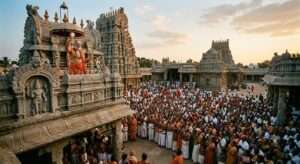
What followed became one of the most powerful episodes in the devotional memory surrounding Rāmānuja. Having received the sacred mantra, Rāmānuja is said to have gone to Tirunarayanapuram and climbed the temple tower. Instead of keeping the mantra exclusively for himself, he proclaimed it publicly so that ordinary people could hear and receive its spiritual benefit. The traditional account presents the scene as astonishing: something regarded as restricted to a qualified disciple was being offered openly to the multitude.
The people gathered below were overwhelmed. The young ascetic repeatedly proclaimed the sacred name, Om Namo Nārāyaṇāya, allowing the sound of devotion to spread among the assembled people. The episode is remembered not simply as an act of religious defiance but as an expression of Rāmānuja’s conviction that divine grace should not become the privilege of a narrow circle. His action transformed knowledge from something privately possessed into something that could become spiritually meaningful to a community.
Tirukkottiyur Nambi, according to the traditional account, was deeply distressed that Rāmānuja had violated the instruction given to him. He reminded his disciple that he had promised to preserve the mantra’s secrecy and warned him of the consequences. Rāmānuja’s answer is remembered for its extraordinary spirit of self-sacrifice: if his own suffering could secure the spiritual welfare of countless others, he was prepared to bear that consequence himself.
Whether read literally as a hagiographical episode or philosophically as a teaching narrative, its moral centre is unmistakable. Rāmānuja places the welfare of others above his own spiritual security. The greatness of the episode lies in the transformation of spiritual knowledge into compassion. Knowledge that remains locked within the individual can become a possession; knowledge offered for the welfare of others becomes service.
The traditional narrative then presents the teacher’s anger turning into profound affection. Seeing that his disciple had accepted personal danger for the sake of others, Nambi is said to have been moved to tears and embraced Rāmānuja. The teacher discovers in the disciple something greater than obedience alone: a heart willing to sacrifice itself for the liberation of others. The story thereby creates a powerful ethical paradox—sometimes the deepest fidelity to the spirit of a teaching may appear, at first sight, to challenge its external form.
This spirit of universal spiritual access also appears in the traditions surrounding Rāmānuja’s relationship with Kāñcīpūrṇa, a devotee whom Rāmānuja deeply respected despite the social hierarchy of his time. Historical-philosophical accounts describe Kāñcīpūrṇa as a Śūdra devotee associated with service to Vishnu at the temple, and they emphasize Rāmānuja’s admiration for his devotion. Rāmānuja’s reverence for Kāñcīpūrṇa demonstrates an important psychological principle: genuine devotion can challenge the assumption that spiritual worth is determined by social status.
The traditional account concerning Rāmānuja’s wife Tāñjamma further dramatizes this conflict between social convention and spiritual recognition. According to the narrative, Rāmānuja wished to honour Kāñcīpūrṇa by receiving him as a revered guest. When the social conventions of the household prevented that relationship from being expressed in the manner Rāmānuja desired, the disagreement became a decisive moment in his life. The tradition connects this conflict with his eventual renunciation of household life and his emergence as Yatirāja, the king among ascetics.
The significance of this episode is deeper than a domestic disagreement. It reveals the tension between inherited social conventions and a spiritual philosophy that places devotion at the centre of human worth. If the same Supreme Being is the inner ground of all souls, then external distinctions cannot be the final measure of spiritual dignity. Rāmānuja’s philosophy therefore supplied a metaphysical foundation for an ethic of relationship: the individual is real, the other is real, and the relationship between individuals has moral significance.
This does not mean that Rāmānuja’s philosophy simply erased every distinction between human beings. Viśiṣṭādvaita is not a doctrine that says all distinctions are meaningless. Quite the contrary: it insists upon the reality of individual souls and their differences. Its radical implication lies elsewhere. Difference cannot become an excuse for denying the spiritual significance of another person. The plurality of souls exists within a larger unity centred upon the Supreme. The metaphor of body and Self used in explaining Rāmānuja’s thought captures this organic relationship: individual selves and the world are related to Brahman as parts of an integrated whole.
From this perspective, the greatness of Rāmānuja’s reform is not merely theological. It is psychological and social. A society organized entirely around inherited status can easily produce humiliation, exclusion and spiritual insecurity among those placed at its margins. When a respected spiritual teacher publicly honours devotion wherever he encounters it, the psychological message is transformative: dignity is not exhausted by social identity.
Such a message can alter the behaviour of both the excluded and the privileged. Those who have been denied recognition may recover confidence, belonging and spiritual self-respect. Those accustomed to privilege are compelled to reconsider whether social position alone constitutes spiritual superiority. In this sense, religious reform can become social reform—not through the rejection of tradition, but through a reinterpretation of tradition around deeper principles of devotion, service and human dignity.
Rāmānuja’s influence was also institutional. Historical scholarship records that he reformed and standardized temple worship in communities associated with the Śrī Vaiṣṇava tradition, and his influence on temple and household religious practice has continued for centuries. His achievement was therefore not confined to philosophical books. He carried philosophy into institutions, ritual practice, teaching and community life.
The deeper strength of Viśiṣṭādvaita lies precisely here. Philosophy is not presented as an intellectual ornament detached from life. If Nārāyaṇa is the Supreme Reality and every soul possesses genuine existence in relation to Him, then one’s relationship with other beings acquires spiritual significance. Service to another person can become service to God; humility can become a form of knowledge; compassion can become an expression of devotion; and surrender can become the foundation of ethical action.
Rāmānuja’s life consequently illustrates a remarkable progression from knowledge to devotion, from devotion to service, and from service to social transformation. His philosophy gave intellectual structure to his spiritual conviction, while his life gave practical credibility to his philosophy. The scholar and the reformer were not two different persons within him. They were two expressions of the same search for truth.
The enduring lesson is that spirituality becomes socially powerful when it crosses the boundary between the temple and human life. A philosophy that speaks of the Supreme but cannot inspire compassion remains incomplete in practice. A devotion that seeks personal liberation while remaining indifferent to the suffering or dignity of others loses much of its transformative power. Rāmānuja’s ideal, as preserved through philosophy and tradition, was broader: the spiritual journey of one person should contribute to the spiritual welfare of others.
His legacy therefore continues to resonate as that of a Yati who sought to make philosophy a living force. His message was not merely that the Supreme should be known, but that knowledge should transform the knower; not merely that Nārāyaṇa should be worshipped, but that devotion should produce humility and service; and not merely that liberation should be sought individually, but that spiritual life should awaken concern for the welfare of others.
The enduring light of Rāmānuja is consequently found at the meeting point of wisdom, devotion, sacrifice and human dignity. His Viśiṣṭādvaita does not ask humanity to escape from relationship; it gives relationship a sacred foundation. The individual soul remains real, the world remains meaningful, action remains necessary, and devotion becomes the discipline through which knowledge enters conduct. In that synthesis lies the enduring power of Rāmānuja as one of the guiding lights of Indian spiritual and social thought.

