
The battlefield of Kurukshetra had become a theatre not merely of physical conflict but of human psychology, political calculation, moral uncertainty, and destiny. As the two armies stood prepared for war, every movement, every formation, and every word carried significance. The opening verses of the Bhagavad Gita reveal that the war was already being fought at another level—the battle within the minds of those who were about to enter the field. In such a moment, an assessment of the opposing army was not simply a military exercise; it reflected the mental condition of the person making that assessment.
“अत्र शूरा महेष्वासा भीमार्जुनसमायुधि
युयुधानो विराटश्च द्रुपदश्च महारथः”
Here, Duryodhana points toward the principal warriors of the Pandava army and tells Dronacharya that there are formidable archers assembled before them, warriors whose martial prowess is comparable to that of Bhima and Arjuna. Yuyudhana, also known as Satyaki, Virata, and Drupada are specifically mentioned as great chariot warriors. The statement appears, on the surface, to be a straightforward military appraisal. A king or commander naturally has to understand the composition, strength, capabilities, and potential weaknesses of the opposing force before committing his army to battle.
Yet the deeper psychological dimension of Duryodhana’s words deserves careful attention. He is not merely informing Drona about the enemy. He is drawing attention to the strength of the Pandava side at a moment when both armies are already assembled and the possibility of retreat has effectively disappeared. His words therefore reveal something about the state of his own mind. When a person is completely secure in his position, he usually speaks of his own strength with composure and examines the adversary with strategic clarity. But when uncertainty enters the mind, the enemy’s strength begins to appear disproportionately large.
The Pandava army was indeed formidable. Bhima possessed extraordinary physical power; Arjuna was among the greatest archers of his age; Satyaki was a distinguished Yadava warrior; Drupada was an experienced king and Maharatha; and Virata commanded the forces of his kingdom. Their presence represented not merely individual military strength but a network of alliances, experience, loyalty, and personal relationships forged through years of political and familial conflict. Duryodhana therefore had legitimate reasons to take their capabilities seriously. Strategic prudence requires an honest recognition of the opponent’s strength.
But the Gita’s psychological insight lies precisely in the difference between recognising an opponent’s strength and becoming psychologically dominated by it. Fear does not always announce itself openly. It can appear as excessive calculation, repeated reference to danger, defensive speech, or an urgent attempt to convince others—and perhaps oneself—that everything remains under control. Duryodhana’s description of the Pandava warriors can consequently be understood as containing both military information and an unconscious expression of apprehension.
The circumstances surrounding the war intensified such apprehension. The conflict had not arisen suddenly. It was the culmination of a long sequence of rivalry, humiliation, political manipulation, broken understandings, exile, failed reconciliation, and competing claims to sovereignty. The Pandavas had endured years of adversity, yet their difficulties had also strengthened their alliances and hardened their determination. Duryodhana, meanwhile, possessed a vast military establishment and the support of powerful kings, but numerical superiority could not automatically guarantee psychological or moral confidence.
The ancient Indian conception of warfare was far more sophisticated than a simple comparison of numbers. The strength of an army depended upon its commanders, formations, discipline, morale, strategic alliances, weapons, terrain, intelligence, communication, and above all, the determination of its warriors. A large army without unity could become less effective than a smaller force whose members possessed a common purpose. Kurukshetra therefore represented a contest between military resources as well as competing convictions about legitimacy, loyalty, honour, and duty.
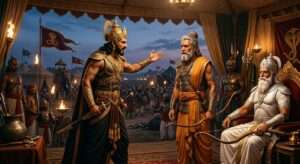
Duryodhana’s choice of Drona as the immediate recipient of these observations is equally significant. Drona was not an ordinary commander. He had trained both the Kauravas and the Pandavas. He knew their abilities intimately. He knew Arjuna’s exceptional mastery of archery, Bhima’s extraordinary strength, and the fighting capabilities of many other warriors on both sides. Therefore, Duryodhana was speaking to a man who needed no introduction to the military capabilities of the Pandavas.
That fact makes the conversation psychologically more revealing. Duryodhana’s words were not intended merely to educate Drona. They also served to direct Drona’s attention toward the seriousness of the opposing force. A commander who is reminded repeatedly of the enemy’s strength may respond with heightened vigilance. Duryodhana could therefore be attempting to stimulate Drona’s fighting spirit, reinforce his commitment to the Kaurava cause, and ensure that the army did not underestimate the Pandavas.
At the same time, Drona’s silence and patience carry their own significance. He understood the personalities involved, the history behind the conflict, and the abilities of the warriors standing before him. He did not need to react emotionally to Duryodhana’s words. A seasoned warrior understands that panic and excitement distort judgment. The battlefield demands concentration, and concentration requires emotional discipline. Drona’s patient listening can thus be viewed as the composure of an experienced military commander who understands that information must be separated from emotion before it can become strategy.
This distinction is fundamental to the Gita’s larger teaching. Fear magnifies the object of fear, while clarity measures it. When the mind is disturbed, strengths appear greater, weaknesses disappear from one’s own side, and possibilities become threats. Under stress, human beings frequently lose proportionality. They either underestimate danger through arrogance or exaggerate it through anxiety. Both errors can lead to strategic failure.
The Pandavas themselves were not free from human vulnerability. The Gita begins precisely because Arjuna, despite being an extraordinary warrior, becomes overwhelmed when he sees his teachers, relatives, elders, and friends standing opposite him. His weapons, knowledge, and experience do not disappear, but his psychological capacity to act becomes paralysed by emotional conflict. This establishes one of the central principles of the Gita: external strength becomes ineffective when the mind loses inner clarity.
The contrast between Duryodhana and Arjuna is therefore subtle. Duryodhana faces the enemy and begins assessing their strength; Arjuna sees the people behind the armies and becomes overwhelmed by the moral consequences of battle. Their reactions are different, but both demonstrate how psychological conditions influence perception. One responds through strategic apprehension; the other through moral anguish. The Gita ultimately addresses both dimensions by moving the individual from emotional disturbance toward disciplined understanding.
The reference to Bhima and Arjuna is especially meaningful because they represent two complementary forms of military power. Bhima symbolises tremendous physical force, courage, and direct combat strength, while Arjuna represents precision, discipline, technical mastery, and strategic excellence. An army containing both kinds of power cannot be dismissed merely because it is numerically smaller or politically disadvantaged. Duryodhana’s recognition of this fact shows that he understood the quality of the forces confronting him.
However, recognition alone does not produce wisdom. Strategic intelligence requires the ability to interpret facts without allowing fear, pride, anger, or personal attachment to distort them. The true commander does not merely ask, “How strong is my enemy?” He must also ask, “How strong is my own force? What motivates my warriors? What are their vulnerabilities? What is the objective of the war? What consequences will follow victory or defeat?” Such comprehensive reasoning is essential to genuine military judgment.
Kurukshetra consequently becomes an extraordinary study in war dynamics. The visible armies represent the external dimension of conflict, while the minds of the principal characters represent its invisible battlefield. Weapons can destroy bodies, formations can break armies, and strategies can determine immediate victories; yet decisions originate in the mind. A commander who loses psychological balance may possess enormous resources and still make disastrous decisions. Conversely, a disciplined mind can transform limited resources into formidable strength.
Duryodhana’s words therefore contain an enduring lesson beyond their immediate historical setting. His description of the Pandava warriors is a factual military assessment, but beneath it lies the human tendency to measure danger through the lens of one’s own emotional condition. The Gita does not teach us to ignore danger; it teaches us to perceive danger without surrendering our judgment to fear.
Drona’s patient response, the warriors’ readiness, and the silent presence of the opposing armies together create the atmosphere in which the Gita’s profound teaching emerges. Before Krishna begins to reveal the nature of duty, action, knowledge, devotion, and the Self, the epic first establishes the psychological reality of the battlefield. The war outside is about to begin, but the deeper war is already underway within the human mind.
Thus, these seemingly simple verses contain a profound truth. Strength must be assessed without arrogance, danger must be recognised without fear, and action must arise from clarity rather than psychological disturbance. The battlefield of Kurukshetra is therefore not merely an ancient war remembered in epic tradition; it becomes a metaphor for every circumstance in which human beings must act amid uncertainty, pressure, competing loyalties, and consequences they cannot fully control. The eternal message of the Gita begins precisely there—where external conflict meets the inner struggle of the human being.