


M Jaishree
“Tac cakṣur devahitaṃ śukram uccarata; paśyema śaradaḥ śataṃ, jīvema śaradaḥ śatam, śṛṇuyāma śaradaḥ śatam, prabravāma śaradaḥ śatam, adīnāḥ syāma śaradaḥ śatam, bhūyaś ca śaradaḥ śatāt.” This ancient Vedic aspiration expresses a remarkably comprehensive vision of human life: may we behold the light of the divine for a hundred autumns; may we live for a hundred years; may we hear, speak, and remain inwardly strong for a hundred years—and may life continue beyond that. The prayer is not merely a request for longevity. It is a wish that longevity should be accompanied by healthy perception, meaningful speech, mental strength, dignity, and constructive participation in society.
The deeper significance of the prayer lies in the quality of life it imagines. Merely surviving for a hundred years cannot be regarded as the fulfilment of the Vedic aspiration. The eyes should continue to behold what is worthy of seeing; the ears should remain receptive to what is worth hearing; speech should contribute something beneficial; and the mind should remain steady rather than becoming defeated by circumstances. Longevity, therefore, is inseparable from responsibility. A long life becomes meaningful when every additional year becomes an opportunity for learning, serving, creating, understanding, and contributing to the welfare of others.
The Upanishadic vision takes this aspiration further by turning attention from the external world towards the inner structure of human experience. The Upanishads do not simply reject the Vedic tradition; they reinterpret its symbols and redirect the centre of spiritual inquiry. The external ritual gradually becomes an internal discipline. The sacred fire is no longer confined to an altar. The sacrifice becomes an activity of consciousness, in which the individual examines desire, thought, action, knowledge, and the relationship between the self and the universe.
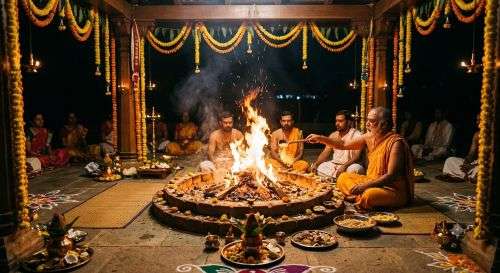
This transformation can be understood as a movement from external ritual to internal yajna. In the earlier ritual imagination, yajna involves an altar, sacred fire, offerings, priests, prescribed procedures, and collective participation. The Upanishadic approach retains the fundamental idea of sacrifice but gives it a more interior and philosophical dimension. Meditation, self-discipline, contemplation, knowledge, and conscious action become forms of offering. The individual becomes both the observer and the participant. The real question is no longer simply, “What is being offered into the fire?” but, “What is being transformed within the person?”
One of the most profound Upanishadic developments is the identification of the universe itself with the sacrificial being, the cosmic person or yajña-aśva in the symbolic meditation of the Chāndogya Upanishad. The imagery is deliberately expansive. Dawn is associated with the head of the cosmic horse; the sun with its eye; Vāyu with its breath; fire with its mouth; the year with its vital structure; heaven with its back; space with its belly; earth with its hoof; the directions with its sides; the intermediate directions with other bodily regions; the seasons and months with its limbs; day and night with its movements; the stars with its bones; and the sky with its flesh. The purpose is not to propose a biological description of the universe. It is a contemplative model intended to overcome the psychological separation between the individual and the cosmos.
Such symbolism has an important philosophical implication. Human beings ordinarily experience themselves as isolated individuals surrounded by an external world. The Upanishadic imagination reverses that perception. It asks us to see ourselves as participants in a larger order of existence. Breath is connected with atmosphere, food with earth, sight with light, bodily life with the cycles of nature, and individual existence with the larger movement of time. The symbolism therefore encourages ecological and existential awareness: human life cannot be understood independently of the natural systems that sustain it.
A scientific temperament can appreciate this insight without confusing metaphor with empirical science. The Upanishadic descriptions of the cosmos should not be presented as substitutes for astronomy, biology, physics, or modern cosmology. Their value lies elsewhere. They are philosophical and contemplative representations designed to cultivate a particular way of seeing. Modern science explains mechanisms through observation, measurement, experimentation, and mathematical reasoning. Upanishadic inquiry investigates experience, consciousness, meaning, identity, and the relationship between the knower and the known. These are different modes of inquiry, and intellectual honesty requires that neither be unnecessarily converted into the other.
The idea of yajna can consequently be extended into everyday life. Eating can become yajna when food is received with awareness and gratitude rather than greed. Work can become yajna when it is performed with competence, sincerity, and responsibility rather than merely for personal advantage. Speaking can become yajna when words are truthful, measured, and constructive. Learning becomes yajna when knowledge is acquired not merely for status but for understanding and service. Even silence can become yajna when it creates space for reflection instead of becoming indifference.
This interpretation also provides a rational social principle. Every society is sustained by countless ordinary actions performed responsibly. A teacher who teaches with dedication, a farmer who cultivates the land, a scientist who searches for evidence, an engineer who builds responsibly, a doctor who serves patients, a worker who performs a task honestly, and a citizen who respects the rights of others are all contributing to the larger social yajna. No single contribution may appear extraordinary, yet civilisation itself is constructed from such disciplined acts repeated over generations.
The social importance of this philosophy becomes particularly clear when viewed through the principle of mutual dependence. Exploitation arises when an individual sees resources, institutions, and other people merely as instruments for personal gain. Yajna reverses that orientation by introducing reciprocity. One receives from society and therefore has responsibilities towards society. One receives from nature and therefore must avoid destroying the conditions that sustain life. One benefits from the knowledge of previous generations and therefore has an obligation to preserve, refine, and transmit knowledge.
The prayer for a hundred years of speech is especially significant in an age of excessive communication. Human beings possess unprecedented means of speaking, publishing, broadcasting, and sharing information, yet communication does not automatically produce understanding. The Vedic aspiration is more demanding: may we speak for a hundred years. The implication is that speech should remain worthy of being spoken. Words should clarify rather than confuse, heal rather than humiliate, and unite rather than unnecessarily divide. Positive speech does not mean avoiding difficult truths; it means presenting truth with responsibility, proportion, and concern for consequences.
Likewise, the prayer to hear for a hundred years carries an equally important lesson. A healthy society requires not only people who speak but people who listen. Listening is an intellectual virtue because it creates the possibility of correcting one’s assumptions. It is a social virtue because it allows another person’s experience to be understood. It is also a spiritual discipline because it weakens the ego’s insistence that one’s own perspective must always be complete.
The expression adīnāḥ syāma—may we remain undiminished, not helpless or broken in spirit—adds another dimension. Physical longevity alone cannot guarantee dignity. A person may live long while becoming inwardly exhausted, resentful, fearful, or intellectually stagnant. The Vedic prayer therefore connects length of life with resilience. To remain steady through changing circumstances requires emotional maturity, intellectual flexibility, ethical discipline, and the ability to distinguish temporary difficulty from permanent defeat.
The Upanishadic concept of yajna can therefore be understood as a disciplined transformation of ordinary existence. The essential question is not whether life contains ritual objects, but whether consciousness is present in action. When a person eats consciously, works sincerely, speaks responsibly, learns continuously, respects nature, and contributes to others, ordinary activity acquires a deeper significance. Awareness converts routine into discipline, discipline into character, and character into social contribution.
This also explains why the Upanishadic path gives such importance to meditation and devotion. Meditation develops the capacity to observe thought without immediately becoming captive to it. Devotion develops humility by reminding the individual that existence is larger than personal ambition. Together they can moderate the ego, which is often the psychological source of excessive attachment, competition, resentment, and exploitation. The objective is not withdrawal from life but a more intelligent participation in it.
The inner journey is consequently not an escape from society. Properly understood, it prepares a person to participate in society with greater clarity. A mind that has examined its own desires is less likely to exploit others. A person who understands interdependence is more likely to act responsibly. A person who values truth is less likely to manipulate through speech. A person who recognises the impermanence of circumstances can respond to success without arrogance and failure without despair.
The Vedic and Upanishadic traditions repeatedly place peace at the centre of this transformation. Peace does not mean the absence of activity or conflict. It means an internal capacity to respond without being completely controlled by agitation. From a modern psychological and social perspective, such stability has practical value: thoughtful decisions are generally more constructive than impulsive reactions, sustained cooperation is more productive than perpetual confrontation, and long-term thinking is more beneficial to institutions than short-term gratification.
The prayer for a hundred years can therefore be read as an ethical charter for an entire lifetime. May our eyes remain open to truth and beauty. May our ears remain receptive to wisdom. May our speech remain constructive. May our minds remain resilient. May our actions contribute to the common good. May our individual existence remain connected with the larger ecological and social order. And when life extends beyond the hundred years imagined in the prayer, may those additional years carry the same spirit of awareness and responsibility.
The most profound message is that life itself can become yajna. There need not always be an external altar, sacred fire, priest, or elaborate ceremony. The human being can transform ordinary existence through intention, awareness, knowledge, ethical action, and service. Every conscious action becomes an offering; every responsible relationship becomes a contribution; every moment of self-understanding becomes an inward illumination.
Seen in this way, the ancient prayer is surprisingly contemporary. It does not merely ask for a long life. It asks for a life in which seeing, hearing, speaking, thinking, working, and living remain meaningful. Its ideal is not longevity without purpose, nor spirituality without reason, nor knowledge without responsibility. It is an integrated life in which inner harmony produces outward responsibility and individual fulfilment becomes inseparable from universal welfare.
That is the enduring brilliance of the Upanishadic vision: to live long, live consciously; to speak, speak constructively; to receive, give in return; to know, remain humble; and to recognise that the greatest yajna is the transformation of one’s own life into a contribution to the larger order of existence.



The symbolism between ecology and existence of human life is very well explained in simple terminology by the author.
The concept of yagna in practical life is dealt with,in relation to Upanishads.
yoga spirit is essential in this age of miscommunication and meaningless interpretation to be useful for one,s self and society at large.