



There is nothing wrong with questioning the outcomes of foreign policy. In fact, a healthy democracy must encourage such scrutiny. But when a senior Congress leader like P. Chidambaram, a former Finance and Home Minister, publicly asks what tangible benefits Bharat has derived from BRICS, the timing and tone of the criticism deserve to be questioned.
The issue is not whether every BRICS summit has produced an immediate, headline-grabbing agreement. The real question is whether Bharat can afford to dismiss a multilateral platform that has grown into one of the most consequential groupings of emerging economies. Chidambaram’s argument that he has not seen tangible benefits from the last two or three BRICS meetings, while also questioning the utility of platforms such as the SCO, G20 and Quad, sounds less like constructive scrutiny and more like political frustration.
The timing makes it particularly difficult to understand.
Within hours, New Delhi is preparing to receive some of the most powerful leaders in the world. Russian President Vladimir Putin is scheduled to arrive on Friday, ahead of the September 12–13 BRICS summit, while Chinese President Xi Jinping is expected on Saturday for his first visit to Bharat in seven years.
Does that, by itself, prove that every BRICS meeting has been an unqualified success? Certainly not. But does it demonstrate that the world takes Bharat’s diplomatic weight seriously? Absolutely.
China is not sending a symbolic delegation. Xi Jinping himself is coming to New Delhi despite the deep mistrust that has characterised India-China relations since the 2020 border crisis. Russia, meanwhile, continues to treat Bharat as a Special and Privileged Strategic Partner. Prime Minister Narendra Modi and President Putin have already reviewed cooperation across defence, energy, space, technology and other sectors, while the bilateral relationship continues to expand despite enormous geopolitical turbulence.
This is precisely where Congress appears to be missing the larger picture.
Foreign policy is not a balance sheet in which every summit must immediately produce a cheque, factory or treaty. Diplomacy creates access, influence, negotiating space and strategic options. It allows Bharat to speak to Washington and Moscow, Beijing and Tokyo, the Gulf and the Global South, without becoming captive to any single power bloc.
BRICS itself has provided tangible institutional outcomes. The New Development Bank is one example. Under Bharat’s 2026 chairship, the BRICS economic agenda has also moved towards strengthening trade, MSME access to global markets and resilient supply chains. The BRICS Trade Ministers’ meeting in Jaipur produced a strategy framework for economic partnership through 2030 and guiding principles aimed at expanding MSME access to global markets.
Even more importantly, Bharat is now using its BRICS chairship to push practical initiatives, including greater cooperation in digital payments and cross-border transactions. The Reserve Bank of India has proposed linking central bank digital currencies among BRICS members to facilitate international payments.
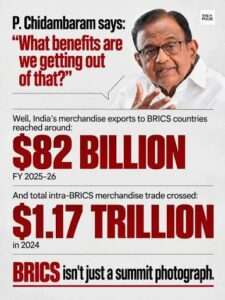
And yet, at this very moment, the Congress response is to ask: What has Bharat got from BRICS?
That question is not merely uninformed; it risks reducing national diplomacy to partisan point-scoring.
The transformation of Bharat’s global standing over the past decade cannot be denied. From being frequently treated as a peripheral player, Bharat today sits simultaneously at the BRICS, G20, Quad and SCO tables. It can engage Russia without abandoning the United States, engage China without surrendering its security interests, and work with the Global South while deepening partnerships with advanced economies.
That is not weakness. That is strategic autonomy.
Congress is free to criticise Prime Minister Narendra Modi and External Affairs Minister S. Jaishankar. It is equally free to demand measurable outcomes from foreign policy. But there is a line between legitimate accountability and appearing to belittle India’s growing global influence.
When the Chinese President and Russian President are making high-profile visits to New Delhi, when Bharat is chairing BRICS, and when major economic, technological, defence and diplomatic conversations are taking place on Indian soil, the responsible political response should be to ask how Bharat can extract the maximum strategic and economic advantage.
Not whether the entire exercise is worthwhile.
If Congress cannot distinguish between questioning a government’s performance and questioning the country’s place at the global high table, its frustration is understandable—but its politics is increasingly difficult to defend.
National interest must rise above partisan frustration. Foreign policy certainly deserves scrutiny. Bharat’s global rise, however, deserves neither apology nor cynicism.


