Lakshmanrao Upadhyayula
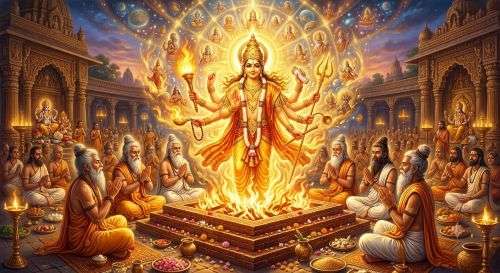
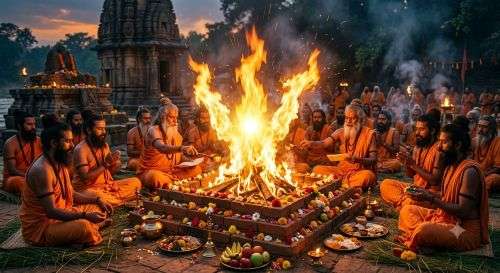
The sage Gādhi, immersed in profound contemplation, invokes Agni through the majestic cadence of Tristup chandas in the Rugvedic hymns. In the sacred dawn of yajna, the radiant Usha, bearer of awakening and carrier of oblations, arrives together with Agni and the divine Aswins. Through the disciplined chants of the Ritvijas, they invite the swift and luminous god Dadhikru, whose celestial vitality symbolizes motion, vigor, and divine intelligence. The atmosphere of sacrifice becomes filled with sacred resonance as the assembled gods, united in harmony and brilliance, incline themselves toward the hymns uttered with devotion and precision. The Vedic seers perceived this sacred invocation not merely as ritual worship, but as the establishment of cosmic correspondence between human aspiration and divine order.
Agni is praised as the mysterious force possessing threefold nourishment, threefold stations, and threefold tongues. His food is manifold because he consumes clarified butter, Soma essence, sacred wood, and the offerings sanctified by mantra. His abodes are understood in both ritualistic and cosmic dimensions. The sages contemplated the three sacrificial fires — Garhapatya, Ahavaneeya, and Dakshina — as manifestations of earthly continuity, celestial aspiration, and transformative energy. Likewise, the three divisions of sacrifice — Ekaha, Aheena, and Satra — reflect the rhythm of time, discipline, and prolonged spiritual dedication. Morning, afternoon, and evening offerings symbolize the movement of consciousness through awakening, action, and contemplation. Agni’s three tongues, known as Pavaka, Pavamana, and Suchi, represent purification, refinement, and illumination. Through these forms, Agni consumes offerings and carries them to the gods, acting as the eternal mediator between visible existence and invisible divinity.
The Vedic sages recognized in Agni a profound scientific temperament concealed within spiritual symbolism. Fire was not viewed merely as physical combustion, but as the universal principle of transformation. Agni converts matter into subtle essence just as knowledge transforms ignorance into wisdom. The observation of flames, heat, light, motion, and cyclical energy inspired the seers to understand natural law through sacred language. Agni was contemplated as the hidden intelligence operating within digestion, the brilliance of the sun, the lightning in the sky, and the vital warmth sustaining life. Thus, the hymns reveal an ancient perception of interconnected energy systems governing the cosmos. The sacrificial altar itself became a symbolic laboratory where material substances were transformed through disciplined procedure, reflecting the eternal laws of conservation, exchange, and renewal.
Agni is further glorified as the knower of all beings born into existence. Nothing remains concealed from his luminous awareness. He is the satisfier of worlds, the dispenser of the fruits of action, and the inexhaustible reservoir of nourishment sustaining creation. The gods themselves adorned Agni with countless forms of brilliance and subtle powers. The hymns poetically describe these as divine illusions or mysterious tactics, suggesting the countless manifestations through which energy operates within nature. Agni exists in the hearth, the stars, the atmosphere, and the living body. Like the sun governing the succession of seasons, Agni regulates cycles of fertility, growth, decay, and renewal. In this vision, the cosmos is not chaotic, but harmoniously ordered through divine intelligence expressed as radiant energy.
The sage also portrays Agni as ancient, truthful, omniscient, and omnipresent. He is the destroyer of Vruthra, the force of obstruction and stagnation. Agni breaks darkness, ignorance, and inertia, opening pathways toward clarity and progress. Though powerful and sovereign among humans, his dominion is not tyranny but the governance of cosmic law and moral order. The Vedic seers understood that civilization itself depended upon mastery of fire — for warmth, protection, metallurgy, nourishment, and sacred rites. Therefore, Agni became both spiritual guide and civilizational foundation. His light symbolizes ethical consciousness, while his transformative force represents the capacity of humanity to rise above limitation through discipline and wisdom.
In reverence, the sage invites Agni to carry the priests beyond the shores of sin and suffering. The yajna becomes a sacred voyage in which divine forces guide humanity toward purification and higher realization. Alongside Agni are invoked Dadhikru, Usha, the resplendent Savitha, the twin Aswins, Bhaga, the Vasus, the Rudras, and the Adityas. Each deity embodies a cosmic principle contributing to universal harmony — light, vitality, healing, prosperity, strength, discipline, and righteousness. Their collective presence transforms the sacrificial arena into a reflection of the cosmic universe itself. Through sacred sound, disciplined ritual, and contemplative insight, the hymn reveals the eternal Vedic vision in which spiritual wisdom and scientific observation exist together in profound unity, illuminating both the outer universe and the inner soul.