


Afflicted by Karna’s relentless assault, Dhrishtadyumna’s spirit faltered as the vigor of battle deserted his weary frame. Speaking in a feeble voice to his faithful charioteer, he confessed, “My hands and legs tremble in distress. The strength of my body has departed, and my mind no longer obeys my will. Your counsel is wise. Drive this chariot either to the mighty Bhimasena, son of Vayu, or to the unconquerable Arjuna, son of Indra. There is no honor in displaying courage when the power to wield it has vanished.” Perceiving the desperate condition of his master, the skilled charioteer swiftly guided the chariot toward Bhimasena. Witnessing Dhrishtadyumna’s withdrawal, Kripacharya proclaimed his triumph by sounding his resounding conch. Twanging his mighty bow, he released glittering torrents of arrows that scattered the opposing warriors as the wielder of the Vajra disperses the hosts of the Asuras.
Elsewhere, Sikhandi confronted Kritavarma with unwavering determination, piercing his chest with five keen arrows. Kritavarma answered with sixty swift shafts that shattered Sikhandi’s bow. Undismayed, Sikhandi seized another bow and showered ninety arrows upon his adversary, yet that weapon too was broken by Kritavarma’s unfailing skill. Like two enraged bulls whose horns had been broken in combat, they continued their dreadful contest without yielding. Grasping yet another bow, Sikhandi struck Kritavarma with such force that the warrior bled profusely, standing upon his chariot like a crimson statue carved from living stone. Inflamed with wrath, Kritavarma seized a fresh bow and discharged seventy arrows that drenched Sikhandi in blood. Returning the assault, Sikhandi pierced Kritavarma’s ribs, inflicting excruciating agony. Furious beyond restraint, Kritavarma covered Sikhandi with innumerable shafts until the heroic son of Drupada lost consciousness. Fearing disaster, Sikhandi’s charioteer carried him far from the battlefield. At the sight of their fallen commander, the Panchala forces scattered in every direction like frightened birds fleeing the arrows of a relentless hunter.
Meanwhile, Arjuna continued his terrible conflict against the Trigarta king. The kings of Sibi and Salva hastened to support their ally, while the warriors who had solemnly vowed to slay Arjuna gathered around him. The famed Narayana force, known also as the Gopala army, advanced with Satyasena, Chandradeva, Mithradeva, Mithravarma, Sousruthi, Suvarma, Susarma, and his valiant brothers. Reporting these events to Dhritarashtra, Sanjaya declared that Satyasena struck Arjuna with three arrows, Mithradeva with sixty-three, Chandradeva with seven, Mithravarma with seventy-three, Sousruthi with seven, Satrumjaya with twenty, and Susarma with eight, until the son of Pandu seemed hidden beneath a storm of missiles. Yet he stood immovable like a mountain enduring the fury of monsoon rains. Without yielding a single step, he pierced Mithradeva with one hundred arrows, struck Satyasena with three, Susarma with eight, Mithravarma with nine, slew Sousruthi with twenty-five arrows, and severed Chandradeva with eight deadly shafts. His incomparable mastery of warfare shone like the radiance of the midday sun.
Then the mighty Satyasena hurled a golden spear that pierced the shoulder of Krishna. The whip slipped from the Lord’s hand, and the reins fell upon the chariot seat. Seeing his beloved charioteer wounded, Arjuna’s righteous fury blazed like sacrificial fire. He urged Krishna to drive directly toward Satyasena. Calm despite his wound, Krishna grasped another whip and guided the divine chariot toward the foe. Arjuna instantly pierced Satyasena’s body with countless arrows before severing his head with a single irresistible shaft. He then slew Mithravarma with a razor-edged arrow and struck down his charioteer without delay. Once more the Trigarta warriors encircled Arjuna like flames surrounding a blazing forest, yet he tormented them with ceaseless showers of arrows. Though overwhelmed by destruction, the kinsmen of Susarma remained steadfast in their vow and continued the struggle. Arjuna then severed the head of King Mithrasena with a broad-headed arrow and pierced Susarma deeply in the chest.
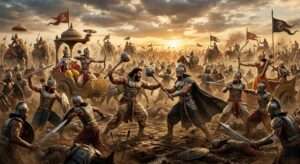
The united host of the sworn warriors roared like thunderclouds as they closed around Arjuna, raining fierce arrows upon him from every side. Instead of succumbing to anger, the great archer smiled with admiration at their fearless resolve. His countenance shone with renewed brilliance as he invoked the irresistible Indrastra. Instantly the celestial weapon manifested in countless forms, smashing chariots, royal umbrellas, horses, swords, spears, bows, arrows, pestles, bludgeons, fans, banners, armor, and conches into fragments. Foot soldiers and horsemen were torn apart, while rivers of blood carried the shattered remnants of war across the devastated earth. Human bodies were mangled beyond recognition, and even the celestial spectators gazed with astonishment upon that dreadful spectacle of flowing blood and towering heaps of the slain. The battlefield became crowded with lifeless elephants, fallen horses, shattered chariots, and broken weapons. Swift steeds raced through the mire of flesh and blood without faltering, while the blazing streams of Arjuna’s arrows consumed the courage of the surviving warriors. When the clouds of dust and smoke finally dispersed, Arjuna stood revealed like a blazing fire emerging from the darkness after a violent storm.
In another quarter of the battlefield, Duryodhana and Yudhishthira engaged in fierce combat. With unwavering concentration, Duryodhana shot nine well-aimed arrows and struck Yudhishthira’s charioteer with a powerful shaft. The righteous king’s eyes reddened with anger as he answered with thirteen arrows that deeply afflicted Duryodhana. He wounded the four horses, struck the charioteer, shattered the royal standard and banner, broke Duryodhana’s bow, and smashed his sword with eight sharp shafts before piercing him with five more arrows. Unable to withstand such relentless assault, Duryodhana withdrew to a place of safety. Though his chariot lay shattered, the resistance he had displayed remained worthy of a mighty warrior.
Seeing Duryodhana’s distress, Aswatthama, Karna, Kripacharya, and many celebrated kings rushed together against Yudhishthira. Observing the gathering peril, Bhima, Arjuna, Nakula, and Sahadeva hastened to defend their elder brother, and soon both armies met with renewed determination. As the day advanced toward midday, every warrior fought with desperate resolve, transforming the battlefield into an immeasurable ocean of destruction.
The clash grew so dreadful that cries of agony echoed from warriors whose limbs had been severed, while the cracking of shattered skulls resounded like countless bursting flames. Horses hung lifeless upon the tusks of maddened elephants, trunks were severed, and infantry stumbled and leaped through torrents of blood like wild buffaloes struggling in turbulent waters. Charioteers were torn into fragments amidst the relentless combat, and pools of blood spread across the earth while crimson droplets rose into the air, staining the heavens with a fearful hue. Flesh, entrails, broken bones, and shattered bodies formed dreadful mounds across the plain until the sacred land of Kurukshetra assumed the appearance of a nightmarish realm. Thus Sanjaya faithfully described to Dhritarashtra the terrible, merciless, and fearsome spectacle of that unparalleled conflict, where valor, destiny, and mortality stood face to face beneath the gaze of heaven.

