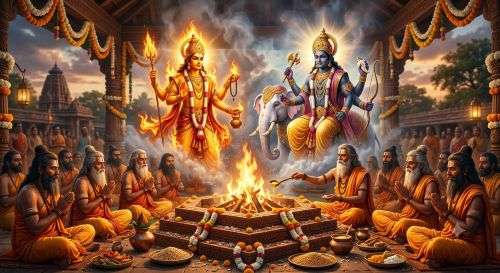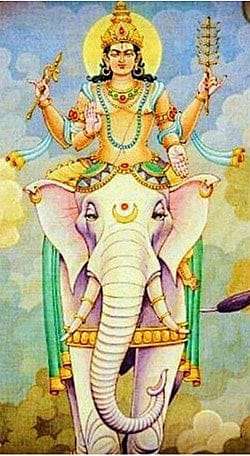
The sage Puruchhepa, in the cadence of the Antyeṣṭi chandas of the Rigveda, raises a profound and measured invocation to Indra, revealing both the spiritual vision and the subtle philosophical insight of Vedic thought. In his contemplation, the gods, though diverse and often opposing in their functions, remain harmonized under the supreme command of Indra, who stands as the integrating force of cosmic order. Even the vast earth, with its manifold energies and sustaining powers, is perceived as moving under his dominion, not as an act of subjugation, but as an orchestration that enhances the brilliance of universal harmony. Thus, Indra emerges not merely as a warrior deity, but as the regulator of balance, embodying a principle akin to a scientific law that governs diversity through unity.
The sage further proclaims that all ritual actions—whether the oblations of dawn, midday, or dusk, or the special sacrificial offerings—inevitably reach Indra, signifying that he is the focal point of all sacred transactions. In this vision, Indra is not confined to a singular form but exists in entirety, permeating every aspect of the ritual field. The patrons, driven by their aspirations for prosperity and transcendence, recognize him as the ultimate recipient of Soma offerings, for it is through him that their desires find fulfillment and their journey toward higher realms is made possible. The metaphor of Indra as a ship that carries the devotees across the turbulent ocean of conflict reflects both a spiritual assurance and a practical understanding of reliance on a higher organizing force, much like a guiding principle that enables navigation through uncertainty.
In the sacrificial arena, the patrons revere Indra with a devotion that parallels the reverence offered to Shiva, acknowledging his auspicious and transformative nature. Without straying from righteousness, Indra proclaims his might through actions that sustain cosmic welfare. The seekers, desiring cattle, prosperity, and freedom from sin, approach him with sincerity, offering oblations along with their families in a collective act of faith and discipline. This communal participation reflects a scientific temperament embedded in Vedic culture, where repeated and structured rituals function as systematic practices aimed at harmonizing human life with natural and cosmic forces.
Indra’s heroic deeds are extolled with clarity and depth, as he is remembered for shattering the fortified dwellings of adversaries and destroying forces that oppose sacred order. These anti-ritual beings symbolize not merely external enemies but also the disruptive tendencies that hinder the flow of harmony and knowledge. By conquering such forces, Indra establishes control over earth and waters, signifying mastery over the fundamental elements of existence. His actions encourage joy and auspiciousness, suggesting that the removal of disorder naturally leads to the flourishing of life. In this sense, the hymn subtly mirrors an empirical observation: when imbalance is corrected, systems tend toward stability and well-being.
The sage and the patrons alike acknowledge Indra as their protector and companion, whose presence ensures safety and prosperity. Their offering of Soma, the elixir of vitality and immortality, is not merely symbolic but represents an exchange of energies, where devotion strengthens the deity, and in return, the deity empowers the devotees. Indra’s roar in battle, likened to that of a lion, signifies not only physical valor but also the assertion of order over chaos. His self-sufficiency and generosity, manifested in the provision of food and nourishment, depict him as a sustaining force, ensuring that life continues to thrive in all conditions.
Renowned as the fulfiller of desires and the subduer of enemies, Indra is invoked as the gateway to heavenly attainment, with the yajña itself being regarded as the door through which higher states are accessed. The sage, with intellectual confidence and creative insight, presents new hymns in the Antyeṣṭi meter, reflecting the dynamic and evolving nature of Vedic expression. This act of composing new hymns underscores a scientific spirit—an openness to innovation within a structured tradition, where knowledge is continuously refined and articulated.
Finally, the hymn culminates in a fervent appeal for protection and justice, where the sage prays that all hostile intentions and destructive tendencies directed toward the devotees may dissolve. The looters and wrongdoers, representing forces of disorder, are implored to lose their power to disturb the righteous. In this closing vision, the narrative affirms a profound truth: that alignment with cosmic order, sustained through disciplined practice and enlightened understanding, leads to both spiritual elevation and worldly harmony, establishing a timeless bridge between faith and reason.