



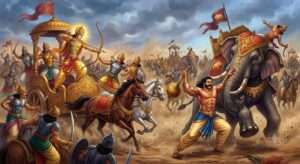
As the dreadful war raged across the blood-soaked plain of Kurukshetra, Bhimasena advanced like a tempest among the armies. At that moment, he was engaged in a fierce encounter with King Kshemadhurti. Though the ruler of Karusha intervened and showered him with arrows in rapid succession, Bhima paid him no heed. He neither turned his gaze toward him nor altered the course of his assault. With unwavering focus, the mighty son of Vayu directed a relentless volley of shafts against the elephant of Kshemadhurti. Pierced on every side, the colossal beast appeared like a gigantic porcupine adorned with ivory tusks. Unable to endure the agony, it recoiled and fled in confusion, scattering all who stood before it.
Bhima pursued the retreating elephant with terrible determination. The king of Kuluta, exerting every effort, turned the wounded beast back toward the advancing Pandava warrior. Bhima then released arrows in such dense lines and circular formations that no portion of the elephant’s body remained untouched. Witnessing this astonishing display, Sanjaya narrated to King Dhritarashtra how the incessant arrow-fire of the Karusha ruler failed to distract Bhima in the slightest. Bhima shattered the king’s bow, but the monarch swiftly seized another and launched blazing shafts that struck Bhima and slew his elephant, which crashed lifeless upon the earth. The soldiers on both sides erupted in shouts as the mighty beast fell.
Descending from the slain elephant, Bhimasena seized his massive mace and rushed forward like Death himself. With tremendous force he struck the elephant of Kshemadhurti. The king leapt down with sword in hand and charged directly at Bhima. Yet before he could deliver a blow, Bhima swung his mace with irresistible power and crushed the king’s head. Kshemadhurti fell beside his elephant, resembling a mountain shattered by the thunderbolt of Indra. He appeared like a lion struck down by celestial lightning. The sight filled the surrounding warriors with horror and dread, causing many to retreat in terror.
At that moment, Karna advanced to restore the courage of the Kaurava host. Covering the sky with countless arrows, he charged into the Pandava ranks with overwhelming fury. His assault struck the opposing army like a crashing wave against a shore. Seeing Karna’s ferocity, the Kauravas cast aside their fear and surged forward once more, fighting with renewed determination. The Pandavas answered with thunderous cries, displaying their pride, valor, and strength. To the wonder of the celestial beings watching from above, the great war continued with undiminished intensity.
The elephants of the Pandava army suffered greatly beneath Karna’s arrows. Some trumpeted in unbearable pain, some collapsed unconscious upon the ground, while others rolled in agony or fled in panic across the battlefield. Amid this chaos, many mighty warriors sought out worthy adversaries. Nakula confronted Karna. Bhimasena engaged Ashwatthama. Satyaki challenged the Kekaya brothers Vinda and Anuvinda. Chitrasena fought Shrutasena. Prativindhya opposed Kritavarma. Yudhishthira faced Duryodhana. Arjuna battled the united forces of many oath-bound princes. Dhrishtadyumna engaged Kripacharya. Shikhandi confronted Kritavarma. Shrutakirti fought Shalya, while Sahadeva met Dushasana in fierce combat.
Among these contests, the battle between Satyaki and the Kekaya brothers blazed with exceptional fury. Vinda and Anuvinda resisted him with remarkable courage and skill. Satyaki shattered their bows, yet they immediately seized new ones and renewed their attack. The warriors repeatedly broke one another’s weapons in a contest of astonishing precision. At last Satyaki drew a powerful bow and severed the head of Anuvinda. The prince’s head, adorned with sparkling earrings and royal ornaments, fell to the earth, bringing grief to both armies.
When Vinda beheld his brother’s death, rage consumed him. He lifted a radiant bow and struck Satyaki with numerous arrows, drawing blood and making him resemble a blossoming palasha tree covered with crimson flowers. Though wounded, Satyaki answered with twenty-five sharp shafts. Their eyes reddened with wrath as they fought savagely. They slew each other’s charioteers and horses and shattered each other’s bows. Abandoning their ruined chariots, they leapt to the ground with swords and shields in hand. Advancing and retreating with practiced skill, they circled one another, their shields crashing together while swords flashed like lightning. Soon their shields were splintered beneath the force of repeated blows. Then, with supreme concentration and unmatched dexterity, Satyaki struck decisively and cut Vinda into two pieces. Thus both Kekaya brothers perished at his hands. Thereafter Satyaki mounted the chariot of Yudhamanyu until another vehicle was brought for him.
Elsewhere, the king of Abhisara engaged Shrutakarma, the valiant son of Sahadeva. The Abhisara ruler struck him with five arrows, but Shrutakarma retaliated with nine keen shafts. The king then wounded Shrutakarma’s charioteer with five arrows. Enraged, Shrutakarma launched a sharp arrow that pierced the king’s chest, causing him to collapse unconscious. Recovering his senses, the king shattered Shrutakarma’s bow. Filled with wrath, the young warrior seized another weapon and severed the king’s head, which instantly fell upon the battlefield.
Sanjaya told Dhritarashtra that the death of their ruler provoked the king’s soldiers to fury. They rushed together and surrounded Shrutakarma from every side. Yet the son of Sahadeva charged among them like a blazing fire consuming a dry forest. His arrows flew with terrible speed, destroying vast numbers of warriors. Unable to withstand his assault, the enemy ranks scattered in all directions.
Meanwhile, Prativindhya challenged Chitra. He struck his foe with five arrows, slew his charioteer, and shattered his bow. In anger, Chitra hurled a spear, but Prativindhya cut it apart in midair. Chitra then cast a mighty mace, killing Prativindhya’s horses and charioteer. He even severed one of the prince’s arms. Overcome with fury, Prativindhya invoked a blazing javelin-like weapon that seemed to spew fire. The surrounding warriors trembled at its terrible brilliance. The weapon pierced Chitra’s armor and body, causing him to fall like a mountain struck by Indra’s thunderbolt. Thus Chitra met his end.
The Kaurava warriors immediately surrounded Prativindhya and unleashed numerous weapons and celestial missiles upon him. Though still youthful, his prowess proved immeasurable. As Sanjaya described, he descended from his chariot and continued fighting on foot, raining arrows upon the encircling foes. Soon the Pandava forces rushed to support him, and the Kaurava soldiers were driven back in disorder.
Amidst these countless struggles, the battle between Ashwatthama and Bhimasena grew increasingly dreadful. Their clash resembled the collision of two raging mountains, shaking the hearts of all who witnessed it. As Sanjaya recounted these terrible events, King Dhritarashtra listened with deep curiosity and mounting anxiety, while the fate of heroes and kingdoms continued to unfold upon the sacred field of Kurukshetra.

