Lakshmanrao Upadhyayula
In the sacred dawn of Vedic revelation, the illustrious sage Vishwamitra raised his luminous contemplation toward Agni through the solemn cadence of the Ushnik chandas, a metre revered for its contemplative depth and restrained spiritual intensity. The hymn emerges not merely as poetic adoration, but as a profound philosophical vision wherein fire becomes the living bridge between the visible and the invisible realms. Agni is invoked as the Lord of peoples, the sovereign energy dwelling within every habitation of existence, whose radiance awakens intelligence, discipline, and divine aspiration in human society. His luminosity is not confined to physical flame alone; it signifies the illumination of consciousness itself, by which ignorance is dispelled and wisdom made resplendent. The wise sages kindle Agni outwardly upon the altar, yet inwardly they ignite the flame of discernment that guides humanity toward truth and righteous conduct.
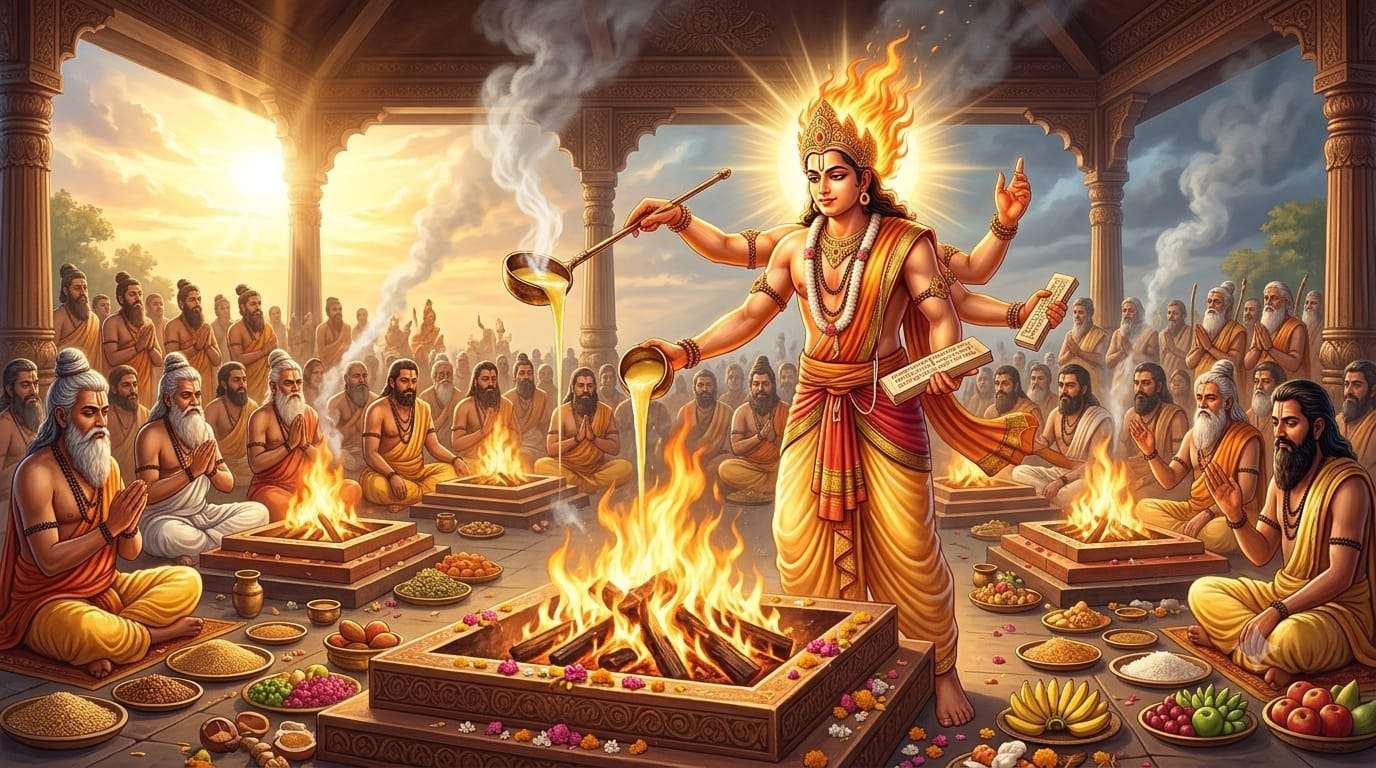
The hymn reverently celebrates Agni as the sacred Hota, the Ritvija, and the Adhvaryu priest of the yajna. In this exalted vision, Agni embodies the entirety of sacrificial order, becoming the invoker, the performer, and the divine witness of the sacred rite. The Vedic yajna was never merely ceremonial combustion; it represented a disciplined cosmic science harmonising human effort with universal law. Within the holy precincts of sacrifice, Agni shines as the purifier of matter and thought alike, transforming earthly offerings into subtle energies ascending toward the celestial spheres. The blazing altar symbolised the dynamic principle of transformation observed throughout nature itself, wherein heat, motion, and energy govern creation and renewal. Thus the Vedic seers perceived in Agni the eternal principle underlying both spiritual ascent and the observable operations of the cosmos.
Agni is extolled as the knower of all born beings, the omniscient witness who perceives the movement of life within every creature. The patrons of yajna approach him with sanctified cakes, clarified butter, and sacred oblations accompanied by resonant hymns of prayer. These offerings were not expressions of superstition, but disciplined acts of gratitude acknowledging the interdependence between humanity, nature, and divine order. The hymn praises those householders blessed with heroic sons, flourishing children, and abundant cattle herds, for prosperity in Vedic thought was inseparable from ethical responsibility and harmonious living. Wealth was revered not for indulgence, but for sustaining society, protecting righteousness, and maintaining sacred duties toward guests, ancestors, sages, and the natural world. Through Agni, the household became a miniature cosmos where spiritual aspiration and worldly welfare existed in noble balance.
The sage further glorifies Agni as the supreme scholar of yajna, the eternal preceptor who arrives accompanied by the seven priests symbolic of the manifold faculties of sacred wisdom. These seven officiants may also be contemplated as the seven flames of consciousness, the seven metres of revelation, or the seven energies governing cosmic order. Agni enters the holy ground together with the gods, carrying divine presence into the sacrificial arena and sanctifying the communion between heaven and earth. In the Vedic vision, the universe itself was understood as an immense yajna sustained by reciprocal exchange, where every element contributes to the harmony of existence. Agni, therefore, becomes the intelligent force coordinating this cosmic rhythm, transforming action into merit and devotion into illumination.
The hymn beholds Agni clothed in brilliance, visible to all seekers desiring righteous wealth and noble prosperity. He is acclaimed as the Lord of worlds whose splendour penetrates every region of existence. The praises offered unto him become themselves sacred hymns carrying subtle vibrations capable of refining the human mind. The Vedic sages possessed deep insight into the psychological and acoustic influence of sacred sound, recognising that disciplined recitation could harmonise thought, emotion, and collective consciousness. Agni, invoked through mantra, becomes the divine messenger who summons the gods to the yajna and establishes an atmosphere of sanctity. In this profound symbolism, speech itself becomes creative power, and the hymn transforms into a vehicle of spiritual awakening.
Agni is further praised as the giver of sanctified nourishment and the supreme organiser of yajna. Through him the sacrificial offering attains divine acceptance, and through his energy life itself is sustained. The Vedic understanding of fire reflects remarkable scientific intuition, for fire was perceived as the transformative force at work in digestion, sunlight, lightning, vitality, and celestial motion. The seers discerned that existence depends upon perpetual cycles of consumption, renewal, and energetic exchange. Therefore, Agni was honoured not only upon the altar, but within the sun, within living beings, and within the subtle processes sustaining the universe. As the conductor of yajna for the gods, he represents the principle through which human action acquires transcendental significance and becomes aligned with cosmic intelligence.
The hymn reveres Agni as the bestower of happiness, the conqueror of hostile forces, and the radiant guardian of auspiciousness. The enemies Agni conquers are not solely external adversaries, but also the inner obstructions of ignorance, greed, fear, and spiritual inertia. His beautiful radiance symbolises the victorious emergence of clarity over confusion and truth over falsehood. To the noble priests and seekers of wisdom, Agni grants glorious riches — not merely material abundance, but the higher treasures of insight, serenity, courage, and divine inspiration. Thus the sacred fire becomes the eternal companion of spiritual evolution, guiding humanity from darkness toward enlightenment.
In the concluding spirit of the hymn, Agni is invoked as the immortal carrier of oblations, perpetually renewed through the sacred act of churning fire from hidden wood. This imagery carries profound metaphysical significance, for just as fire lies concealed within the friction of the arani sticks, divine knowledge remains latent within the depths of consciousness awaiting disciplined awakening. The noble priests inspire Agni with special oblations, sustaining the sacred relationship between humanity and the divine order. Through this sublime Vedic vision, the hymn of Sage Vishwamitra reveals Agni not merely as elemental fire, but as the eternal principle of transformation, wisdom, sacrifice, and cosmic harmony governing both the spiritual destiny of humankind and the scientific rhythm of the universe itself.