
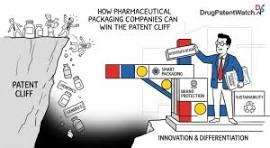
A wave of the world’s best-selling drugs is about to lose patent protection. When that happens, cheaper copies (generics and biosimilars) flood in, prices crash, and someone has to manufacture all those cheaper copies. That “someone” is very often an Indian company.
This is called a patent cliff. It has happened before, but the one arriving between 2025 and 2030 is the largest in over a decade. Here is what is expiring, why it matters, and how the opportunity is structured across the industry, without naming individual companies.
First, the size of the prize
Roughly ₹22–23 lakh crore worth of drug sales, in the US market alone, are set to lose patent protection between 2025 and 2030. Just the top 20 drugs on that list are worth about ₹16.9 lakh crore a year today.
Indian companies collectively will not capture all of that. Most estimates put realistic Indian-industry capture at around ₹29,000–48,000 crore a year, once price collapse post-expiry is accounted for. That is still a meaningful, multi-year growth opportunity for the sector as a whole.
The drugs going off patent, and why they matter
Keytruda (Merck) is the world’s best-selling drug, earning roughly ₹2.8–3.1 lakh crore a year across various cancers. Its core US patent is expected to expire around 2028. Because it is a biologic, a complex protein rather than a simple chemical pill, copying it requires a biosimilar, which is far harder and costlier to develop than a standard generic.
Eliquis (Bristol Myers Squibb / Pfizer), a blood thinner doing around ₹1.15 lakh crore a year, faces generic entry in the US from roughly 2028. As a simple pill, it should be comparatively fast and easy for generic makers to copy once the door opens.
Stelara (Johnson & Johnson) treats immune conditions such as psoriasis and Crohn’s disease, worth about ₹96,000 crore a year. Biosimilar competition has already begun since 2025.
Opdivo (Bristol Myers Squibb), another major cancer immunotherapy at roughly ₹86,000 crore a year, is expected to lose US protection around 2028–29. Like Keytruda, it is a biologic.
Xarelto (J&J / Bayer), a blood thinner worth about ₹67,000 crore a year, faces US patent expiry around 2026, one of the more closely watched pill-based cliffs.
Farxiga (AstraZeneca), used for diabetes and kidney disease, does roughly ₹67,000–74,000 crore a year, with key patents starting to lapse from 2025.
Entresto (Novartis), a heart-failure drug worth about ₹58,000 crore a year, already saw its first US generic launch in July 2025.
Ibrance (Pfizer), a breast cancer pill worth ₹52,000–61,000 crore a year, is expected to face generic competition around 2027.
Enbrel (Amgen / Pfizer), an immune-disease biologic worth about ₹52,000 crore a year, is expected to lose protection around 2028.
Prolia/Xgeva (Amgen), used for bone health, brings in ₹38,000 crore-plus a year; its US patent already expired in 2025, with biosimilars now launching.
Januvia/Janumet (Merck), diabetes pills worth ₹21,000–36,000 crore combined, lose protection in 2026.
Why the pill-versus-biologic distinction matters
Simple pills (Eliquis, Xarelto, Entresto, Ibrance, Farxiga) are relatively easy for generic manufacturers to copy; this is business Indian companies have executed at scale for over 20 years. Biologics (Keytruda, Stelara, Opdivo, Enbrel, Prolia) are complex proteins grown in living cells; copying them as biosimilars is much harder, far more capital-intensive, and achievable by only a small subset of manufacturers globally.
This distinction is the real fault line in the sector, not company size. It separates “easy, crowded, margin-competitive” opportunities from “hard, capital-intensive, higher-payoff-if-successful” ones.
How exposure is structured across the industry
Large, diversified pharma majors. Several of India’s largest pharmaceutical companies already have established US generics businesses and are investing in biosimilar pipelines, in some cases through partnerships with global biosimilar specialists, in-house pembrolizumab (Keytruda) biosimilar candidates, or first-to-file litigation-heavy generic wins in oncology. For a diversified major, this patent-cliff wave is one growth driver among several, not the whole investment case. It reduces single-molecule risk but also caps the theoretical upside from any one drug’s expiry.
Focused biosimilar and specialty players. A smaller set of companies, some technically small-cap by market classification, have signed specific, named co-development or supply deals tied to individual expiring biologics (for example, a nivolumab/Opdivo-class biosimilar destined for a specific geography). This is a materially different risk profile: a single deal, trial outcome, or regulatory approval can move the stock far more than it would move a diversified major. Concentrated bets like this cut both ways.
“Picks and shovels” ingredient and API suppliers. Some companies do not own a branded biosimilar or generic themselves but manufacture the fermentation-based active pharmaceutical ingredients used across immunosuppressant and oncology drug classes. Brokerage coverage on names in this category has specifically cited the 2026–2028 patent cliff (roughly 90 drugs, worth about ₹5.1 lakh crore) as a long-term tailwind, independent of which end-branded biosimilar ultimately wins.
GLP-1 and peptide-adjacent manufacturers. A separate but related opportunity has opened around GLP-1 peptide manufacturing, relevant to diabetes and weight-loss drugs going off patent. Some mid-sized contract manufacturers and specialty ingredient companies have named GLP-1 peptide capacity as an explicit growth driver on earnings calls, including dedicated commercial peptide facilities coming online.
Why true micro-cap exposure is scarce
Genuinely tiny, under-the-radar companies with outsized exposure to this theme are hard to find, for a structural reason: developing a biosimilar costs roughly ₹100–150 crore per molecule and requires specialized biologics manufacturing capability that is out of reach for most very small companies. At the smallest end of the market, real exposure typically comes through supplying ingredients or contract manufacturing capacity to larger players, not through a small company owning its own branded biosimilar. The rare exceptions that do exist required years of prior capital investment to get there.
What this means at the sector level
- The opportunity is real but unevenly distributed. Simple-pill generics are lower-risk, lower-reward; almost any competent generic manufacturer can make these. Biosimilars are higher-risk, higher-reward; only a handful of companies can execute them, but the payoff is larger when they do.
- Diversified majors offer steadier, more moderate exposure. They are unlikely to “blow up” a portfolio on this theme alone, but they also will not multiply in value from it alone, since it is one growth driver within a large, diversified business.
- Focused biosimilar players and ingredient suppliers offer concentrated, higher-conviction exposure. A single deal, launch, or capacity ramp matters far more to these companies’ outcomes, which raises both the potential reward and the potential downside.
- Patent dates are not fixed. Originators fight to delay generic and biosimilar entry through litigation, patent extensions, and settlements. Merck alone has reportedly filed around 300 patents around Keytruda to push out competition. Calendar dates in analyst notes should be treated as estimates, not commitments.
- Biosimilar uptake is slower than generic-pill uptake. Doctors and patients switch to biosimilars more gradually than they switch to a generic tablet, so even a successful biosimilar launch takes longer to show up meaningfully in revenue.
The 2025–2030 patent cliff is one of the more durable, multi-year growth themes in Indian pharma, supported by real demand estimates and real company-level evidence: deals, concall commentary, and capacity build-outs. The structure of exposure matters more than any single name: diversified majors offer steady participation, focused biosimilar and specialty-ingredient players offer concentrated, execution-dependent upside. Either way, the winners in this theme will be decided by execution and regulatory timing, not sector membership alone, which argues for tracking company-specific announcements and quarterly concalls rather than treating “pharma” as a single homogenous bet.